
The Allowance · Site Atlas
The bells of Notre-Dame: what a recasting teaches
Emmanuel survived the Revolution; four north-tower bells did not survive scrutiny in 2013 — what was kept, recast, and what doctrine says about replacing fabric.
- Level
- Beginner
- Reading time
- 14 minutes
- Evidence
- heritage-evidence
- Reviewed
- 2026-08-09
Jump through this guide
The short version
Notre-Dame's bells are not one artifact but a set with two very different histories inside the same towers. Emmanuel, cast in 1683, survived the wholesale bell-melting of the French Revolution and still hangs today; four bells in the north tower did not survive close listening centuries later; and both facts are documented in the cathedral's own account of its bells 1. Reading those two histories side by side, against international conservation doctrine on restoration and reconstruction, turns Notre-Dame's bells into a compact case study in when replacing historic fabric is a documented, justified decision, and when it is not 23.
After reading, you can
- State what the cathedral's own record documents about Emmanuel and the 2013 recasting
- Distinguish what was kept from what was replaced, and why
- Apply Venice Charter and UNESCO reconstruction principles to a functional object, not only a structural one
- Identify what this case study leaves open rather than settled
01
Two histories in one set of towers
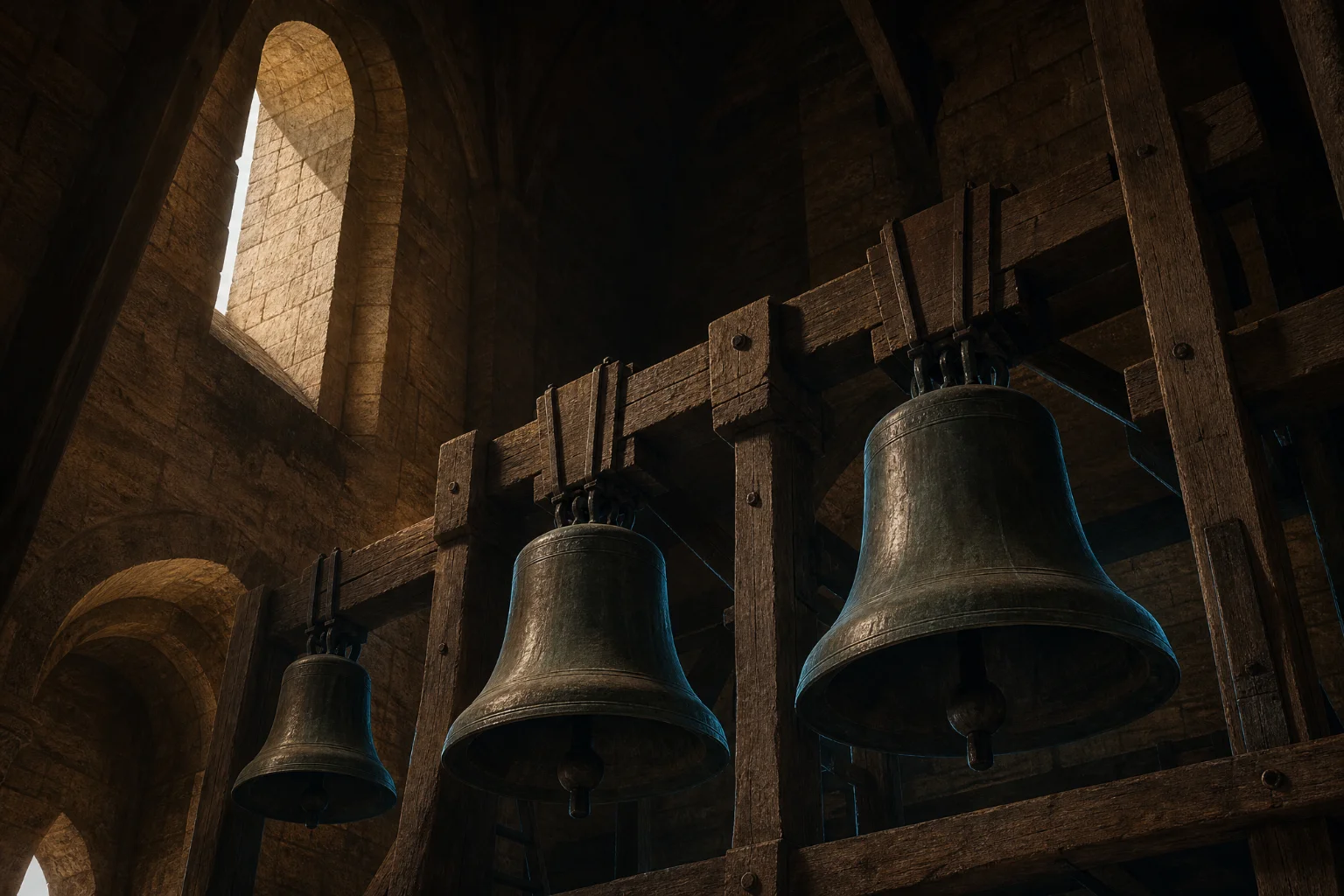
Notre-Dame de Paris carries bells with sharply different biographies. One bell, Emmanuel, has hung in the south tower since the seventeenth century and survived an era that destroyed nearly every other bell like it in France. A separate set of four bells in the north tower did not survive scrutiny three centuries later, not to war or revolution, but to a professional judgment about their sound. Both facts come from the cathedral's own published account of its bells, which names the founders and the reasoning behind the 2013 recasting directly 1.
Reading the two histories together is the point of this entry. A single monument can hold, at the same time, an object treated as irreplaceable and an object judged to have failed and replaced accordingly. Conservation doctrine has to be able to explain both decisions, not only the dramatic one.
02
Documented: Emmanuel, the survivor
Emmanuel was cast in 1683. It sounds an F-sharp, has a base diameter of 2.62 metres, a wall thickness of 21 centimetres, and a total weight of 13 tonnes including a 500-kilogram clapper. When revolutionary authorities melted down the cathedral's other bells in 1791 and 1792 for their metal, Emmanuel was spared, and it remains in the south tower today, one of the very few bells of its age and scale to have survived that period intact 1.
Those dimensions are not decoration; they are the load-bearing facts of this case study. A 13-tonne bronze object cast in 1683 that still rings is a documented survival, not an inference, and it sets the baseline the north-tower story is measured against.
03
Documented: what was recast, and why
The four bells that had hung in the north tower were replaced in 2013. The cathedral's own account gives the reason plainly: poor metal quality was causing harmonic discordance, meaning the bells were not sounding as they should against each other or against the surviving Emmanuel. The replacement bells for the north tower were cast by the Cornille-Havard foundry; a new bourdon bell, Marie, was cast separately by Royal Eijsbouts 1.
This is a materially different situation from the Revolution's bell-melting. Nothing here describes irreplaceable historic bronze being destroyed for its metal value. It describes bells that were, by the cathedral's own account, failing to do the one thing a bell exists to do, ring in tune with its neighbors, and being replaced by working foundries commissioned to correct that failure 1.
04
What was kept, what was replaced, and why the difference matters
Emmanuel was kept because it survived intact and functions as intended; the north-tower bells were replaced because, whatever their history, their metal quality was judged inadequate to their acoustic job. That is not a case of a steward choosing between an old bell and a new one on sentiment. It is a case of one object passing a functional and historical test and another failing a functional one, and the cathedral's documentation treats the two as separately justified decisions rather than a single blanket policy toward old bronze 1.
It is worth being precise about what this pillar's source pool does and does not establish about the north-tower bells' own prior history. The record here documents that they were replaced in 2013 for poor metal quality causing harmonic discordance, and names the two founders involved. It does not, in this pool, give a fuller account of when those particular north-tower bells were themselves cast or what earlier history they carried before 2013. That gap is worth naming rather than papering over with a plausible-sounding guess.
05
What conservation doctrine says about replacing fabric
International conservation doctrine treats restoration and reconstruction as an ascending ladder of intervention, and international guidance draws a hard line: restoration must stop at the point where conjecture begins, and any recreation of missing fabric must be exceptional and grounded in complete documentation, not assumption 23. A bell recast for failed acoustic performance is not quite either category as those documents usually frame it, since a bell's core value is functional and sonic, not only material and formal, but the underlying discipline still applies: the decision to recast is justified by documented, stated evidence, harmonic discordance traced to metal quality, rather than by taste or convenience 123.
Reading the 2013 recasting against that doctrine is an interpretation this article makes explicitly, not a claim the cited charter or policy text makes about bells specifically. Neither the Venice Charter nor UNESCO's reconstruction guidance discusses bell-founding; both discuss the general discipline of justifying an intervention with evidence and documenting it as it happens 23. The same cathedral's own broader restoration campaign shows a parallel worth noting: its documentation of the post-fire vault and masonry work also grounds decisions in survey and record rather than assumption, the same evidentiary posture this guide reads into the 2013 bell recasting 4.
06
Open question
What this case study leaves open is exactly what it should leave open, given what the source pool actually says. The metallurgical detail behind 'poor metal quality,' the full deliberation that led to recasting rather than repair or retuning, and any surviving record of the replaced bells' own earlier history are not established in this pool. Readers should treat those as open questions rather than filled in with a confident-sounding narrative this article has no source for.
What is settled is narrower and still meaningful: one seventeenth-century bell survived an era that destroyed almost everything like it, and, three centuries later, a different set of bells was replaced through a documented, named, deliberate process rather than lost to accident or neglect. Both are true at once, in the same towers, and a conservation doctrine worth trusting has to be able to hold both.
Working vocabulary
Glossary
- Bourdon
- The largest, lowest-sounding bell in a set or peal.
- Founder / foundry
- The craftsperson or workshop that casts a bell in bronze.
- Harmonic discordance
- A condition in which a bell's partials fail to sound in proper relation to each other or to neighboring bells.
- Restoration
- Conservation work that preserves and reveals a monument's value while respecting original material.
- Reconstruction
- Recreation of lost fabric, treated by doctrine as an exceptional measure requiring strong documentation.
- Clapper
- The internal striker that swings to sound a bell.
Source ledger
References and further study
Numbered citations point to the sources below. We favor standards, government laboratories, peer-reviewed research, and primary technical documentation. A link is evidence for the claim it supports—not an endorsement of every claim on that website. Read the full editorial and correction method.
- The BellsCathédrale Notre-Dame de Paris · official cathedral documentation↗Opens in a new tab
- International Charter for the Conservation and Restoration of Monuments and Sites (Venice Charter)ICOMOS · international heritage charter↗Opens in a new tab
- Policy Compendium — ReconstructionUNESCO World Heritage Centre · intergovernmental policy compendium↗Opens in a new tab
- Restoration of the vaults and masonryRebâtir Notre-Dame de Paris · official project documentation↗Opens in a new tab