
Monument Atlas · Debate
Could we build Notre-Dame today? We just helped rebuild it
The 2019-2024 Notre-Dame restoration as evidence: Gothic vault and masonry skills are alive, working alongside digital documentation and conservation doctrine.
- Level
- Intermediate
- Reading time
- 14 minutes
- Evidence
- heritage-evidence
- Reviewed
- 2026-08-09
Jump through this guide
The short version
Could a Gothic cathedral be built today? The question is usually asked rhetorically, with the answer assumed to be no. The restoration of Notre-Dame de Paris between the fire of 2019 and the reopening of 2024 turned it into an answerable question: damaged rib vaults and load-bearing masonry were brought back by living carpenters, masons, and carvers working alongside surveyors and conservators, under public documentation. This guide reads that campaign as evidence about craft continuity, keeps the evidence classes explicit, and starts from the restoration project's own account of the vault and masonry work 1.
After reading, you can
- Use the 2019-2024 Notre-Dame campaign as evidence when evaluating claims that cathedral craft is lost
- Distinguish restoration, reconstruction, and new construction under conservation doctrine
- Explain why documentation is treated as part of the craft rather than paperwork after it
- Separate documented, interpreted, open, and speculative claims about cathedral building
01
The claim on the table
The argument surfaces wherever cathedrals are discussed: medieval builders are said to have possessed abilities modern people have lost, so a building like Notre-Dame de Paris could supposedly never be made now. It is an appealing story. It flatters the past, excuses the present, and requires no measurement. But it is a testable claim, not a mood. The fire of 2019 created the test nobody wanted: Gothic vaults and load-bearing masonry, partly collapsed and heat-damaged, had to be brought back by whoever could actually do the work 1.
One clarification before the debate starts. The word we in our title means the present era's trades, institutions, and instruments, not this publication, which restores nothing and only reads the record. Framed that way, the question becomes tractable. If Gothic craft were truly extinct, a faithful restoration would have been impossible at any budget. It was not. The campaign finished, the cathedral reopened in 2024, and the limiting factors that emerged were organization, money, and doctrine rather than any missing human skill 1.
02
What the vaults and masonry required
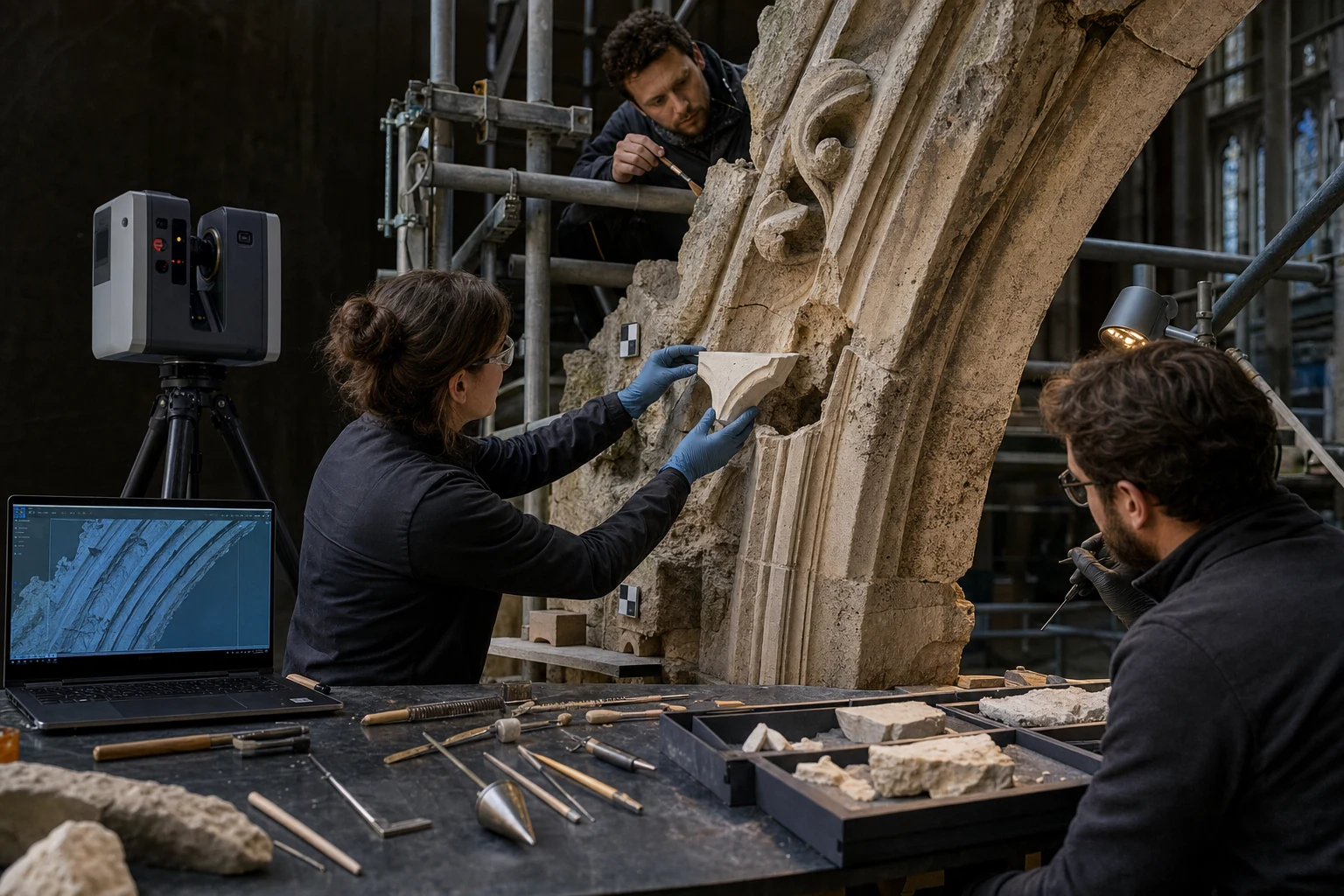
The restoration project's public account describes the securing and restoration of the stone vaults and masonry after the fire 1. Work of this kind runs from survey to stone: recording every damaged bay, judging which ribs and webs could remain, selecting compatible stone, cutting replacement voussoirs to template, and rebuilding over temporary centering. None of those steps is exotic in a restoration workshop. All of them demand judgment that accumulates only through practice, such as reading a bedding plane, trusting or rejecting a cracked block, and knowing when a joint is tight enough.
Restoration is not identical to raising a cathedral from a bare field, and the difference matters. Most of the structure survived, so geometry could be taken from standing fabric and prior surveys rather than invented. But the core competencies in question, vault geometry, stone cutting, lime-mortar masonry, and carpentry at height, were exercised on the real building, in public, to a finished result 1. A skill demonstrated under those conditions cannot honestly be called lost. It can be called rare, expensive, and worth training.
- Condition survey and bay-by-bay damage records
- Selection of compatible replacement stone
- Voussoirs and rib sections cut to template
- Temporary centering and shoring during rebuilding
- Lime-based mortars matched to the historic fabric
- Documentation running alongside every step
03
Living trades on the scaffold
The campaign was carried by present-day carpenters, masons, carvers, scaffolders, and conservators, which is the whole debate in one sentence 1. These trades did not reappear for the occasion. Cathedral workshops and restoration firms have cut Gothic tracery, framed heavy timber, and repointed medieval walls continuously, because major monuments require constant care and someone has been providing it all along. The fire made a standing workforce briefly visible to people who had assumed it vanished centuries ago.
Living craft is not costume drama. The same hands that work from a template also read laser surveys; modern cranes, safety systems, and materials analysis surround techniques a medieval mason would recognize. Conservation doctrine explicitly allows modern technique where traditional means fall short, and that rule cuts both ways: the traditional techniques must exist and be mastered for the judgment to mean anything 2. On this site they existed, and the doctrine could be applied as written.
04
Documentation and doctrine
Modern restoration is documentation-led. Condition records, measured drawings, and digital models coordinate hundreds of decisions before a stone is cut, and the record remains after the scaffolding comes down. This is not new bureaucracy. The Venice Charter made precise, published documentation a duty of restoration in 1964, long before laser scanning existed 2. The same charter draws the line that keeps restoration honest: the work must stop at the point where conjecture begins 2.
UNESCO's operational framework adds the tests of authenticity and integrity for World Heritage properties: what survives must genuinely carry the values claimed for it, and interventions must not hollow those values out 3. Under both instruments, the Notre-Dame campaign reads as restoration on strong evidence, meaning a documented building, recorded fabric, and surviving geometry, rather than reconstruction from belief. That distinction, more than any romantic notion of medieval genius, is what separates heritage practice from theme-park building 3.
05
Restoration is not construction from zero
Could a wholly new Gothic cathedral rise on an empty site? Here the honest answer splits. As technique, the operations demonstrated at Notre-Dame, quarrying, cutting, vaulting, and carpentry, are the operations required; nothing in the physics expired. UNESCO policy is meanwhile clear that reconstruction of lost heritage fabric is acceptable only in exceptional circumstances and only on complete, detailed documentation, never on conjecture 4. A new cathedral would not be reconstruction at all: it would be new architecture using old means, and it would be judged as new work.
The genuine open questions are social. Medieval cathedral campaigns ran across generations, sustained by patronage and civic institutions organized differently from anything now standard. Modern safety law, labor economics, and funding cycles would reshape a decades-long masonry project, and no source in our pool settles whether the will would hold. That is an open question about societies, not about hands. Claiming certainty in either direction outruns the record, so this article declines to.
- Technique: demonstrated and documented
- Doctrine: a new cathedral is new work, not reconstruction
- Funding and patronage at cathedral scale: open
- Multi-generation institutional continuity: open
- Changed safety and labor context: a condition, not a wall
06
Verdict
On the narrow question the evidence is unambiguous: the craft skills exist, because they were just used at scale on one of the most scrutinized building sites of the era 1. On the broad question of whether anyone would commission such a building fresh, the record supports no verdict, and the interesting conversation moves to economics, institutions, and what a society chooses to make endure. The lost-skills framing fails in both directions: it underrates living trades and overrates mystery.
For makers, the useful residue is a habit of mind. Treat monuments as documented achievements of organized, trainable skill rather than as riddles. Treat restoration as the continuing life of a building, governed by doctrine that ranks evidence above imagination 24. And when a claim about the past sounds flattering, unfalsifiable, or both, ask what document, survey, or workshop record would test it. Notre-Dame happened to supply all three at once; most claims are not so lucky.
- Skills: demonstrated on the building itself
- Doctrine: restoration stops where conjecture begins
- Documentation: a duty, and now a digital one
- Open: patronage, time, and civic will
- Off the table: lost-secret stories
Working vocabulary
Glossary
- Rib vault
- A masonry ceiling in which arched stone ribs frame and stiffen thinner infill webs, gathering loads toward the supports.
- Voussoir
- A wedge-shaped stone forming part of an arch or vault ring; its taper locks the ring under compression.
- Centering
- Temporary framework, usually timber, that supports an arch or vault until the masonry can carry itself.
- Restoration
- Conservation work that preserves and reveals a monument's value while respecting original material and authentic documents.
- Reconstruction
- Re-creation of lost fabric; under heritage doctrine, acceptable only in exceptional cases and on complete documentation.
- Authenticity
- The degree to which a property's surviving materials, design, setting, and traditions genuinely carry its claimed values.
Source ledger
References and further study
Numbered citations point to the sources below. We favor standards, government laboratories, peer-reviewed research, and primary technical documentation. A link is evidence for the claim it supports—not an endorsement of every claim on that website. Read the full editorial and correction method.
- Restoration of the vaults and masonryRebâtir Notre-Dame de Paris · official project documentation↗Opens in a new tab
- International Charter for the Conservation and Restoration of Monuments and Sites (Venice Charter)ICOMOS · international conservation charter↗Opens in a new tab
- Operational Guidelines for the Implementation of the World Heritage ConventionUNESCO World Heritage Centre · intergovernmental guidelines↗Opens in a new tab
- Policy Compendium — ReconstructionUNESCO World Heritage Centre · heritage policy compendium↗Opens in a new tab