
The Allowance · Craft Notebook
Where ornament belongs on a bell
The interior profile and soundbow are acoustically load-bearing. Ornament lives on the waist, shoulder, and inscription band — modelled on the mould before pouring.
- Level
- Intermediate
- Reading time
- 14 minutes
- Evidence
- craft-and-standards
- Reviewed
- 2026-08-09
Jump through this guide
The short version
A bell is not a blank canvas. Its interior profile and soundbow set the acoustic relationships this series has already followed from the mould to the tuning lathe, and no amount of decoration can safely disturb them. That is a real constraint, not an argument against ornament: bell decoration already has a home, on the waist, shoulder, and inscription band, and a documented method, modelled in relief directly on the mould so the poured bronze takes its exact shape in one irreversible cast. Notre-Dame's own record of its bells names the artist behind that practice; the constraint is physics, and the freedom it leaves is real.
After reading, you can
- Explain why a bell's interior profile and soundbow cannot safely carry surface decoration
- Identify where ornament conventionally sits on a bell's exterior instead
- Describe the documented practice of modelling bell decoration in relief on the mould before casting
- Distinguish a constraint that bounds freedom from one that denies it
01
A bell's interior does the acoustic work
Everything this series has already established about tuning rests on one fact: wall thickness, especially at the soundbow, the thickest part of a bell near where the clapper strikes, controls the spacing of a bell's rim partials and, through them, the strike note a listener hears. Bell acoustics researcher Bill Hibbert's analysis shows that a thicker bell compresses its rim partials together and a thinner one stretches them apart, and either change also shifts the strike note itself, which is generated in the listener's ear and brain rather than existing as a single physical frequency in the bell's sound 2. That relationship is precise enough that founders have historically struggled to predict it from geometry alone, which is exactly why the tuning reserve this series covers elsewhere exists at all.
Conservation research into English bellfounding confirms the same point from the mould side: founders who let the inner and outer moulds drift out of precise alignment produced bells with non-uniform thickness that "sound very poor," a mark, historically, of a poor founder 3. Any decoration that interrupts or thins the interior profile, or the soundbow specifically, is not a stylistic risk, it is an acoustic one. This is the one part of a bell where the physics leaves no real room to negotiate.
02
Where ornament actually lives
None of that rules ornament out, it relocates it. Bell decoration conventionally sits on the exterior zones that carry the least acoustic load: the waist, the broad exterior surface below the shoulder and above the soundbow; the shoulder itself, where the bell's profile curves outward from the crown; and the inscription band, the dedicated surface many bells carry for names, dates, and dedications. These zones can carry ornament without disturbing the interior geometry that the soundbow and profile depend on, because decoration there works with the bell's surface rather than against its wall-thickness relationships.
Notre-Dame's own institutional record of its bells documents exactly how that decoration is produced, and names the artist behind its own bells' ornament. Virginie Bassetti, a graduate of the School of Fine Arts in Rennes and the Higher School of Art and Design in Le Havre-Rouen, discovered the art of molten metal during a pour in the workshop of Marcel Dinahet. She specializes in the design and creation of contemporary bell decorations and collaborates with the Cornille-Havard foundry, the same foundry that cast the recast bells of Notre-Dame's north tower 1.
03
Why relief lives on the mould, not on the bronze
Notre-Dame's record is explicit about method: "the manufacture of bells requires extreme precision to achieve the desired sound. The decorations are made in relief on a mold, then molten metal is poured in, taking the exact shape of the bell" 1. Decoration, in other words, is not engraved or carved into a bell after it is cast, it is modelled into the mould beforehand, and the pour transfers that relief into bronze as a single, irreversible act along with the rest of the bell's shape.
Read alongside the rest of this series, that sequencing makes practical sense. A cast bell's bronze is hard, and reworking a finished casting by hand risks disturbing the very wall thicknesses a tuner is separately trying to protect within the tuning reserve. A mould's surface, by contrast, is soft and workable before it ever meets metal, whether raised in loam or built up in sand, which is exactly the stage where an artist can model fine detail without touching the acoustic geometry the strickle has already set elsewhere on the same mould. Ornament and acoustics do not compete for the founder's attention at the same moment, because they belong to two different stages of the same build.
04
Freedom bounded by physics, not freedom denied
The constraint on a bell's interior is real and does not soften with better tools or a more talented artist: the soundbow and interior profile are acoustically load-bearing, and decoration that disturbs them risks the same over-thinning and tone loss this series has already documented on the tuning lathe. But a constraint that governs one part of an object is not a ban on ornament across the whole of it. The waist, shoulder, and inscription band remain genuinely open to an artist's judgment, and the documented mould-relief method gives that judgment a real, well-established place to work, before a single ounce of bronze has been poured 1.
This is the shape the pillar's argument takes across every article in this series: a machine, a mould, or a physical law prepares and bounds the blank, and a human keeps the last, most consequential decisions inside that boundary. On a bell, the boundary is acoustic and the human decision is where, and how, to decorate the surfaces physics leaves free.
05
What this means as moulds go digital
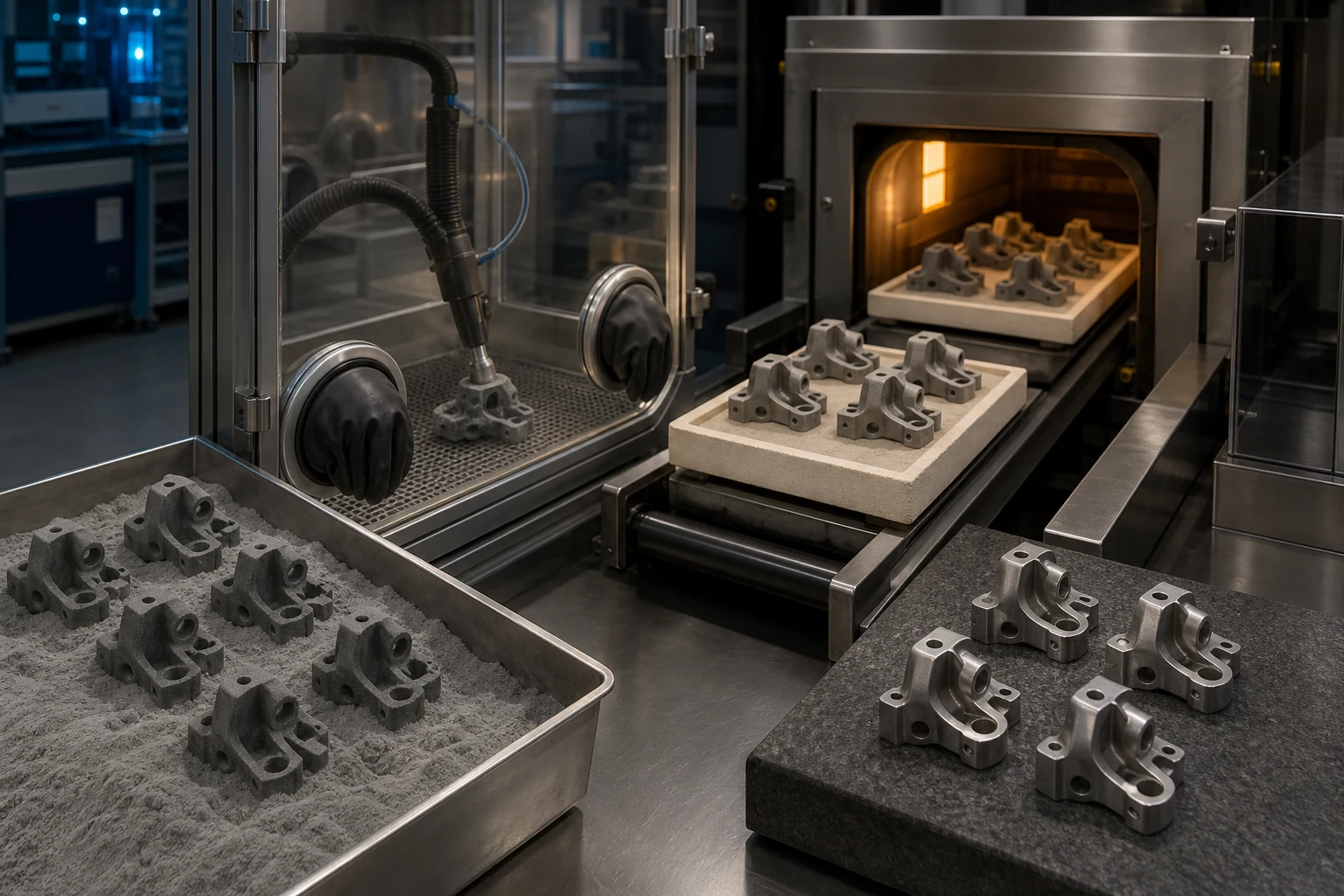
This series' companion guide on printed sand moulds documents that binder jetting can build a foundry mould, and that a bell foundry has already used a printed pattern in production, though not yet, in any source this pillar has verified, one carrying relief decoration. Extending the documented mould-relief method to a digital file is a reasonable interpretation, not a documented fact: if decoration is already modelled onto a mould surface before casting, a printed mould's geometry could in principle carry the same relief as part of the same digital model that sets the bell's acoustic profile. Whether any foundry has done this, and how well a printed surface would hold fine relief compared with a hand-modelled one, is not something this pillar's sources address, and this article does not claim otherwise.
What does not change, printed mould or hand-built one, is the constraint itself. A printed mould's interior profile and soundbow would carry exactly the same acoustic responsibility a loam mould's does, because the physics governing a bell's tone does not care how its mould was built. The freedom to decorate the waist, shoulder, and inscription band would travel with the mould-relief method regardless of the tool that raised the mould; the boundary around the soundbow would travel with it too.
06
A restraint worth keeping
Bells hang in active places of worship and are cast by working foundries whose names, like Cornille-Havard's, attach to real commissions and real craftspeople like Virginie Bassetti, not to symbolism borrowed for effect. Nothing about a bell's ornament, or its physical constraints, carries any fraternal or lodge meaning; the waist, shoulder, and inscription band are acoustic and decorative terms belonging to the trades of bellfounding and campanology, full stop.
The discipline this article describes, keep decoration off the load-bearing interior and onto the surfaces that can carry it, model it on the mould before the metal ever moves, is worth keeping precisely because it has already produced centuries of bells that both look considered and sound true. A constraint that has been tested that long, and that still leaves real room for an artist's hand, is not a limitation to argue around. It is the shape the freedom actually takes.
Working vocabulary
Glossary
- Soundbow
- The thickest part of a bell's wall, near where the clapper strikes, most influential on tone; acoustically load-bearing.
- Waist
- The broad exterior surface of a bell's profile between the shoulder and the soundbow, conventional territory for decoration.
- Shoulder
- The curved zone where a bell's profile turns outward below the crown, another conventional decoration surface.
- Inscription band
- A dedicated exterior surface on many bells carrying names, dates, or dedications.
- Relief
- Decoration raised or recessed from a surface rather than flat, readable by light and shadow.
- Mould-relief decoration
- The documented practice of modelling a bell's ornament into the mould surface before casting, so the poured metal takes its exact shape.
Source ledger
References and further study
Numbered citations point to the sources below. We favor standards, government laboratories, peer-reviewed research, and primary technical documentation. A link is evidence for the claim it supports—not an endorsement of every claim on that website. Read the full editorial and correction method.
- The BellsCathédrale Notre-Dame de Paris · cathedral institutional record↗Opens in a new tab
- Building a bell soundBill Hibbert, The Sound of Bells · bell acoustics research and craft history↗Opens in a new tab
- Church Bells in TrustDavid J Kelly, Cathedral Communications, Historic Churches · conservation trade publication↗Opens in a new tab