
Heritage Lab · Debate
Repair, restore, reconstruct—or leave it alone?
A conservation-ethics ladder from maintenance to reconstruction, tested against Abu Simbel's relocation and Notre-Dame's restoration, and when to leave a ruin alone.
- Level
- Intermediate
- Reading time
- 15 minutes
- Evidence
- heritage-evidence
- Reviewed
- 2026-08-09
Jump through this guide
The short version
Every intervention on a historic structure sits somewhere on a ladder: maintenance, repair, restoration, reconstruction, each rung demanding stronger justification than the one below it. International conservation doctrine treats the ladder's upper rungs as exceptions, not defaults, bound by principles of minimal intervention, reversibility, distinguishable new work, and respect for every historic phase, not only the earliest one 1. This guide works the ladder through two documented cases, Abu Simbel's rescue relocation and Notre-Dame's post-fire vault and masonry restoration, and closes on the hardest question: when is leaving a ruin alone the most honest choice a steward can make 2?
After reading, you can
- Name the four rungs of the conservation-intervention ladder and what distinguishes them
- Explain the principles of minimal intervention, reversibility, and distinguishability in plain terms
- Describe Abu Simbel's relocation and Notre-Dame's vault restoration as documented worked examples
- Articulate when leaving a ruin unreconstructed is the evidence-respecting choice
01
Four verbs, one ladder
Maintenance is the ongoing, low-intervention work that prevents decay: clearing drainage, monitoring cracks, controlling moisture. Repair fixes specific, localized damage using compatible methods and materials. Restoration goes further, returning a structure closer to a known earlier state using largely existing material. Reconstruction is the strongest intervention: recreating destroyed or missing fabric where little or none of the original survives. International conservation doctrine, most influentially the Venice Charter, treats these as an ascending ladder, each rung requiring stronger evidence and stronger justification than the one beneath it 1.
The ladder exists because intervention is not neutral. Every repair, restoration, or reconstruction changes the historic fabric a future generation will read, and undoing a bad decision is often far harder than making it. Treating the four verbs as a ladder rather than a menu keeps that asymmetry visible: choosing the lightest intervention that solves the actual problem is the doctrine's default, not an afterthought applied once a bigger plan is already underway 1.
02
The principles that constrain intervention
Minimal intervention asks for the smallest change that achieves the conservation goal, resisting the temptation to "improve" a structure beyond what decay or damage requires. Reversibility asks that, wherever possible, an intervention can be undone without harming the original fabric; where true reversibility is impossible, distinguishability becomes the fallback, making new work honestly recognizable as new rather than disguised as ancient. Authenticity asks that repairs respect original material, technique, and design intent rather than substituting a modern architect's preference for the historic builder's 1.
A further principle often overlooked outside professional circles: a structure's later historic phases deserve respect too, not only its earliest or most celebrated state. Stripping away a genuine medieval addition to reveal a hypothetical Roman original erases real history in service of a preferred story, precisely the kind of conjecture doctrine warns against when evidence for the earlier state is incomplete 1.
- Minimal intervention: do the least that solves the problem
- Reversibility: undo it if you can; if not, make it distinguishable
- Authenticity: respect original material, technique, and intent
- Respect every historic phase, not only the earliest one
03
When reconstruction is justified
UNESCO's policy guidance on reconstruction treats it as an exceptional measure, appropriate only where destruction was recent, thorough documentation of the lost state exists, and reconstruction serves a compelling social, cultural, or scientific purpose, not as a routine option whenever a structure is damaged or missing 2. Reconstruction built on speculation rather than documented evidence risks manufacturing a false history: a confident, well-built replica of something that never quite existed in the form presented.
That guidance is a caution, not a prohibition. It asks stewards to be explicit about what is documented versus conjectural in any reconstruction, and to weigh reconstruction against leaving a site as a ruin, which itself carries authentic evidentiary and educational value. The strongest reconstructions in the historic record are the ones built on the most complete surviving documentation, not the ones argued most persuasively after the fact 2.
04
Worked example: Abu Simbel's relocation
Abu Simbel's rock-cut temples faced a threat no repair or restoration could answer: rising water from the Aswan High Dam reservoir would have submerged them entirely. UNESCO's account of the site documents an international campaign that physically relocated the temples, cutting and reassembling them at a new, higher location to preserve the monuments themselves rather than let them be lost 3. That is neither repair nor restoration in the usual sense; it is a preservation decision outside the standard ladder, chosen because inaction meant total loss.
Abu Simbel is a reminder that the ladder's categories do not cover every real situation stewards face. Sometimes the honest choice is not how much to intervene on a structure in place, but whether an entirely different strategy, relocation, is the only way to keep a monument's material authenticity intact at all. The documented campaign remains one of the most significant heritage rescue efforts on record 3.
05
Worked example: Notre-Dame's vaults and masonry
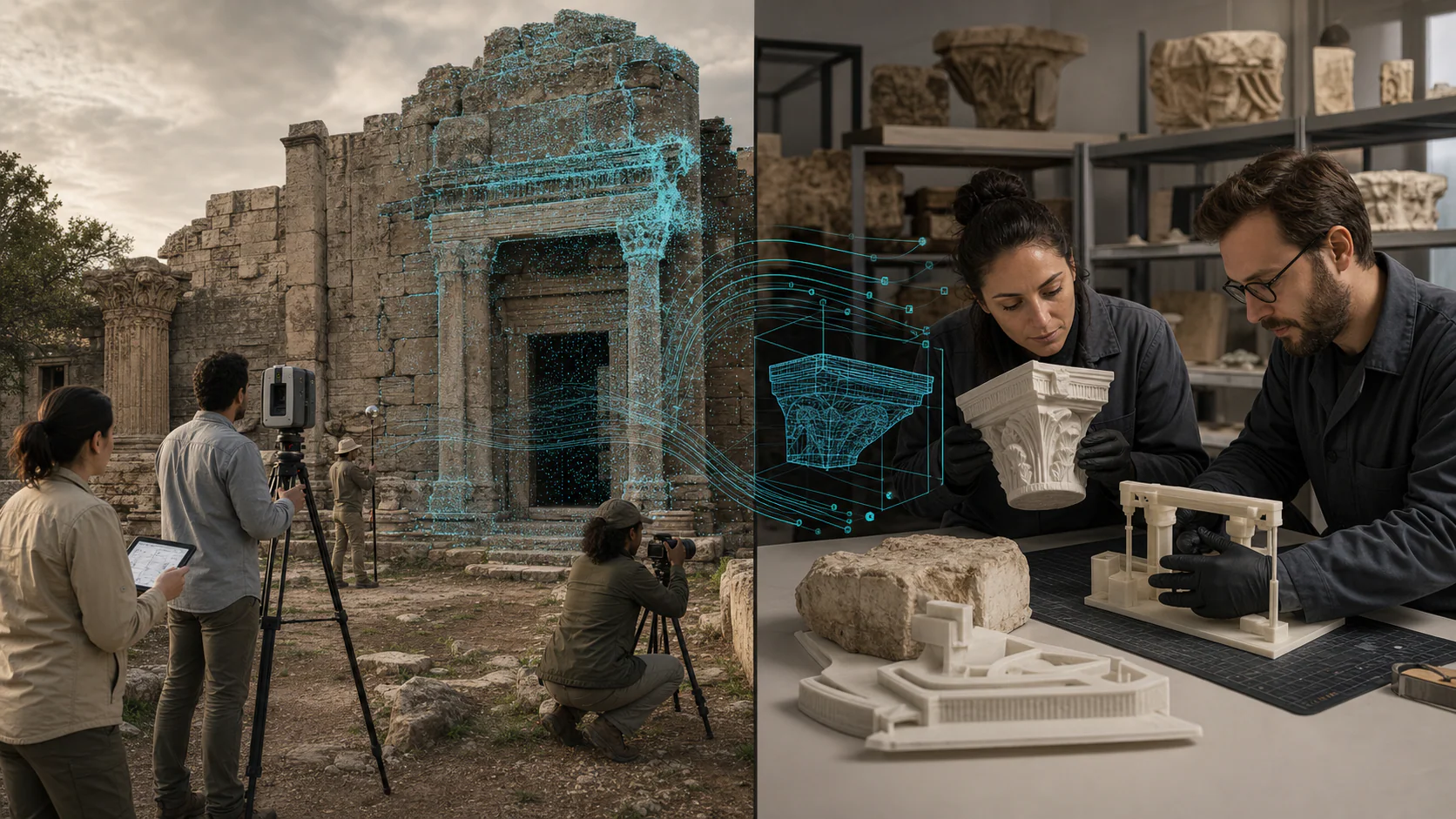
Notre-Dame's post-fire recovery documents repair and restoration operating together at cathedral scale. The project's own documentation of vault and masonry work describes stabilizing and restoring stone structures damaged in the 2019 fire, combining traditional stonemasonry and carpentry skills with modern coordination and scanning tools to guide the work with precision 4. That combination, living craft skill paired with digital documentation, is exactly what the ladder's principles ask for: intervention grounded in careful evidence rather than improvisation.
The project is restoration in the technical sense: returning damaged fabric to a known, well-documented earlier state using surviving material, historic techniques, and detailed records of the structure as it stood before the fire. It illustrates that restoration at this scale is not a relic of the past; skilled masons, carpenters, and conservators are still doing this work today, and doing it under close public and professional scrutiny 4.
06
When leaving it alone is right
Sometimes the most respectful intervention is the lightest one available: stabilize and consolidate a ruin so it stops decaying further, and stop there. Where evidence for a lost state is incomplete, where a reconstruction would rely heavily on conjecture, or where descendant communities object to rebuilding, doctrine's caution against unjustified reconstruction points toward leaving the ruin as a ruin, an authentic, partial record rather than a confident but speculative replacement 12.
This is not indecision; it is a considered choice with its own justification. A stabilized ruin preserves exactly what survives, invites honest questions about what is missing, and avoids overwriting the documented past with a modern guess dressed as history. Deciding among repair, restoration, reconstruction, and leaving a site alone is, in every case, a documented judgment call, weighed against evidence, principle, and the voices of the communities the monument belongs to 12.
Working vocabulary
Glossary
- Maintenance
- Ongoing, low-intervention work that prevents decay, such as drainage clearance and condition monitoring.
- Repair
- Fixing specific, localized damage using materials and methods compatible with the original fabric.
- Restoration
- Returning a structure closer to a known earlier state, using largely existing material and documented evidence.
- Reconstruction
- Recreating destroyed or missing fabric; treated by doctrine as an exceptional measure requiring strong documentation and justification.
- Reversibility
- The principle that an intervention should be undoable without harming the original fabric wherever possible.
- Distinguishability
- The principle that new work should be honestly recognizable as new, rather than disguised as historic fabric.
- Anastylosis
- Reassembling existing but dismembered original parts, a specific technique referenced in international conservation doctrine.
Source ledger
References and further study
Numbered citations point to the sources below. We favor standards, government laboratories, peer-reviewed research, and primary technical documentation. A link is evidence for the claim it supports—not an endorsement of every claim on that website. Read the full editorial and correction method.
- International Charter for the Conservation and Restoration of Monuments and Sites (Venice Charter)ICOMOS · international heritage charter↗Opens in a new tab
- Policy Compendium — ReconstructionUNESCO World Heritage Centre · intergovernmental policy compendium↗Opens in a new tab
- The story of Abu SimbelUNESCO · world heritage feature page↗Opens in a new tab
- Restoration of the vaults and masonryRebâtir Notre-Dame de Paris · heritage restoration project documentation↗Opens in a new tab