
Future Foundry · Manifesto
What should endure? A PrintMason civic design brief
Six values for public buildings — beauty, dignity, maintenance, accessibility, participation, repairability — argued in the open and tethered to real sources.
- Level
- Beginner
- Reading time
- 13 minutes
- Evidence
- editorial-concept
- Reviewed
- 2026-08-09
Jump through this guide
The short version
This is an editorial argument, and it is labeled as one: a proposal for what public buildings owe the people who use, maintain, and inherit them. It is not a neutral survey. But its anchors exist outside our opinion — the legal floor of accessibility, the apprenticeship system that trains repairers, government research on new construction methods, and the conservation doctrine that treats built work as something held in trust, to be handed on, in the words of the Venice Charter, in the full richness of its authenticity 1.
After reading, you can
- State six proposed values for civic buildings and why each is argued
- Separate legal requirements and existing programs from editorial proposals
- Explain why maintenance and repair skills are design inputs, not afterthoughts
- Apply the endurance test to a public building near you
01
Endurance is a decision, not an accident
Buildings that endure were chosen twice: once by the people who built them well, and again — repeatedly, expensively, quietly — by every generation that maintained them. Conservation doctrine formalizes the second choice. The Venice Charter of 1964 treats historic buildings as common heritage and names a common responsibility to hand them on in the full richness of their authenticity 1. That is settled text, cited above. What this page adds is a proposal, labeled as ours: apply that duty at the drawing board, to buildings that do not exist yet.
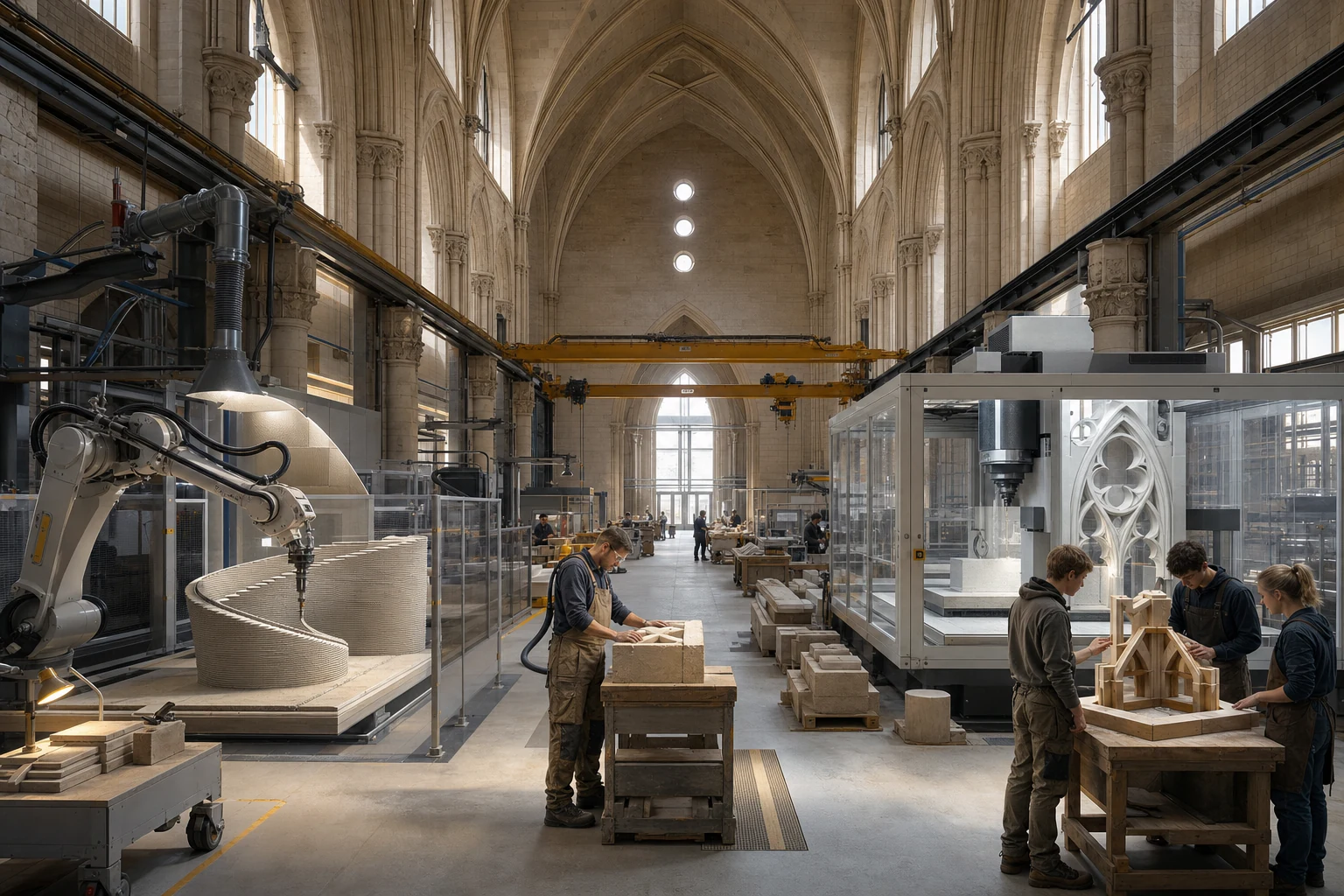
PrintMason covers new fabrication and old craft, and both are means. A manifesto is a statement about ends, so here is the question this one serves: what should a civic building be for, such that the people of 2126 choose to keep it? Everything below is our argument, tethered at four points to things that exist — a law, a training system, a research report, a charter — and labeled wherever it leaves the ground.
02
Six values, argued in the open
We propose six values for public buildings: beauty, dignity, maintenance, accessibility, local participation, and repairability. One of the six is not like the others. Accessibility, in the United States, is federal civil-rights law — the Americans with Disabilities Act, documented at ADA.gov, sets enforceable requirements for access to public life 2. The other five are values we argue for and cannot cite into existence. Keeping that distinction visible is the difference between a manifesto and a bluff.
The six will conflict, and endurance is the tiebreaker we propose: when values collide, choose what still serves in a century. Beauty that cannot be maintained becomes a ruin with good bones. Participation without craft becomes a mural on a shed. Accessibility bolted on late reads as an apology in ramp form. The argument of this page is that the six survive together or not at all — a building is a system, and so is the neighborhood that keeps it.
- Beauty: worth a century of looking (proposed)
- Dignity: serves everyone without sorting them (proposed)
- Maintenance: designed to be cared for (proposed)
- Accessibility: the enforceable legal floor (documented)
- Local participation: built with, not only for (proposed)
- Repairability: failure planned as an event, not an ending (proposed)
03
Accessibility is the floor; dignity is the argument above it
What exists: the ADA is not a design fashion but a legal floor, with standards and technical assistance published by the Department of Justice at ADA.gov 2. Routes, entrances, doors, restrooms, communication — the requirements are specific, enforceable, and the minimum. A project team that treats them as a checklist has met the law and has not yet met the public. The law tells a builder what must be possible; it cannot tell a builder what should be pleasant.
Above the floor, our argument, labeled as such: dignity is what remains when access is so well integrated that nobody notices being accommodated. No statute mandates the items at right as a set; we propose them as a minimum posture. The difference matters because a building teaches. A side-door lift teaches one lesson about who was expected; a single generous entrance teaches another. The law points toward this value and cannot legislate it — that is what the other five values are for.
- One shared entrance everyone uses together (proposed)
- Acoustics that include aging ears (proposed)
- Seating and shade wherever waiting happens (proposed)
- Restrooms that do not require an expedition (proposed)
04
Repair is a skill you must keep alive
A building endures only while people who can repair it exist, so the skills pipeline is structural, not sentimental. What exists: the registered apprenticeship system, documented at Apprenticeship.gov, organizes paid on-the-job training with recognized credentials across the construction trades 3 — the masons, plasterers, roofers, and carpenters that repair actually requires. The system is real, national, and, in our view, underused as a design input. A maintenance plan that names no trades is a wish.
Our proposal, labeled: civic projects should budget the repairers with the rebar. Write a skills plan into the project — which trades the building will need across fifty years, and where they will come from 3. Put apprentices on the original construction so the people who will maintain the building helped make it. Fund a modest repair endowment the way percent-for-art programs are funded. None of this is current standard practice; all of it is possible with instruments that already exist.
05
New fabrication under old duties
What exists: the U.S. Department of Housing and Urban Development has published research on 3D-concrete-printed construction systems, examining how the method performs and where it stands with respect to codes 4. That is study, not endorsement — a federal agency mapping a new method's real behavior, which is precisely the evidence class a civic argument should want. New fabrication earns civic use the same way any method ever has: by being measured, regulated, and repaired.
Our speculation, labeled: printed and hybrid printed-masonry civic buildings designed for repair from day one — documented mixes and material passports, replaceable wearing elements, joints that admit future hands rather than defying them, and craft finishing where the public touches the building. The Venice Charter's respect for authentic material, read forward, argues for exactly this: buildings that record their own making so that future repairers work with knowledge instead of archaeology 1.
- Documented mixes and a material passport (proposed)
- Replaceable wearing parts at grade and coping (proposed)
- Joints that admit future repair hands (proposed)
- Craft finishes where the public touches the building (proposed)
- Federal performance research as the evidence base (documented)
06
The endurance test
The endurance test, offered for use at any public meeting. Who maintains this building, with what skills, funded how 3? Can everyone present enter and use it with the same dignity 2? What fails first, and is that failure a planned event with a documented repair, or a surprise? Would the neighborhood defend this building in fifty years, and is anything about it worth defending? What of its making — material, mix, method — is recorded for the people who will fix it 4?
We expect disagreement with the six values, and the manifesto format exists to make disagreement efficient: argue back, in public, with better values if you have them. The charter generation wrote its duty of care for buildings already old 1; the proposal here is only that new public buildings deserve the same seriousness at birth. Posterity does not attend ribbon-cuttings. It inherits the maintenance schedule, and it will know what we valued by what we made easy to keep.
Working vocabulary
Glossary
- Civic building
- A building owned by or serving the public: halls, libraries, markets, courts, schools.
- Manifesto
- A public statement of values and intent, argued openly rather than presented as neutral fact.
- Accessibility
- The legal and design requirement that people of all abilities can reach, enter, and use a building.
- Registered apprenticeship
- A formal program combining paid on-the-job training with instruction, leading to a recognized credential.
- Authenticity
- In conservation, the genuineness of a building's material, design, setting, and workmanship as evidence of its history.
- Repairability
- The degree to which a building's failures are anticipated, reachable, and correctable with available skills and parts.
- Material passport
- A proposed record of what a building is made of, in what mixes and assemblies, kept for future repairers.
Source ledger
References and further study
Numbered citations point to the sources below. We favor standards, government laboratories, peer-reviewed research, and primary technical documentation. A link is evidence for the claim it supports—not an endorsement of every claim on that website. Read the full editorial and correction method.
- International Charter for the Conservation and Restoration of Monuments and Sites (The Venice Charter)ICOMOS · heritage charter↗Opens in a new tab
- ADA.govU.S. Department of Justice · government legal resource↗Opens in a new tab
- Apprenticeship.govU.S. Department of Labor · government workforce program↗Opens in a new tab
- 3D-Concrete Printed Construction Systems, Part 2U.S. Department of Housing and Urban Development · government research report↗Opens in a new tab