
Future Foundry · Systems Sketch
Could a data center heat homes without making them unlivable?
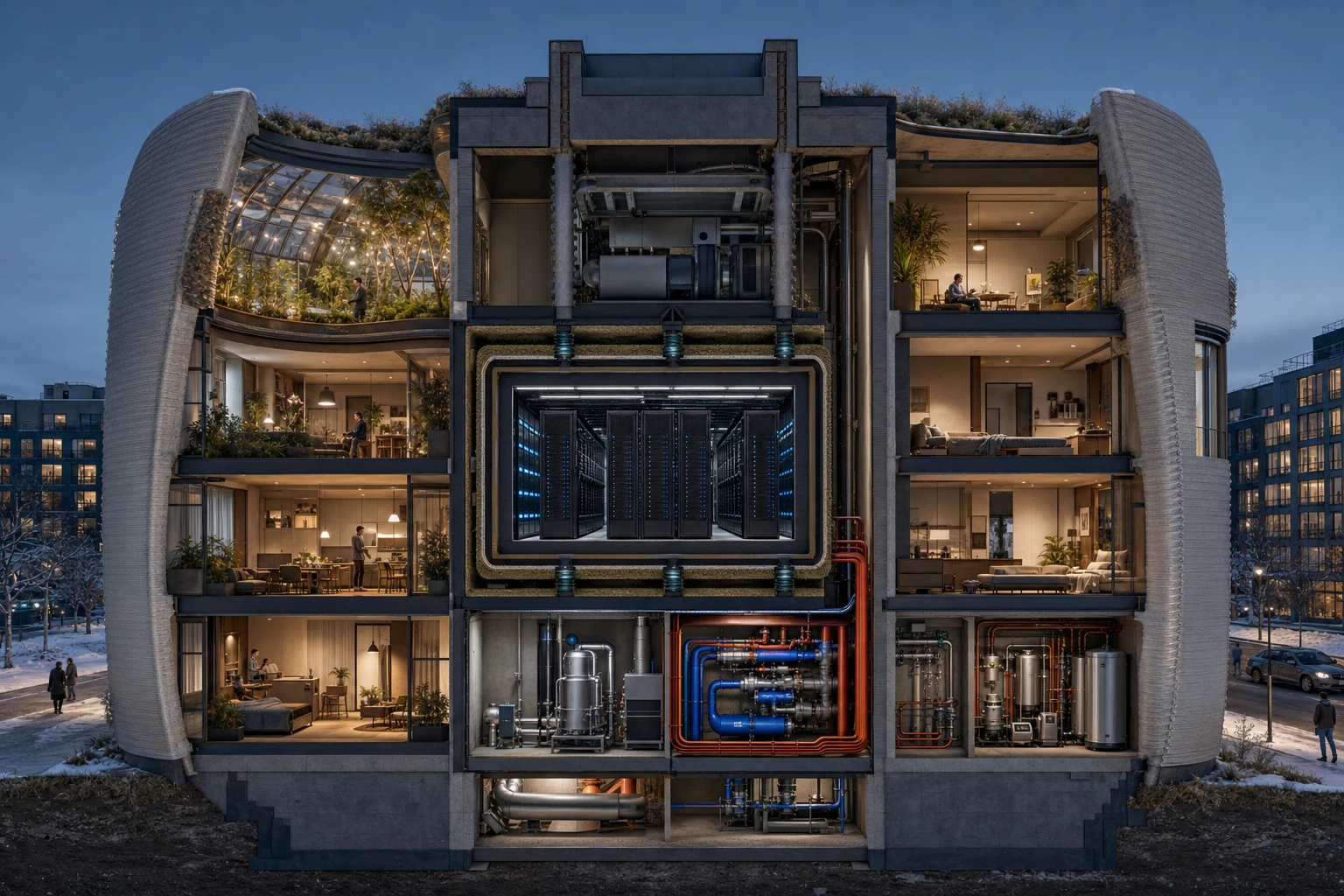
Data-center waste heat already warms homes in real programs; whether printed or masonry construction could add safe separation stays labeled speculation.
- Level
- Intermediate
- Reading time
- 14 minutes
- Evidence
- editorial-concept
- Reviewed
- 2026-08-09
Jump through this guide
The short version
Data centers reject enormous amounts of heat as an ordinary byproduct of computation, and in at least one documented program, that heat already warms homes through a district network rather than a cooling tower. This systems sketch separates what is documented, real heat-recovery programs and the physical requirements data centers already meet, from what is labeled speculation here: whether printed or masonry construction could contribute the mass, ducting, and separation shells such a project would need, grounded in the International Energy Agency's overview of data centres and energy demand 1.
After reading, you can
- Distinguish documented waste-heat recovery programs from this article's labeled speculation
- Explain why data centers and housing cannot simply share a wall without separation engineering
- Describe low-grade heat and district-loop concepts in plain terms
- Identify where printed or masonry construction might plausibly contribute, and why that remains a sketch
01
The pitch, and the catch
Every data center is, among other things, a very efficient heater: nearly all the electricity it draws eventually leaves as heat, usually into outside air or a cooling tower, discarded as waste. The pitch writes itself: capture that heat before it leaves and pipe it somewhere useful, like nearby homes. The International Energy Agency's overview of data centres and data transmission networks documents rising electricity demand from computing, and the heat load that comes with it, as a real and growing planning question for energy systems 1.
The catch is that piping it somewhere useful hides most of the engineering. Data-center exhaust is usually low-grade heat, warm rather than hot, which travels poorly over distance and typically needs boosting before it can heat a home's water or air. And a data center is not a good neighbor by default: it hums, vibrates, draws serious power, and holds sensitive equipment and data behind security most housing never needs. Getting from waste heat to warm homes means solving both problems, not just the pipe.
02
What already works: the Stockholm model
This is not purely hypothetical. Stockholm Data Parks, an initiative connected to the city's district-heating infrastructure, documents a program that recovers heat from data centers sited in the city and feeds it into Stockholm's existing district-heating network, which already carries heat to buildings across the city from multiple sources 2. That existing network is the quiet hero of the story: a city that already pipes heat to buildings can add a new heat source to the mix far more easily than a city starting from nothing.
The lesson generalizes past Stockholm's specific network: waste-heat reuse works best where district-heating infrastructure already exists, because the hard, expensive part, a network of insulated pipes reaching many buildings, is a one-time civic investment rather than a per-project cost. Where no such network exists, a data-center-to-homes heat project has to build the network and the source relationship at once, a considerably larger undertaking than Stockholm's documented case 2.
03
Why you can't just build them touching
Separation is not squeamishness; it is engineering. Acoustic separation keeps cooling-fan and mechanical noise out of bedrooms sited nearby. Vibration isolation keeps racks and rotating equipment from transmitting hum through a shared structure. Fire separation keeps an electrical-equipment fire, a real risk class in dense server rooms, from becoming a housing fire. Air separation keeps data-center exhaust and particulates out of residential ventilation. Security separation keeps a facility holding sensitive equipment and data away from casual public access. None of these is optional, and all of them cost space, structure, and money.
This is where the sketch has to be honest about maturity: no source in this pool specifies how a housing-adjacent data center should be built. That specific design is not documented anywhere consulted here; what is documented is that data centers already operate under serious energy and infrastructure demands as a matter of course, and that any shared-site housing project would need to meet ordinary residential code on top of whatever a co-located facility required 1.
- Acoustic: mechanical and fan noise kept from living spaces
- Vibration: isolate racks and rotating equipment from structure
- Fire: electrical-equipment risk kept from housing
- Air: exhaust and particulates kept from residential ventilation
- Security: sensitive equipment and data kept from public access
04
Low-grade heat needs a network
Here the sketch begins, labeled as such. Low-grade heat recovered from data-center cooling loops would likely need a heat pump to raise it to a useful temperature for space heating or hot water, then a local loop, pipes running through a neighborhood or building cluster, to actually deliver it. No source in this pool describes a residential-scale loop of that kind in detail; the pattern is drawn by analogy to Stockholm's documented district network 2 and to how conventional district heating already works, not from a specific engineering study of housing-adjacent recovery.
A loop like this would also need to run in reverse some of the year: a data center's heat output does not know or care that homes want less warmth in summer, so a real system needs a way to reject surplus heat when nobody wants it, likely back to conventional cooling. That balancing question is a real design problem for anyone attempting this, and it stays an open question here rather than a claimed solution.
05
What printed or masonry construction could contribute
This is where PrintMason's own speculation enters, and we label it clearly: printed or masonry construction could plausibly contribute the separation shell itself. A thick, mass-heavy printed or masonry wall between a server hall and adjoining housing offers the kind of acoustic and thermal mass behavior documented, in general terms, for construction-scale 3D-concrete-printed systems elsewhere, including in the federal research examining their material and structural properties 3. Ducting and chase geometry, voids and cavities planned into a printed wall before it cures, could in principle carry a heat-recovery loop through a structure more directly than retrofitting ducts into finished conventional walls.
None of this is documented as built. No source in this pool describes a completed printed or masonry structure combining data-center separation and residential heat recovery; it is a plausible combination of documented individual pieces, not a reported project. If it were built, it would still need everything a normal building needs: engineering review, code compliance, and the acoustic, vibration, fire, air, and security separation described above, printed material or not.
- Thick mass walls: acoustic and thermal buffering, conceptually
- Ducts and chases: planned into the wall before it cures
- Separation shell: a structural boundary as much as a wall
- Nothing here is a built or reported project
06
What this is, and is not
To be precise about evidence class: real, rising data-center energy and heat loads are documented 1; a real heat-recovery program is documented 2; real construction-industry research into printed and masonry systems is documented 3. What does not exist in any source consulted here is a documented project combining housing, printed or masonry construction, and data-center heat reuse on one site. That combination is this article's sketch, not a report.
Readers building on this idea should start with the two things that are real: an existing or planned district-heating network, and a data center willing to share its waste heat, the way Stockholm's documented program already does 2. Everything about separation shells, ducting, and printed construction contributing to that shell stays a design conversation, worth having, clearly labeled, and not yet a claim this publication or anyone else has built.
Working vocabulary
Glossary
- Waste heat
- Heat generated as a byproduct of a process, here computing, that is normally discarded rather than used.
- District heating
- A network of insulated pipes that distributes heat from central or distributed sources to many buildings.
- Low-grade heat
- Heat at a relatively low temperature, often too cool to use directly without boosting.
- Heat pump
- A device that moves heat from a cooler source to a warmer destination, raising its usable temperature.
- Separation shell
- A structural and mechanical boundary designed to isolate two occupancies with different hazard and access requirements.
- Thermal mass
- A material's capacity to absorb, store, and slowly release heat, moderating temperature swings.
- Acoustic isolation
- Construction measures that prevent sound and vibration from transmitting between adjoining spaces.
Source ledger
References and further study
Numbered citations point to the sources below. We favor standards, government laboratories, peer-reviewed research, and primary technical documentation. A link is evidence for the claim it supports—not an endorsement of every claim on that website. Read the full editorial and correction method.
- Data Centres and Data Transmission NetworksInternational Energy Agency · international agency research page↗Opens in a new tab
- Stockholm Data ParksStockholm Data Parks / Stockholm Exergi · industry program information↗Opens in a new tab
- 3D Concrete Printed Construction Systems, Part 2: An Overview of 3DCP Construction PracticesU.S. Department of Housing and Urban Development, Office of Policy Development and Research · government research report↗Opens in a new tab