
The Allowance · Future Sketch
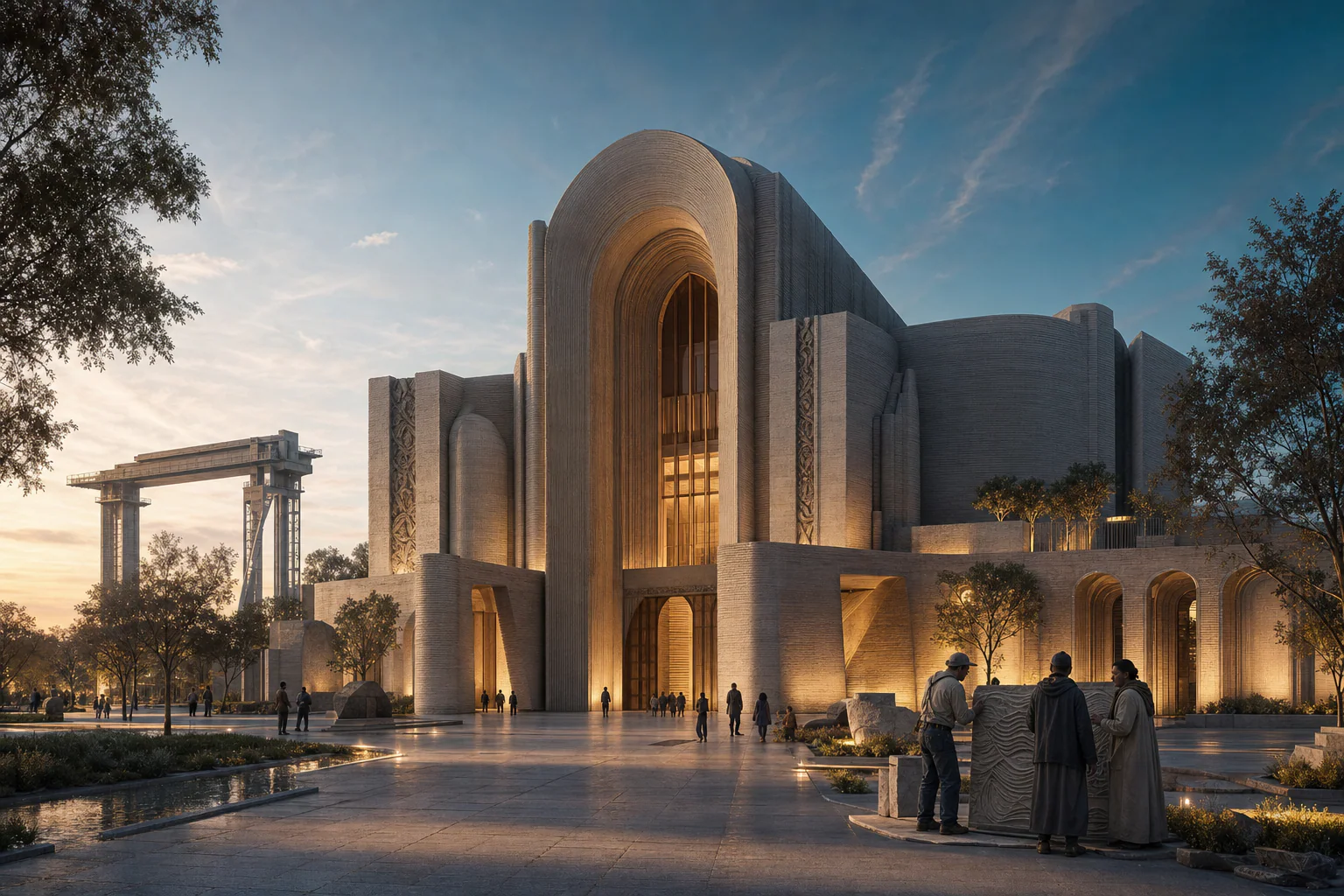
The printed cathedral: a horizon, honestly labelled
Printed moulds, near-net stone, and printed mineral walls are documented today. A printed cathedral has no precedent here — this sketch keeps that line visible throughout.
- Level
- Beginner
- Reading time
- 16 minutes
- Evidence
- speculative-horizon
- Reviewed
- 2026-08-09
Jump through this guide
The short version
Several pieces of a printed cathedral already exist, separately, and are documented: binder-jetted sand moulds cast metal today, robotic roughing already pre-shapes stone toward a near-net form, and 3D-printed mineral walls have already been built and studied at building scale 1237. What does not exist, anywhere in the research and standards record this pillar draws on, is all of that assembled into a full masonry cathedral: vaulted, ornamented, code-approved, and built to last centuries. This is a horizon piece, and every sentence that steps past documented fact into forecast is labelled as speculation here, not smuggled in as if it were already true.
After reading, you can
- List which technologies behind a printed cathedral are documented today, and in what form
- Identify why scaling documented pieces into a full cathedral is a speculative leap, not a small extrapolation
- Explain what code acceptance for 3D-printed construction currently covers and does not cover
- Articulate why century-scale durability and repair are open questions, not settled ones
01
What is real today
Four pieces of a hypothetical printed cathedral are documented separately, in different fields, at different scales. Binder jetting can print sand moulds used to cast metal parts, a process federal research programs study directly as an established additive manufacturing technology 1. Government laboratory research documents printing single-use moulds and reusable patterns for large-scale casting work, extending that same mould-printing logic toward foundry-scale production 2. Robotic systems already pre-cut natural stone toward a near-net rough form before a carver finishes it by hand, a documented industrial process, not a concept 3. And full-scale 3D-printed mineral walls have already been built and studied well enough to produce federal technical documentation on their construction systems 7.
Each of those is real, present, and backed by a named source. None of them, individually, is a cathedral. The leap from 'these four things exist' to 'therefore a printed cathedral is coming' is exactly the leap this article refuses to make quietly. It is stated here, out loud, as the speculative step it is.
02
Speculative: what a printed cathedral would actually require
Speculative. Nothing in this pool documents a full masonry cathedral built through any combination of these technologies. A real cathedral asks for vaulted structural spans, buttressing that manages thrust across a full building height, ornament integrated with structure rather than applied to a wall panel, weather and fire performance sustained over centuries, and bells, towers, and interior volumes proven at a scale no printed mineral structure has yet reached in this record. Assembling documented mould-printing, near-net stone shaping, and printed mineral walls into that structure is a plausible research direction. It is not a built or tested outcome, and this article will not describe it as one.
Speculative. The honest version of the vision is modular and partial, not monolithic: printed moulds casting ornamental or structural metal elements, near-net stone blanks finished by hand for load-bearing or carved work, and printed mineral walls forming enclosure where a code pathway allows it, assembled by the same trades that already coordinate stone, metal, and concrete on any large masonry building today. A wholly printed cathedral, raised in one continuous process, is a different and much larger claim, with no precedent in this record.
03
Code: the part that has to exist before anything else
Whatever gets built at civic scale has to satisfy a code official first, and that process is already underway, documented, and incomplete. A code evaluation body runs a specific programme to assess 3D-printed construction methods, which is direct evidence that acceptance pathways for this technology are being actively built right now, not a future promise 4. Federal technical research on 3D-printed construction systems documents the performance questions, such as layer bonding, reinforcement, and structural behavior, that any such code pathway has to be satisfied on before a wall, let alone a cathedral, is approved 7.
None of that documented code activity yet covers a structure at cathedral scale, with vaults, height, and centuries-long service life in view. Extending today's code pathways for printed walls to a full civic monument is, again, a speculative extension of a documented, narrower process, and it is labelled as such here rather than implied by proximity to real code language.
04
Open question: durability and maintenance across a century
This is a genuine open question, not a speculative claim, because the honest answer is that nobody yet knows. No source in this pool reports how 3D-printed mineral construction performs over decades or centuries; the technology is recent enough that century-scale weathering, fatigue, and maintenance data simply does not exist yet in this record. Historic masonry earns trust the slow way, by having already stood through weather, use, and repair for hundreds of years, and that kind of evidence cannot be manufactured early. It can only be waited for.
Institutions built specifically to steward long-lived material culture exist because maintaining historic fabric across centuries is itself a discipline with its own accumulated practice 8. That practice is documented for the masonry, metal, and materials cathedrals have always been built from. Whether it transfers cleanly to a printed mineral wall, whose long-term behavior nobody has yet observed for a century, is an open question this article is not going to answer speculatively.
05
Speculative: who repairs it in a hundred years
Speculative. International conservation doctrine already governs how historic fabric gets repaired: minimal intervention, reversibility where possible, honest distinguishability where it is not, and reconstruction treated as an exceptional measure requiring strong documentation rather than a routine option 56. Whether a century-old printed mineral wall would be repaired under that same doctrine, under some future variant of it, or under a framework that does not exist yet, is not knowable from this source pool. No printed structure has reached the age where this question stops being hypothetical.
Speculative. The most useful thing a horizon article can do here is name the question precisely rather than answer it convincingly: a printed wall that fails in year eighty needs someone who can read what it is, source or reproduce a compatible repair material, and decide whether reversibility and distinguishability are even achievable in a material system built by extrusion rather than by hand-laid unit. That is a real design problem for today's printing research to consider now, while the record is still being written, not a problem to defer to whoever inherits the building.
06
Verdict, held at the right confidence
The documented pieces are genuinely exciting on their own terms: mould printing, near-net stone shaping, and printed mineral walls are real, present, and improving 1237. The step from those pieces to a printed cathedral is not documented anywhere in this pool, and this article has tried, at every turn, to say so rather than let an inspiring picture do the arguing. Code pathways are being built now; durability and maintenance data are not yet in hand; and the question of who repairs a printed monument in a hundred years has no answer yet, because no printed monument has lived that long.
None of that is a reason to stop the research. It is a reason to keep the labels on. A horizon is worth describing honestly precisely because it has not arrived: readers who want to build toward it need to know exactly which parts are already load-bearing fact and which parts are still, for now, a good idea waiting on evidence.
Working vocabulary
Glossary
- Binder jetting
- An additive manufacturing process that selectively deposits liquid binder into a powder bed to build a shape, widely used to print sand moulds for casting.
- Near-net shape
- A roughed form that closely approaches, but does not equal, a finished target geometry.
- Code evaluation body
- An organization that assesses new construction methods and materials against performance criteria for building code acceptance.
- Reversibility
- The conservation principle that an intervention should be undoable without harming original fabric wherever possible.
- Distinguishability
- The conservation principle that new work should be honestly recognizable as new rather than disguised as historic.
- Reconstruction
- Recreation of lost fabric, treated by doctrine as an exceptional measure requiring strong documentation.
- Interlayer bond
- The plane of contact between one printed layer and the next, a documented structural concern in printed construction.
Source ledger
References and further study
Numbered citations point to the sources below. We favor standards, government laboratories, peer-reviewed research, and primary technical documentation. A link is evidence for the claim it supports—not an endorsement of every claim on that website. Read the full editorial and correction method.
- Binder JettingNational Institute of Standards and Technology · government research program↗Opens in a new tab
- Additively manufactured single-use molds and reusable patterns for large automotive and...Oak Ridge National Laboratory · government laboratory research↗Opens in a new tab
- Industrial robot-based sawing method for natural stone sculptureJournal of Computational Design and Engineering · peer-reviewed research↗Opens in a new tab
- 3D printing programmeICC-ES · code evaluation body↗Opens in a new tab
- International Charter for the Conservation and Restoration of Monuments and Sites (Venice Charter)ICOMOS · international heritage charter↗Opens in a new tab
- Policy Compendium — ReconstructionUNESCO World Heritage Centre · intergovernmental policy compendium↗Opens in a new tab
- 3D Concrete Printed Construction Systems, Part 2U.S. Department of Housing and Urban Development · federal research report↗Opens in a new tab
- Getty Conservation InstituteGetty Conservation Institute · conservation research institute↗Opens in a new tab