
The Allowance · Design Notebook
Near-net blanks: designing a block a carver can finish
Datums, scanned stock, and a stated allowance turn a roughed block into a blank a carver can trust — marking where the machine's job ends and the hand's begins.
- Level
- Intermediate
- Reading time
- 15 minutes
- Evidence
- standards-and-practice
- Reviewed
- 2026-08-09
Jump through this guide
The short version
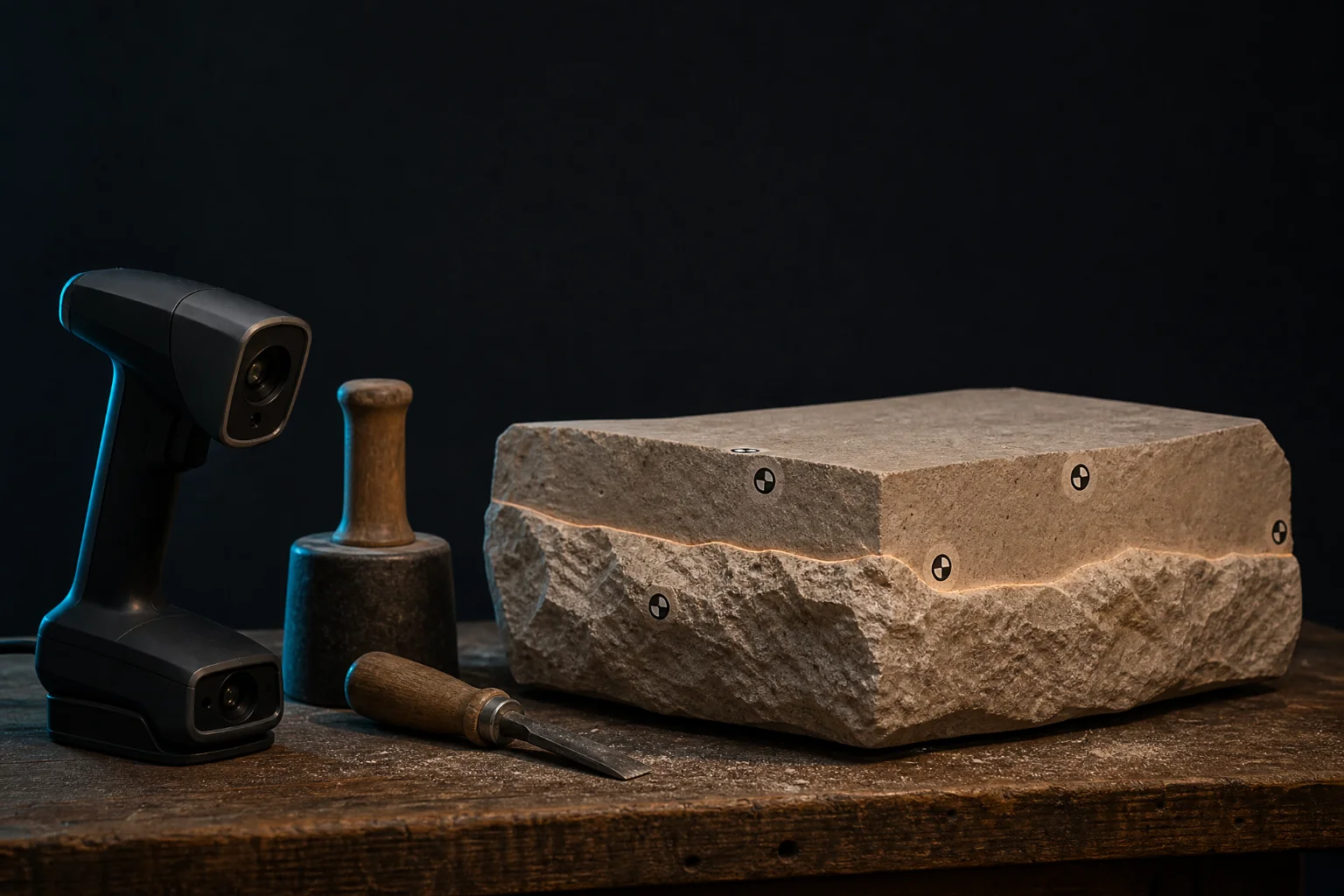
A near-net blank is not a finished part, and it is not raw stock either; it is a block that has already been roughed toward a target shape, with material deliberately left where a carver will still work by hand. Getting that handoff right depends on decisions made before any tool touches the material: shared datums that let scan data, machine path, and hand tool agree on the same coordinate system; scanning the actual piece in hand rather than trusting a nominal drawing, because real stock is irregular; and a stated, not assumed, allowance describing where extra material stays and where a surface is already meant to be final. This guide works through that handoff using documented robotic stone-roughing practice and digital fabrication and metrology sources 123.
After reading, you can
- Explain why a near-net blank needs shared datums between the roughing process and the carver
- Describe why scanning actual stock, not a nominal model, drives a trustworthy allowance
- Distinguish surfaces finished to size from surfaces left with carving allowance, and why the difference must be stated, not assumed
- List what a blank needs to carry with it when it is handed to a person
01
What 'near-net' actually promises
A near-net blank sits between two more familiar things: raw stock, which promises nothing about final shape, and a finished part, which promises everything. Robotic roughing of natural stone is documented specifically as a bulk-removal step, cutting a sculpture's rough form so the material closely approaches its target geometry before any hand work begins 1. The promise a near-net blank makes is narrower than 'ready to install' and more specific than 'a block of the right material.' It promises that the bulk of the unwanted volume is already gone, and that what remains has been left there on purpose.
That last clause is the whole design problem. A blank that merely approximates a target shape, without a stated record of where the approximation is loose and where it is tight, forces the carver to rediscover the machine's intent by eye before any carving can begin. A blank designed for handoff carries that intent with it.
02
Datums and registration
Before stock is roughed, scanned, or finished, the block needs reference points, or datums, that every stage of the process can agree on. A datum lets a scan taken today, a tool path calculated from that scan, and a carver's own measurements next week all describe the same physical location on the same physical block. Without shared registration, each stage effectively works from its own private map, and small disagreements between maps compound into a blank that no longer matches the record describing it.
Registration matters most exactly where the allowance is thinnest. A shared datum lets a carver check, quickly and independently, whether a critical surface has drifted from its intended position before committing an irreversible cut. That check is only possible if the datum was built into the blank from the start, not improvised afterward on the bench.
03
Scan the block you actually have
Natural stone and cast or printed stock both vary from the nominal model that designed them: veining, density, minor voids, and dimensional drift are normal, not exceptional. Digital stone fabrication practice, as fabricators describe their own process, scans the material in hand and works from that captured geometry rather than trusting the original design file alone, so machine roughing responds to the piece that actually exists 2. Robotic stone-roughing research documents the same logic from the process side: pre-cutting is planned against the block's real geometry, so the bulk-removal pass strips excess material efficiently without either gouging into the target form or leaving more than intended 1.
The practical consequence is that 'stock' and 'blank' are not interchangeable words. Stock is what arrives. A blank is what results after that specific piece of stock has been measured and roughed against its own scan, not against an average or an assumption. Skipping the scan step does not save the allowance; it just moves the uncertainty from the machine's calculation onto the carver's judgment, uncompensated. Standardized geometric-capability test artifacts exist for exactly this reason: they let a machine's real dimensional performance, not its rated specification, be measured and built into how confidently an allowance can be set 3.
04
Where to leave stock, and where to finish to size
Not every surface on a blank deserves the same treatment. Registration and bearing surfaces, the faces a blank sits on, clamps against, or is measured from, generally want to be finished close to final size, because leaving allowance there just relocates the fitting problem downstream without solving it. Surfaces that will carry fine detail, texture, or hand-judged form, the places where this pillar's whole argument about the hand lives, are the surfaces that should carry the allowance, left deliberately oversize so a carver has real material to work with rather than a margin so thin that one miscalculated cut removes the target surface entirely.
This publication is not going to attach numbers to that principle. No source in this pool states a specific stock allowance in millimetres or inches for stone or mineral blanks, and inventing one here would misrepresent research and company documentation as a specification neither actually provides. The principle, generous allowance on hand-finished surfaces and tight tolerance on registration surfaces, is what the sources support; a number belongs to a shop's own qualified process, not to this article.
- Bearing and registration surfaces: finish close to final size
- Hand-detailed or textured surfaces: leave deliberate allowance
- State the allowance in the record; never leave it implied
- No numeric allowance value is asserted here; none is sourced
05
Leaving the carver room to work
A near-net blank can be dimensionally accurate and still be useless to a carver if it leaves no physical access for a hand or power tool to reach the surface that needs finishing. Robotic roughing removes bulk material specifically so that subsequent inspection, refinement, texturing, and finishing can happen at all 1; a roughing pass that undercuts its own access, trapping a chisel or rasp against a wall of unremoved stock, defeats the purpose of leaving allowance in the first place. Tool clearance is therefore a design constraint on the blank itself, not an afterthought solved once carving begins.
This is also a safety constraint, not only a workflow one. A carver working in a tight, poorly cleared pocket with a mallet and chisel, or a powered grinder, is working in a position that is harder to control and easier to be injured in. A well-designed near-net blank leaves the machine's efficient bulk-removal geometry and the carver's safe working posture as compatible goals, not competing ones.
06
How a blank is handed over
The handoff from machine to person is where the allowance either survives or gets lost. A blank handed over as an unlabeled object forces the carver to re-derive, by eye and experience, everything the roughing process already knew: where the datums are, which surfaces are finished, which carry allowance, and how much confidence the scan data deserves. A blank handed over with that record attached, referenced to its own datums, lets the carver start from documented fact instead of a guess.
None of this requires exotic technology, only discipline: datums that survive from scan to roughing to bench, a record of what was measured and when, and an explicit statement of intent for every surface on the block. That discipline is what turns 'a machine roughed this' into 'a person can finish this,' which is the entire promise a near-net blank is supposed to keep.
Working vocabulary
Glossary
- Near-net shape
- A roughed form that closely approaches, but does not equal, a finished target geometry.
- Datum
- A defined reference point, line, or surface that other measurements and processes are located against.
- Registration
- The act of aligning a physical object with its digital or planned reference geometry.
- Stock
- Raw or minimally processed material before roughing begins.
- Allowance
- Material deliberately left beyond a target surface for later removal by hand.
- Bearing surface
- A face designed to carry load or serve as a fixed reference, not to be hand-carved.
- Geometric capability
- A machine's actual, measured dimensional performance, as distinct from its rated specification.
Source ledger
References and further study
Numbered citations point to the sources below. We favor standards, government laboratories, peer-reviewed research, and primary technical documentation. A link is evidence for the claim it supports—not an endorsement of every claim on that website. Read the full editorial and correction method.
- Industrial robot-based sawing method for natural stone sculptureJournal of Computational Design and Engineering · peer-reviewed research↗Opens in a new tab
- The Technology Behind Digital Stone FabricationQuarra Stone · company-reported information↗Opens in a new tab
- NIST Additive Manufacturing Test ArtifactNational Institute of Standards and Technology · government research program↗Opens in a new tab