
The Allowance · Manifesto
The allowance: what the machine leaves for the hand
Bell founders cast thick on purpose. Carvers work from oversized blocks. That reserve is old, deliberate — and the most useful idea in digital fabrication.
- Level
- Beginner
- Reading time
- 13 minutes
- Evidence
- craft-and-standards
- Reviewed
- 2026-08-09
Jump through this guide
The short version
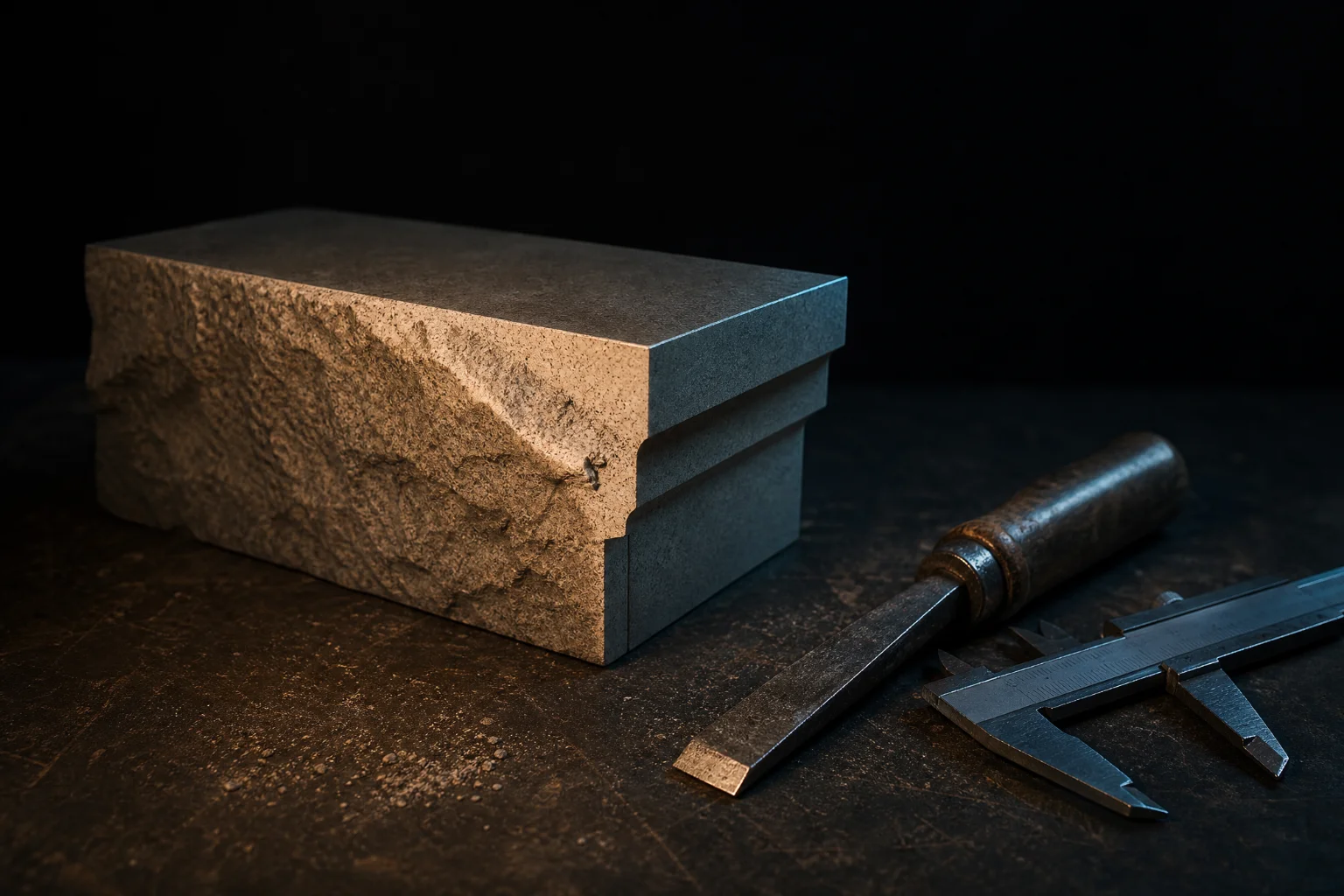
A bell foundry casts a bell heavier than the finished bell needs to be, because a tuner can remove metal and can never add it back 12. A stone shop roughs a block close to shape and leaves the last few millimetres for a carver. Neither practice is a compromise, and neither is new. Both describe the same deliberate reserve of material, held back from the machine so that a person can make the final decision in the material itself. This is the idea PrintMason is organised around: the interesting question in digital fabrication is not what the machine can finish, but what it should be told to leave.
After reading, you can
- Define the allowance as deliberately reserved material rather than leftover error
- Recognise the same reserve operating in bell founding, stone carving, and mould making
- Explain why one-way material removal makes the reserve a design decision, not an afterthought
- Apply the idea to judge where automation belongs in a fabrication sequence
01
A founder says it better than a manifesto can
Tim Verdin, sixth-generation president of a bell foundry established in 1842, described the constraint his shop works under when it began printing bell patterns. Making a pattern undersized would flatten the pitch of the finished bell, and no later operation can undo that. In his words: "I can't sharpen the bell, I can only flatten it" 3. That sentence is the whole of this argument, delivered by someone who has to live with it. Material removal runs one way. Everything upstream of the person doing the removing has to be planned around that fact.
The consequence is not caution but generosity. If the only permitted direction is downward, the responsible move is to leave a margin above the target, deliberately and by a known amount. Bell founders have done this for centuries, casting bells thicker than the final specification so that a tuning reserve of metal remains available along the interior 2. The reserve is not waste and not sloppiness. It is the working room the next person needs.
02
What the reserve actually buys
In a bell, the reserve buys tone. Metal is removed from the inside on a vertical boring lathe, and different regions of the interior shift different partials, so the tuner can bring the hum, prime, tierce, quint, and nominal into the intended relationships 1. Vertical boring machines arrived late in the nineteenth century and let a tuner cut from any part of the bell's interior; before that, tuning meant a hammer, chisel, or file at the soundbow and lip, and far less control 2. More reserve means more room to correct. It also means more mass to remove, and removing too much thins the bell and spoils its tone, so the reserve has an upper bound as well as a lower one 1.
In stone, the reserve buys judgement. Industrial practice now uses robotic and CNC roughing to take a block close to shape, and published work describes robot-based sawing methods developed specifically for natural stone sculpture 4. Digital fabrication shops describe scanning the actual stock so the machine can compensate for a block's real irregularities rather than an idealised model of it 5. What the machine hands over is not a finished carving. It is a blank, positioned and sized so a carver can do the part that requires a person.
- Reserve too little: no room to correct, and the error is permanent
- Reserve too much: wasted material, wasted removal time, and in a bell, a ruined tone
- Reserve unevenly: the person downstream inherits a problem instead of a blank
- Reserve without datums: the blank cannot be located, so the allowance cannot be used
03
The ornament was always made somewhere else
There is a habit of imagining that decoration is applied to a finished object at the end. In bell founding it is not. Decoration is modelled in relief on the mould, and the poured metal takes the exact shape of what the artist built there. Notre-Dame's own account of its bells names Virginie Bassetti, who specialises in designing and creating contemporary bell decoration and works with the Cornille-Havard foundry, and describes exactly this sequence: relief made on the mould, then metal poured to take its form 6. The artist's surface is the negative, not the bronze.
That detail matters for anyone thinking about additive manufacturing and heritage craft together, because it relocates the interesting question. If the ornament lives on the mould, then a printed mould or a printed pattern is not competing with the artist at all. It is producing the surface the artist works on, or the tooling that produces it. Print the thing that shapes the thing. Leave the shaping of meaning to the person.
04
Where the machine genuinely belongs
Automation earns its place on the operations that are repetitive, heavy, hazardous, or dimensionally demanding, and it earns nothing by taking the operations that carry judgement. Roughing out tonnes of stone is exhausting and dangerous work. Holding a datum to a tight tolerance across a large component is something a machine does better than a tired person. Producing a mould with internal passages that no rigid pattern could be drawn from is a capability that simply did not exist before, and standards bodies now treat design for additive manufacturing as its own discipline with its own rules 78.
None of that argues for automating the last cut. The final surface of a carved capital, the decision about where a moulding should break, the correction that brings a bell into tune, the judgement that a repair should stay visibly distinguishable from original fabric: these are the places where a person's accountability is the point. Conservation doctrine has said something close to this for a long time, insisting that restoration stop where conjecture begins and that new work be distinguishable from the historic fabric it joins 9. The allowance is that principle expressed in millimetres.
- Give the machine: bulk removal, repeatability, datums, tolerance, hazardous operations
- Keep for the person: the final surface, the judgement calls, the corrections, the meaning
- Write the handover down: how much was left, where, and to what reference
05
What this commits the publication to
Treating the allowance as the organising idea imposes obligations. It means describing sequences, not machines, because the interesting unit is the handover between operations rather than any single device. It means reporting what a process leaves as carefully as what it produces. It means resisting the claim that a technology has replaced a trade when what it has actually done is take over one operation inside a much longer chain, as the bell foundry did when it printed a pattern and went on forming its moulds and pouring and tuning exactly as before 3.
It also means saying plainly where the idea runs out. Printed sand moulds and robotic stone roughing are documented practice 345. Whether a printed mineral material can be formulated to be genuinely carvable, rather than merely printable, is an open question this publication has found no settled answer to. A printed cathedral is speculation, and will be labelled as such every time it appears here. The reserve is only honest if the uncertainty is reserved too.
06
Modern tools, timeless craft, stated precisely
The tagline this publication runs under can sound like a pleasantry. Read through the allowance, it becomes a specification. Modern tools prepare the blank to a known state, hold the datums, and stop short by a defined amount. Timeless craft takes it from there, using the reserve that was deliberately left, and carries the responsibility for the result. Neither half works alone. A blank nobody finishes is not architecture, and a carver handed a block with no allowance has been handed a problem.
A bell that has been tuned cannot be untuned. A moulding that has been cut cannot be uncut. That irreversibility is not a limitation to engineer around; it is the reason the work has ever required judgement, and the reason it still does. The most useful question to ask of any fabrication sequence is not how much of it can be automated. It is a quieter one: what should this machine be told to leave, and for whom.
Working vocabulary
Glossary
- Allowance
- Material deliberately left on a workpiece beyond its final dimensions so a later operation, often performed by hand, can remove it.
- Tuning reserve
- The extra thickness a bell is cast with so a tuner can remove metal to adjust its partials.
- Near-net shape
- A part produced close to its final geometry, requiring only limited finishing to reach specification.
- Datum
- A reference feature or surface from which other dimensions and machine positions are measured.
- Partial
- One of the individual frequencies present in the sound of a bell; the lowest five are the hum, prime, tierce, quint, and nominal.
- Pattern
- A reusable positive model of an object, used to form the cavity of a sand mould around it.
- Distinguishability
- The conservation principle that new work added to historic fabric should remain identifiable as new rather than imitating the original.
Source ledger
References and further study
Numbered citations point to the sources below. We favor standards, government laboratories, peer-reviewed research, and primary technical documentation. A link is evidence for the claim it supports—not an endorsement of every claim on that website. Read the full editorial and correction method.
- Building a bell soundBill Hibbert, The Sound of Bells · specialist research resource↗Opens in a new tab
- Church Bells in TrustCathedral Communications, Historic Churches · conservation trade publication↗Opens in a new tab
- A Resonant Harmony for Bell Casting and 3D PrintingAdditive Manufacturing Media · trade journalism, company-reported figures↗Opens in a new tab
- Industrial robot-based sawing method for natural stone sculptureJournal of Computational Design and Engineering · peer-reviewed research↗Opens in a new tab
- The Technology Behind Digital Stone FabricationQuarra Stone · company-reported information↗Opens in a new tab
- The BellsCathédrale Notre-Dame de Paris · institutional primary source↗Opens in a new tab
- ISO/ASTM 52900 — Additive manufacturing fundamentals and vocabularyInternational Organization for Standardization · international standard↗Opens in a new tab
- ISO/ASTM 52910 — Design requirements, guidelines and recommendationsInternational Organization for Standardization · international standard↗Opens in a new tab
- International Charter for the Conservation and Restoration of Monuments and Sites (Venice Charter)ICOMOS · international conservation charter↗Opens in a new tab