
Monument Atlas · Site Atlas
Stonehenge: what the stones support—and what they don't
A site atlas entry sorting Stonehenge claims by evidence: documented axis and phases, interpreted purposes, open questions, and the over-claims to retire.
- Level
- Beginner
- Reading time
- 14 minutes
- Evidence
- heritage-evidence
- Reviewed
- 2026-08-09
Jump through this guide
The short version
Stonehenge may be the most over-explained monument on Earth, which makes it the right first entry for a site atlas built on evidence classes. The documented record is rich: a megalithic monument of shaped sarsen and bluestone, raised and rearranged in phases across a landscape of related prehistoric monuments broadly spanning c. 3700-1600 BCE, with an architectural design laid out in relation to the solstices. The interpreted record is careful and plural. The speculative record is an industry. This guide walks the claims ladder rung by rung, starting from the World Heritage listing that documents the site's design, phasing, and setting 1.
After reading, you can
- State what is documented at Stonehenge—materials, phased construction, solstitial axis, burials—and where that record comes from
- Distinguish measured alignment from claims about intent, and interpretation from open question
- Summarize the bluestone transport question as a documented fact with debated mechanisms
- Recognize over-claims—precision calendars, healing energies, non-human builders—and say why they fail
01
What kind of thing Stonehenge is
Strip away the paperbacks and the documented object is impressive enough: a prehistoric megalithic monument whose large sarsen stones were shaped and joined with deliberate architectural sophistication, and whose smaller bluestones came from sources far to the west. The World Heritage listing describes a concentric plan, dressed stones, and a level of design unmatched among prehistoric stone circles, set within one of the densest concentrations of related prehistoric monuments in Europe, shared between the Stonehenge and Avebury landscapes 1.
Just as important: Stonehenge is not a single event. The monument visible today is the late state of a site built, used, and rearranged in phases across many centuries within the broad span of c. 3700-1600 BCE 1. Ditches, timber settings, stone settings, and burials belong to different generations. Any explanation that treats the monument as one design executed to one purpose by one community has already failed the first evidence check. English Heritage, the charity that manages the site, presents it the same way: a monument with a long biography, not a moment 2.
- Shaped sarsen structure with joined uprights and lintels
- Bluestones from distant western sources
- Phased construction and rearrangement over centuries
- Part of a wider prehistoric monument landscape
- Managed today as a protected World Heritage property
02
Documented: the record beneath the claims
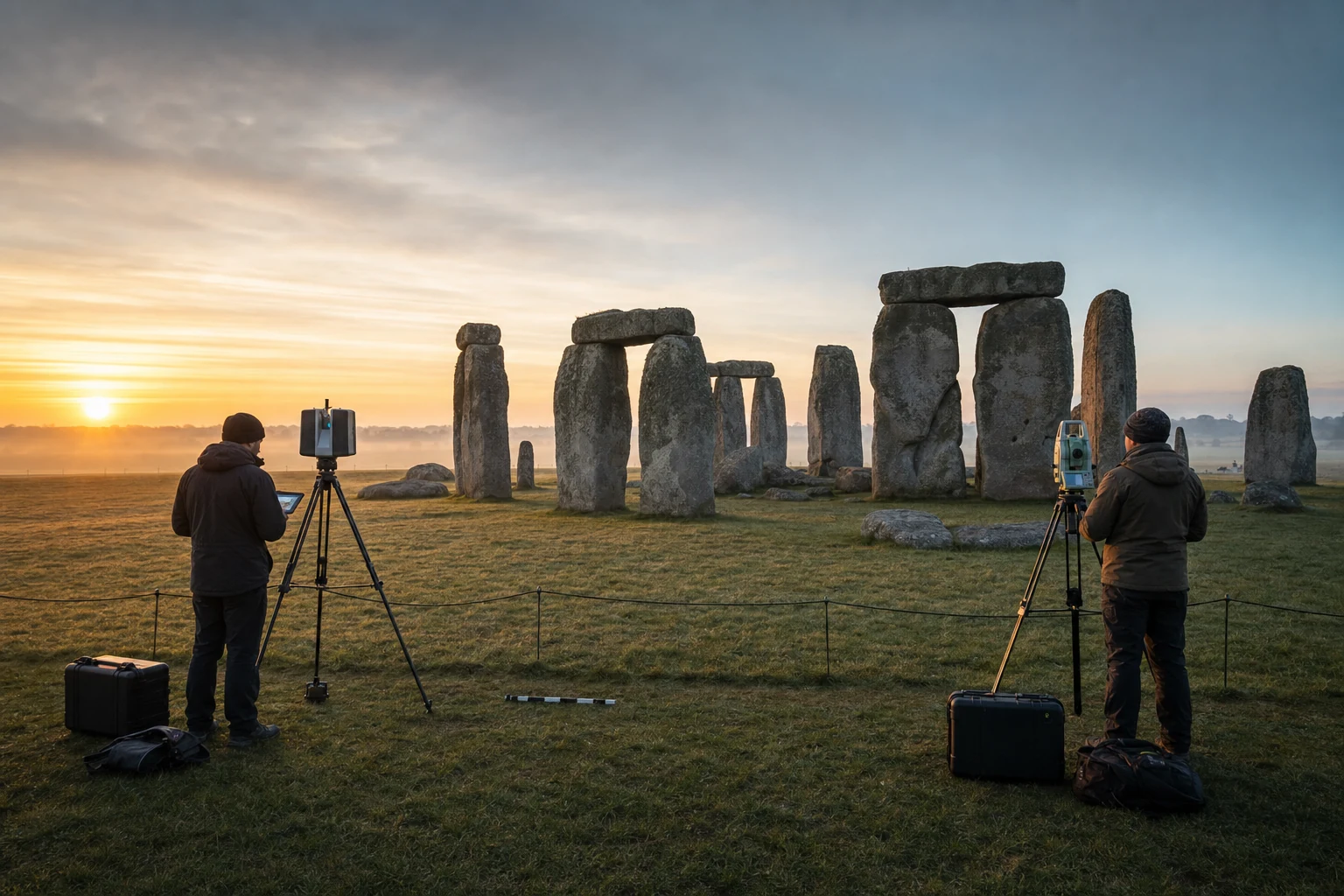
The strongest facts at Stonehenge are architectural and archaeological. The stones stand where surveys record them, and the monument's principal axis is laid out in relation to the solstices: midsummer sunrise and midwinter sunset fall along it. That alignment is measured geometry, confirmed every year in public view, and the World Heritage listing cites the monument's astronomical and solstitial design among the reasons for its outstanding value 1. Excavations across the twentieth and twenty-first centuries add a second documented layer: Stonehenge held cremation burials, making it, among its other roles, a cemetery 2.
The documented record also includes absences, which matter as much. No inscriptions, no depictions of the builders at work, no surviving account of intent: the communities who raised Stonehenge left no writing. Everything about purpose is therefore inference from fabric, finds, and landscape—strong inference in places, but inference. Keeping that line visible is what separates a site atlas from a souvenir booklet. The stones support a great deal; they dictate very little 1.
03
Interpreted: purpose, plural
Archaeologists read Stonehenge as a ceremonial and funerary monument whose solstitial axis tied gatherings to the turning points of the year. That reading rests on the measured axis, the cremation burials, the effort invested in shaping and raising the stones, and the surrounding monument landscape 12. It is a strong interpretation because multiple independent lines of evidence converge on it, and because it stays close to what the fabric shows. Note its modesty: it names a family of uses—assembly, ceremony, burial, seasonal marking—rather than one exclusive function.
Interpretation weakens as it grows specific. Claims about which rituals, which beliefs, whose ancestors, or how gatherings were organized go beyond what fabric can carry, and careful accounts flag them as proposals. The test from our field-guide method applies here: a good interpretation cites the evidence it stands on and names what would change its mind. Purpose claims about Stonehenge should be held as a ranked list under revision—the site's stewards present them with exactly that plurality 2.
- Ceremonial and funerary use: well supported, multi-line
- Solstitial gathering: supported by axis and landscape
- Specific rituals and beliefs: proposals, not records
- Single exclusive function: unsupported by the phased record
04
Open question: the bluestones' journey
The bluestones are the site's best honest mystery. Their geological sources lie in west Wales, a very long way from Salisbury Plain, and their presence at Stonehenge is documented fact recognized in the property's listing 1. How they made the journey is the open question: human transport by land, water, or both; the routes taken; the organization such a project implies; and whether natural glacial movement carried any stones part of the way. These are live research questions, and reasonable specialists have disagreed in print for a century.
Watch how the uncertainty is bounded, because this is what a well-behaved open question looks like. Nobody doubts the stones moved; the debate concerns mechanism and route. Each hypothesis makes testable commitments—quarry traces at source outcrops, transport feasibility, glacial deposit evidence—and the field grinds through them. An open question is not a void that any story may fill. It is a defined gap between documented endpoints, and the wilder fillings still owe evidence 12.
05
Over-claimed: what the stones cannot carry
Three families of claims outrun the evidence. First, precision-instrument claims: Stonehenge as an exact calendar, eclipse computer, or observatory of fine astronomical events. The documented solstitial axis does not upgrade into instrument precision; weathered, re-set stones cannot certify the accuracies claimed, and the phased history undercuts any single engineered design 1. Second, energy and healing claims—ley lines, earth forces, cures—which measure nothing and predict nothing. Third, displaced-builder claims handing the work to wizards, giants, or visitors from elsewhere.
The third family deserves the bluntest reply, because it has a cost. Stonehenge was built by prehistoric communities in Britain whose capability is documented by the monument itself and its landscape 1. Reassigning their achievement to someone else is not open-minded speculation; it is erasure of real people wearing the costume of curiosity. The honest wonder is better: organized communities without metal tools or writing quarried, moved, shaped, and raised these stones, and the monument has held its geometry for thousands of years 2.
- Precision calendar or computer: exceeds the measured record
- Healing or energy properties: no measurable claim to test
- Lost or non-human builders: erases documented communities
- Single genius designer: contradicted by phased construction
06
Visiting the evidence
Stonehenge is unusually accessible for a monument of its importance: a managed visitor operation, an exhibition presenting excavated finds, and the stone circle itself viewed from a boundary path that protects fragile ground 2. The boundary is part of the evidence system. Millions of feet compact soil, erode surfaces, and endanger exactly the buried contexts future methods will read better than ours. Respecting it is how visitors participate in preservation rather than subtraction. Solstice gatherings, managed by the site's stewards, continue the axis's oldest documented role 2.
For makers and modelers, Stonehenge rewards study precisely because its record is layered. A respectful scale model can show the phases as separable states rather than one frozen scene; a teaching model can make the solstice axis tangible with a lamp. Both depend on published survey data rather than invention, and both should carry their uncertainty visibly—our confidence-layer challenge exists for exactly this discipline. The property's stewardship under World Heritage guidelines treats documentation as a continuing duty, and models are one more way to read it 3.
Working vocabulary
Glossary
- Sarsen
- A hard sandstone used for the large uprights and lintels of Stonehenge's main structure.
- Bluestone
- Collective name for Stonehenge's smaller non-local stones, whose geological sources lie in west Wales.
- Trilithon
- A setting of two uprights carrying a horizontal lintel, characteristic of Stonehenge's sarsen architecture.
- Solstitial axis
- The monument's principal alignment, laid out toward midsummer sunrise in one direction and midwinter sunset in the other.
- Phase
- A distinct construction or use episode in a monument's history, established by stratigraphy and dating.
- Cremation cemetery
- A burial ground of cremated remains; excavated deposits document this role at Stonehenge.
- Ley line
- A claimed straight alignment of sites attributed to earth energies; no measurable basis has been established.
Source ledger
References and further study
Numbered citations point to the sources below. We favor standards, government laboratories, peer-reviewed research, and primary technical documentation. A link is evidence for the claim it supports—not an endorsement of every claim on that website. Read the full editorial and correction method.
- Stonehenge, Avebury and Associated Sites — World Heritage listingUNESCO World Heritage Centre · world heritage listing↗Opens in a new tab
- StonehengeEnglish Heritage · site steward information↗Opens in a new tab
- Operational Guidelines for the Implementation of the World Heritage ConventionUNESCO World Heritage Centre · intergovernmental guidelines↗Opens in a new tab