
Monument Atlas · Comparative Atlas
Pyramids across cultures are not one thing
Egypt, Nubia, Mesoamerica, and North America each built stepped or pyramidal monuments independently, for different purposes, in different eras—one shape, many stories.
- Level
- Beginner
- Reading time
- 15 minutes
- Evidence
- heritage-evidence
- Reviewed
- 2026-08-09
Jump through this guide
The short version
A pyramid is a shape, not a civilization. Stepped and pyramidal monuments rose independently on at least three continents, built by state administrations, kingdoms, and communities that shared no contact, no blueprint, and often no purpose. Old Kingdom Egypt raised royal tombs at Memphis; the Kingdom of Kush built steeper funerary pyramids at Meroë centuries later; Mesoamerican cities raised stepped temple-platforms at Teotihuacan, Chichén Itzá, and Tikal; and Mississippian communities at Cahokia raised earthen platform mounds using no stone at all. This guide compares them on their own evidence, beginning with the World Heritage listing that documents Egypt's pyramid fields from Giza to Dahshur 1.
After reading, you can
- Compare pyramidal and stepped monuments across cultures without flattening their distinct purposes and eras
- State what is documented about each tradition's builders, function, and approximate period
- Explain why independent invention, not diffusion, is the evidence-supported reading of shared pyramidal forms
- Identify the specific over-claims that diffusionist and 'lost civilization' framings make, and why they fail
01
One shape, many inventors
A stepped or pyramidal silhouette is one of the simplest ways to raise a very large, very stable monument by hand: stack material inward as it rises, and gravity does most of the engineering. That simplicity is exactly why the form appears, independently, wherever large communities organized enough labor to build monumentally. Egypt, Nubia, several Mesoamerican civilizations, and Mississippian North America each arrived at a pyramidal or stepped monument without shared blueprints, shared engineers, or, in most cases, any contact with one another at all.
Treating 'pyramid' as one story with one origin erases that independence and, with it, the achievement of each culture that solved the problem separately. This guide keeps the traditions apart on purpose: different builders, different centuries, different functions, different construction sequences, each documented by its own evidence rather than borrowed from a neighbor's. Where the record is thin, we say so plainly rather than filling the gap with a shared myth of origin.
02
Egypt: state monuments for royal dead
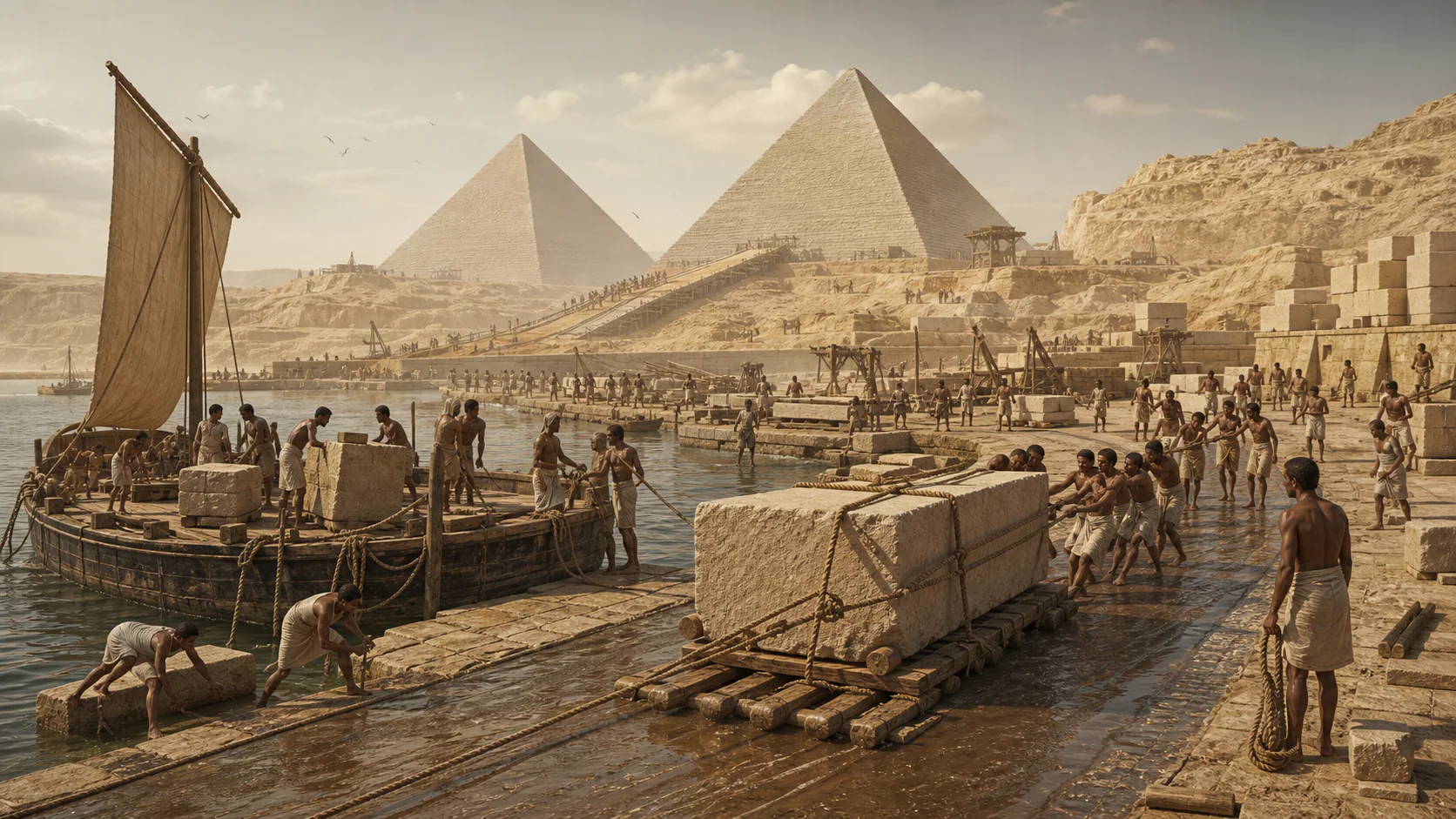
The pyramid fields between Giza and Dahshur, built primarily during Egypt's 4th Dynasty in the twenty-sixth and twenty-fifth centuries BCE, are documented as royal funerary monuments constructed by a centralized state with the administrative capacity to organize labor, materials, and logistics at enormous scale, according to the World Heritage listing covering the Memphis necropolis 1. That the pyramids marked royal burials and expressed state and religious authority is well established; the finer logistics of labor organization and construction sequencing remain active research questions refined by ongoing fieldwork.
Modern non-invasive scanning shows how that research continues without disturbing the fabric. A 2017 study used cosmic-ray muon imaging, a technique that detects particles passing through stone to map hidden density, and documented a previously unknown large void inside Khufu's pyramid 2. The void's existence is documented; its function is an open question, with proposals ranging from a construction feature to an unused chamber. No excavation has resolved it, and honest reporting says so.
03
Nubia: a distinct kingdom, a distinct silhouette
Centuries later and hundreds of kilometers south, the Kingdom of Kush built its own pyramid tradition at Meroë, documented by its World Heritage listing as spanning roughly the 8th century BCE to the 4th century CE 3. Kushite pyramids are their own architectural achievement: steeper-sided and generally smaller than Egyptian examples, built as royal funerary monuments by a kingdom with its own administration, religion, and material practice, in an era largely after Egypt's Old Kingdom pyramid-building had ended.
Egypt and Kush had extensive historical contact, including periods of shared rule, and Kushite funerary architecture draws on ideas known from Egypt. That documented relationship is different from the claim that Meroë's pyramids are simply copies, or that Nubian builders needed outside instruction: the site's distinct proportions, era, and cultural context are Kushite achievements, credited to Kushite communities and their own state, not treated as a footnote to Egypt 3.
04
Mesoamerica: platforms for temples, not tombs
Three Mesoamerican sites show how differently the stepped form was used. Teotihuacan, a major urban center from the 1st to 7th centuries CE, raised massive stepped platforms supporting temples at its city's core, built by a population whose specific ethnic and linguistic identity remains an open question in current scholarship, unlike better-documented neighboring cultures 4. Chichén Itzá, with major construction from roughly the 6th to 13th centuries CE, combined Maya and later Toltec-associated influence in a stepped temple-pyramid tradition documented by its World Heritage listing as a major religious and civic center 5.
Tikal, with Classic-period florescence around 200-900 CE, raised temple-pyramids as funerary and ceremonial monuments for Maya rulers within a lowland city documented by its own listing 6. Across all three, the architecture is platform-and-temple, not solid royal tomb: function, era, and culture differ from Egypt's pyramids and from each other's, even though all three share the stepped silhouette that makes them recognizable at a glance.
- Teotihuacan: stepped platforms, urban core, builders' identity debated
- Chichén Itzá: Maya and Toltec-associated influence, civic-religious center
- Tikal: temple-pyramids for Maya rulers, funerary and ceremonial
- None are royal burial tombs in the Egyptian sense
05
North America: earth, not stone
Cahokia, a Mississippian mound center documented as occupied roughly 800-1350 CE with its peak in the 11th and 12th centuries, raised large earthen platform mounds using packed soil rather than dressed stone, a materially and technically distinct achievement from any of the traditions above 7. No plausible route of contact connects Mississippian North America to Old Kingdom Egypt, Kushite Meroë, or Classic Mesoamerica; each tradition's builders solved the same structural problem, a large stable raised platform, using their own materials and methods.
That is the strongest evidence against diffusionist storytelling: independent invention is the ordinary, well-documented pattern in human building history, not the exception requiring a shared origin. Mississippian communities receive full credit for Cahokia exactly as Egyptian, Kushite, and Mesoamerican communities receive full credit for theirs, each in its own materials, era, and cultural context 7. Comparing the four traditions side by side, on their own evidence, is more instructive than any single shared-origin story could be, and it costs nothing but the discipline to keep the traditions apart.
06
Reading a pyramid, culture by culture
Before comparing any two pyramidal monuments, ask the same four questions this atlas applies everywhere: which culture and era built it, what documented function does the evidence support, what remains an open question, and what claims have been added later that the fabric cannot carry. Applied here, those questions keep Giza, Meroë, Teotihuacan, Chichén Itzá, Tikal, and Cahokia distinct rather than blurred into one generic 'ancient pyramid' story that belongs to no one in particular.
Every site above is actively studied and stewarded today by descendant communities, national heritage authorities, and international partners; none is an abandoned mystery awaiting an outside explanation. Diffusionist and lost-civilization narratives that hand credit to unnamed outsiders erase that documented, living stewardship. The more accurate story, that many separate human societies independently reached for the same durable, monumental shape, is also the more remarkable one.
Working vocabulary
Glossary
- Stepped pyramid
- A pyramidal monument built as a series of receding platforms or tiers, rather than a smooth-sided form.
- Funerary monument
- A structure built primarily to house or memorialize the dead, often signaling status or religious belief.
- Kingdom of Kush
- An ancient Nubian state centered south of Egypt, with its own royal pyramid-building tradition at sites including Meroë.
- Muon tomography
- A non-invasive imaging technique that maps internal density by measuring cosmic-ray particles passing through a structure.
- Platform mound
- A raised earthen or stone platform built to support a structure or ceremonial activity above ground level.
- Diffusionism
- A discredited framework attributing independently invented achievements in different cultures to a single shared, often externally credited, origin.
- Classic period (Mesoamerica)
- A broad chronological phase of major urban and monumental development among Mesoamerican cultures, applied differently by site and region.
Source ledger
References and further study
Numbered citations point to the sources below. We favor standards, government laboratories, peer-reviewed research, and primary technical documentation. A link is evidence for the claim it supports—not an endorsement of every claim on that website. Read the full editorial and correction method.
- Memphis and its Necropolis – the Pyramid Fields from Giza to Dahshur — World Heritage listingUNESCO World Heritage Centre · world heritage listing↗Opens in a new tab
- Discovery of a big void in Khufu's Pyramid by observation of cosmic-ray muonsarXiv (Cornell University) · research preprint↗Opens in a new tab
- Archaeological Sites of the Island of Meroe — World Heritage listingUNESCO World Heritage Centre · world heritage listing↗Opens in a new tab
- Teotihuacan — World Heritage listingUNESCO World Heritage Centre · world heritage listing↗Opens in a new tab
- Pre-Hispanic City of Chichen-Itza — World Heritage listingUNESCO World Heritage Centre · world heritage listing↗Opens in a new tab
- Tikal National Park — World Heritage listingUNESCO World Heritage Centre · world heritage listing↗Opens in a new tab
- Cahokia Mounds State Historic Site — World Heritage listingUNESCO World Heritage Centre · world heritage listing↗Opens in a new tab