
Monument Atlas · Field Guide
How to read a 'mysterious' ancient site
A field method for reading ancient sites honestly: provenance, stratigraphy, dating, and uncertainty—worked through Göbekli Tepe, Nabta Playa, and Gunung Padang.
- Level
- Beginner
- Reading time
- 15 minutes
- Evidence
- heritage-evidence
- Reviewed
- 2026-08-09
Jump through this guide
The short version
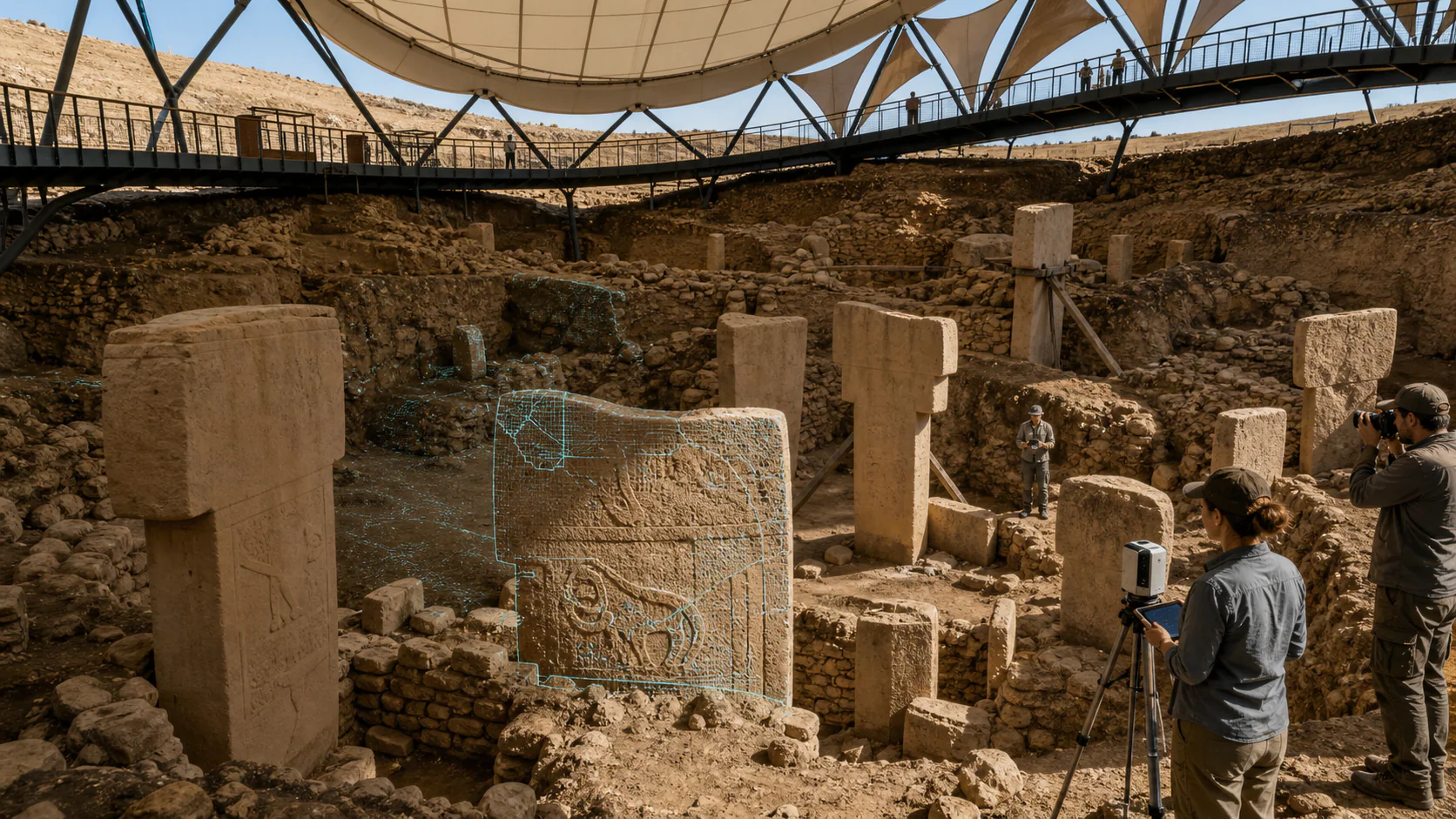
Mysterious is a marketing word, not an evidence class. Every ancient site holds open questions; the difference between archaeology and entertainment is how those questions are handled. This field guide offers a reader's method: ask where a claim's evidence comes from, how the site's layers were read, how dates were obtained and with what uncertainty, and which statements are documented, interpreted, open, or speculative. We work the method through three sites from our Monument Atlas, Nabta Playa in Egypt, Gunung Padang in Indonesia, and Göbekli Tepe in Türkiye, whose World Heritage listing documents monumental enclosures raised by hunter-gatherer communities around 9600-8200 BCE 1.
After reading, you can
- Apply the four evidence labels—documented, interpreted, open question, speculative—to claims about ancient sites
- Explain conceptually how stratigraphy and context give artifacts and dates their meaning
- Describe what radiocarbon and similar methods date, and why association matters more than precision
- Use a source-quality ladder to evaluate sensational claims, including a real retraction case
01
'Mysterious' is a sales word
Call a site mysterious and you have said nothing about the site, only about your marketing. Unanswered questions are archaeology's normal condition: excavation is slow, preservation is partial, and honest researchers publish ranges and hypotheses rather than verdicts. Göbekli Tepe is a useful first example because it is genuinely astonishing, monumental enclosures with carved T-shaped pillars, built by communities of hunter-gatherers in the tenth and ninth millennia BCE, and none of that required mystery language to establish: it is documented in excavation records summarized by the site's World Heritage listing 1.
The trouble with mystery framing is what it smuggles in. If a site is unknowable, then every guess is as good as every other, and the loudest guess wins. The method in this guide runs the opposite direction: sort claims by the evidence beneath them. Four labels do most of the work, documented, interpreted, open question, and speculative, and the skill is refusing to let a claim drift upward in that ladder without new evidence. Sites deserve curiosity; readers deserve to know which kind of claim they are holding.
02
Start with provenance and stratigraphy
Archaeological knowledge is made of relationships, not objects. A carved stone means little by itself; a carved stone found beneath an undisturbed floor, beside a hearth with charred seeds, inside a building of known type, means a great deal. Stratigraphy, the reading of deposited layers in order, is how those relationships are established, and provenance, the documented findspot and chain of custody, is how they stay trustworthy. Looting and casual collecting destroy exactly this, which is why an undocumented artifact is nearly mute no matter how spectacular it looks.
Active excavations show the method in motion. Karahantepe, a neighbor of Göbekli Tepe in the Taş Tepeler research program, was recorded in 1997 and has been excavated by a university-led team since 2019; the project documents phases of communal buildings and dwellings and, notably, publishes its readings with explicit hedges, describing one rock-cut structure as interpreted as related to transition rituals rather than declaring it so 2. That is what careful looks like from the inside: even the excavators label their own inferences.
- Ask where exactly a find came from, and who recorded it
- Layers in order tell time; disturbed layers tell warnings
- Association with datable material gives objects their age
- Undocumented artifacts carry stories, not evidence
- Excavators' own reports distinguish finding from reading
03
Dating: numbers with error bars
Most headline dates for prehistoric sites rest on radiocarbon measurements of organic material, charcoal, bone, seeds, found in secure association with human activity. The method dates the organic sample, not the stone beside it, so the argument is always in the association: was this charcoal deposited when the wall was built, or did it wash in later, or was old wood reused? Good publications answer with stratigraphy and multiple samples, and they report ranges. A period statement like 9600-8200 BCE compresses many measurements and their uncertainties into one honest span 1.
Nabta Playa, in Egypt's southern desert, shows dating discipline applied over decades. The long-running research synthesis describes a Neolithic ceremonial landscape used across roughly 7000-3500 BCE, built by cattle-herding communities around a seasonal lake 3. Peer-reviewed fieldwork there reported megalithic alignments and stone circles tied to the dated occupation, with the region's abandonment fixed by the environmental record 4. The dates are strong because they chain many lines of evidence together, not because any single number is magic.
04
Function: hypothesis, ranked by evidence
What a monument was for is usually the hardest question, and the honest answer is often a ranked list of hypotheses. At Nabta Playa, researchers documented alignments to cardinal and solstitial directions and proposed that the complex expressed early astronomy and ideology; the alignments are measured, the astronomical intent is an interpretation built on them, and the deeper symbolic readings are more interpretive still 4. Nothing is wrong with interpretation, it is the point of scholarship, provided each layer of inference is visible and revisable 3.
The same discipline applies at the Anatolian sites. That Göbekli Tepe's enclosures were communal and heavy with symbolism is well supported; precisely which rituals, beliefs, or social arrangements they hosted remains under active investigation, and ongoing excavation at related sites like Karahantepe keeps revising the picture 12. A reader's test: does the account tell you what evidence would change its mind? Documented claims can cite a context. Interpretations can cite their reasoning. Speculation can only cite its author.
- What is measured? (alignments, residues, wear, contexts)
- What reading does the measurement support directly?
- What alternative readings survive the same evidence?
- What new find would separate the alternatives?
05
When claims collide: Gunung Padang
Gunung Padang, a terraced stone sanctuary on a West Javan hilltop, is a live case study in claim collision. The documented record is solid: noted in 1914, identified in 1979 as a punden berundak, a terraced sanctuary of the region's megalithic tradition, and maintained since as protected cultural heritage by Indonesia's culture directorate 5. Published archaeological estimates commonly place the visible monument in late prehistory or the early historic period, while acknowledging that its full chronology remains under study. Open questions, openly held.
In 2023 a journal paper claimed the hill concealed vastly older buried construction, which would have rewritten world prehistory 6. Critics responded that the radiocarbon samples came from natural soil layers never shown to be associated with human construction, and the journal subsequently retracted the paper. That sequence is not scandal; it is the system working. Extraordinary claims were published, examined against the standards of association and context, and withdrawn when they failed. The site remains significant, protected, and genuinely still under study 5.
06
A reader's field kit
Rank your sources. Site stewards, heritage listings, and excavation project pages document what is actually recorded 125. Peer-reviewed reports carry the primary evidence and its uncertainties 46. Research syntheses gather decades of work into context 3. Journalism varies with its sourcing; entertainment content optimizes for wonder, not accuracy. Descending the ladder is fine for curiosity, but claims should be checked against the upper rungs before repeating them. If a dramatic assertion appears nowhere above the bottom rung, that is your answer.
Learn the red flags, and one courtesy. Precision without provenance, secret knowledge suppressed by academics, a lone genius outsider, and lost-civilization stories that hand local achievements to vanished outsiders, each of these erases the documented ancestors of living communities, which is disrespect wearing a costume of curiosity. The sites in this guide were built by real people whose descendants and nations steward them today. Read generously, verify upward, and let open questions stay open until evidence, not appetite, closes them.
- Red flag: precision with no findspot or context
- Red flag: 'they don't want you to know'
- Red flag: lost civilizations replacing documented builders
- Green flag: ranges, hedges, and cited contexts
- Green flag: the account says what would change its mind
Working vocabulary
Glossary
- Stratigraphy
- The study of deposited layers in sequence, used to establish relative order of events at a site.
- Context
- The precise position and associations of a find; the relationships that give it meaning.
- Provenance
- The documented origin and custody history of an artifact or sample.
- Radiocarbon dating
- A method dating organic material by radioactive carbon decay; it dates the sample, and association ties the date to human activity.
- Punden berundak
- Indonesian term for a terraced, stepped sanctuary of the regional megalithic tradition, such as Gunung Padang.
- T-shaped pillar
- A characteristic carved monolith form of the early Neolithic sites of the Şanlıurfa region.
- Retraction
- The formal withdrawal of a published paper by a journal after serious flaws are established.
Source ledger
References and further study
Numbered citations point to the sources below. We favor standards, government laboratories, peer-reviewed research, and primary technical documentation. A link is evidence for the claim it supports—not an endorsement of every claim on that website. Read the full editorial and correction method.
- Göbekli Tepe — World Heritage listingUNESCO World Heritage Centre · world heritage listing↗Opens in a new tab
- KarahantepeTaş Tepeler Project, Republic of Türkiye Ministry of Culture and Tourism · official excavation project page↗Opens in a new tab
- The Megaliths of Nabta Playa, South Western Desert of EgyptInstitute of Archaeology and Ethnology, Polish Academy of Sciences · research project synthesis↗Opens in a new tab
- Megaliths and Neolithic astronomy in southern EgyptNature · peer-reviewed research article↗Opens in a new tab
- Penemuan, Penelitian dan Pelindungan Situs Gunung Padang (Discovery, research, and protection of the Gunung Padang site)Directorate General of Culture, Ministry of Education and Culture, Indonesia · government heritage documentation↗Opens in a new tab
- Geo-archaeological prospecting of Gunung Padang buried prehistoric pyramid in West Java, IndonesiaArchaeological Prospection (Wiley) · peer-reviewed article (retracted)↗Opens in a new tab