
The Commons · Community Challenge
The confidence-layer reconstruction challenge
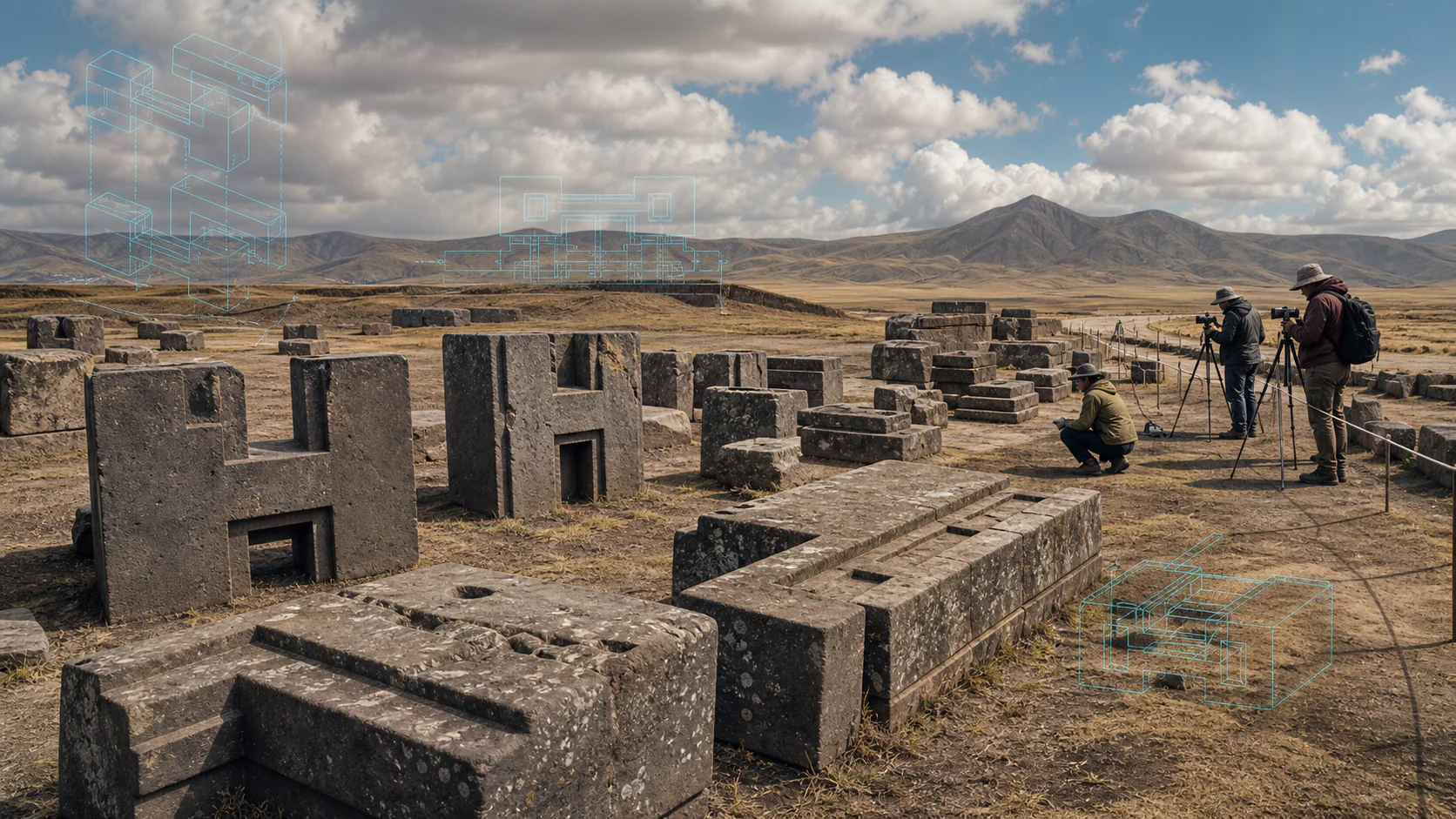
A community challenge: model a damaged or incomplete object and color-code documented, inferred, and unknown geometry in three distinct materials or colors.
- Level
- Beginner
- Reading time
- 7 minutes
- Evidence
- community-brief
- Reviewed
- 2026-08-09
Jump through this guide
The short version
Reconstruction is one of the hardest calls in conservation, and international doctrine treats it as an exception that demands documentation, not a shortcut for filling gaps with a confident guess 1. This challenge turns that discipline into a hands-on design exercise: choose a damaged or incomplete object, real or invented, and model it using three visually distinct colors or materials for what is documented, what is reasoned inference, and what is genuinely unknown. The result should teach whoever picks it up exactly where the evidence ends, the same honesty the Venice Charter asks of professional restoration work, scaled down to a tabletop object 2.
After reading, you can
- Design a three-way color or material key distinguishing documented, inferred, and unknown geometry
- Apply conservation doctrine's caution against unjustified conjecture to a personal making project
- Present a reconstruction honestly, including what it deliberately does not claim to know
01
Why this challenge
Reconstruction done badly hides its own guesswork behind a confident, seamless finish, and readers or viewers have no way to tell where evidence ends and imagination begins. International conservation guidance treats reconstruction of missing or destroyed fabric as an exception requiring documented justification, precisely because unmarked conjecture can quietly become accepted as fact 12. This challenge asks you to build that honesty into the object itself, rather than explaining it afterward in a caption nobody reads.
It is also a genuinely useful design discipline. Separating an object's geometry into what you actually know, what you reasonably infer, and what you simply do not know forces a clearer analysis than modeling the whole thing in one uniform, confident material ever would. Many makers find the unknown category is larger than they expected, which is itself the lesson.
02
The brief
Choose a damaged or incomplete object to model: a broken personal item, a weathered architectural fragment you can study directly, or a hypothetical object you invent and deliberately damage in the design. If you reference a real heritage object, use only publicly available images or your own reference photography, and do not claim precise dimensions or dates beyond what a credible public source states. Build or design your model in three clearly distinct colors or materials, one each for documented geometry, inferred geometry, and unknown or placeholder geometry. Keep the object small enough to finish, since a modest, well-argued key beats an ambitious model with a muddled one.
Include a short key or caption explaining your color code and, briefly, why each zone earned its classification. A single sentence per zone is enough: what you measured or copied directly, what you reasoned from symmetry or comparable examples, and what you genuinely could not determine and chose not to invent confidently. A single, well-labeled key photographed clearly is worth more to viewers than several unlabeled angles of the finished object alone.
- Three distinct colors or materials for documented, inferred, and unknown zones
- A short caption or key explaining the classification
- Real-object references limited to public sources you can name
- No invented precise dimensions or dates beyond your source
03
Safety and rights boundaries
Original design work only: no trademarked characters, no logos, and no scanned or remixed commercial parts presented as your own reconstruction. If you model a real heritage object, treat it as a study exercise, name your source, and never present your finished model as an authoritative or official reconstruction of that site or object. If you share design files, consider an open license such as CC BY 4.0 so others can build on your key system with attribution 3. Do not describe a personal study model as verified or peer-reviewed; it is a design exercise built to practice honest classification, not a scholarly publication.
Standard making hazards apply throughout: hot tools and nozzles, dust from sanding or finishing, and full curing and washing of resin parts before handling. Choose colors or materials that stay genuinely distinct after painting, weathering effects, or photography, since a confidence key that fades into itself defeats the entire purpose of the challenge. Test your color or material choices under normal lighting before finishing the piece, since a confidence key only works if a viewer can actually tell the three zones apart.
04
How to participate
Post your model publicly on Instagram or X and tag @print.mason or @printmasons with the hashtag #PrintMasonChallenge, or email it to right.just.right@gmail.com. There are no on-site accounts, uploads, or comments for this or any challenge. Participation is ongoing with no deadline, and we promise no prizes and no guaranteed features, only genuine appreciation for a well-argued confidence key. Feel free to enter more than once as your understanding of the object, and your confidence key, improves with practice.
Show your key clearly in at least one photo, alongside the finished object from an angle that makes all three zones visible at once. If your object references real research or a real site, name the source in your post so viewers can check your documented zone against it themselves. A caption naming your color code in plain words, documented in blue, inferred in gray, unknown left bare, for example, helps viewers who cannot examine the object closely.
05
What a strong entry shows
A strong entry has a legible, unambiguous three-way key, visible in a single glance rather than buried in a paragraph of explanation, and it resists the temptation to shrink the unknown category just to make the object look more complete. The inferred zone should show its reasoning briefly, symmetry, comparison to a documented parallel, structural necessity, rather than asserting confidence without a stated basis.
The best entries treat the unknown zone as an honest feature, not a failure: a visibly simplified or placeholder unknown region teaches more about the discipline of reconstruction than a seamlessly filled gap ever could. That restraint, choosing not to guess convincingly, is the entire skill this challenge is built to practice 12. A viewer should be able to look at the finished object for a few seconds and correctly guess which zone is which before ever reading the caption.
Working vocabulary
Glossary
- Confidence layer
- A visible distinction, by color or material, between documented, inferred, and unknown parts of a reconstruction.
- Documented geometry
- Form directly supported by measurement, surviving material, or a credible cited source.
- Inferred geometry
- Form reasoned from symmetry, comparable examples, or structural necessity, without direct surviving evidence.
- Unknown or placeholder geometry
- Form that cannot currently be determined and is marked as such rather than filled with a confident guess.
- Conjecture
- A proposed reconstruction of missing evidence, treated by conservation doctrine as requiring clear labeling and strong justification.
Source ledger
References and further study
Numbered citations point to the sources below. We favor standards, government laboratories, peer-reviewed research, and primary technical documentation. A link is evidence for the claim it supports—not an endorsement of every claim on that website. Read the full editorial and correction method.
- Policy Compendium — ReconstructionUNESCO World Heritage Centre · intergovernmental policy compendium↗Opens in a new tab
- International Charter for the Conservation and Restoration of Monuments and Sites (Venice Charter)ICOMOS · international heritage charter↗Opens in a new tab
- Creative Commons Attribution 4.0 International (CC BY 4.0)Creative Commons · license text↗Opens in a new tab