
Heritage Lab · Field Guide
What 3D printing can responsibly do for heritage
Tactile models, teaching replicas, repair molds, and clearly-labeled facsimiles: where 3D printing genuinely helps heritage work, and the line it must never cross.
- Level
- Intermediate
- Reading time
- 14 minutes
- Evidence
- heritage-evidence
- Reviewed
- 2026-08-09
Jump through this guide
The short version
Printing turns a documented scan into something you can hold, and that is genuinely useful for heritage work in specific, bounded ways: tactile access models for visitors who cannot see or touch the original, teaching replicas for classrooms, molds that help produce compatible repair material under a conservator's judgment, conjectural fragments built to test a hypothesis, and museum facsimiles that bring closed or distant sites to new audiences. None of it replaces the original, and none of it should ever be presented as the original. Organizations such as the Factum Foundation document this practice at scale, working from digitization to physical facsimile under conservation principles 1.
After reading, you can
- List the documented, bounded uses of 3D printing in heritage practice
- Distinguish a tactile access model or facsimile from a claim to be the original
- Explain how printed molds and conjectural fragments relate to conservation's reversibility and distinguishability principles
- Describe the rights and consent questions that govern printing from heritage scan data
01
From scan to something you can hold
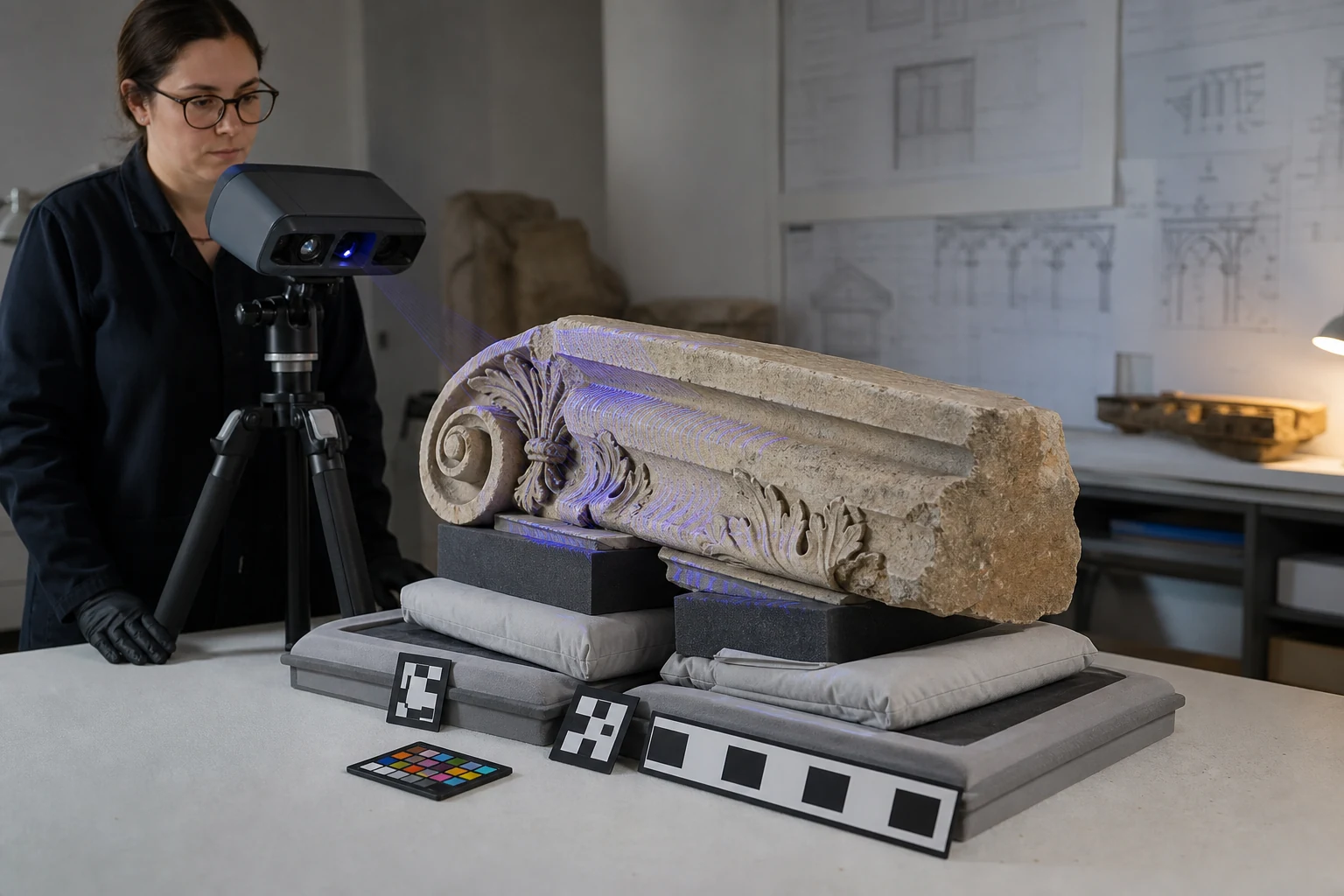
A digital scan documents geometry; a print makes that geometry physical again, and that step matters because touch, handling, and physical scale communicate things a screen cannot. Printing lets a documented digital record do new work, teaching, access, testing, without a single additional touch on the original object. Organizations that combine digitization and physical facsimile production, including the Factum Foundation, treat that translation from data to object as a documented craft in its own right, not an automatic byproduct of having a scan 1.
The bounded uses below share a common shape: each starts from documented data, states its purpose plainly, and stays visibly distinct from the original it references. That discipline is what separates responsible heritage printing from novelty souvenir-making, and it is the same evidence-first standard this publication applies to every other claim about the past. Readers should treat any printed heritage object with the same evidence-class questions this publication applies elsewhere: what was measured, what was inferred, and what the maker is choosing to leave out or mark uncertain.
02
Tactile and access models
Printed models let visitors who are blind or have low vision engage with a monument's form directly, a use case that depends entirely on the model being sturdy, handleable, and made for touch, unlike the fragile or protected original it represents. The same models serve classroom teaching, letting students handle a stepped pyramid's platforms or an arch's voussoirs at a scale a photograph cannot convey. Digitization programs built for public access, such as the Smithsonian's, exist in part to make this kind of downstream use possible from well-documented source data 2.
The distinction that keeps this responsible is deliberate and visible: a tactile model is built to be touched, while the original usually is not, and every label, caption, or museum text accompanying the model should say so plainly. Confusing a visitor about which object is the historic one, even by omission, undermines the access mission the model was built to serve.
- Built sturdy, on purpose, for handling
- Used for accessibility, classrooms, and public engagement
- Clearly labeled as a study or access model
- Never substituted for the original in a way that misleads
03
Molds and compatible repair
Printed patterns and molds can help produce shaped repair or cast material designed to match surrounding original fabric, a role that sits on the repair rung of the conservation ladder rather than replacing conservator judgment. The print is tooling, not the finished intervention: a conservator still selects a compatible material, still tests it against the original, and still decides where reversibility and distinguishability principles apply to the result. Printing simply makes the geometry of that tooling faster and more precise to produce.
This use stays responsible only when it remains subordinate to conservation principles rather than driving them: a distinguishable, reversible repair guided by a mold is consistent with international doctrine's caution against disguising new work as old, while a mold used to produce an undisclosed, seamlessly blended patch is not 3. The technology does not change the ethics; it changes how precisely the ethics can be executed.
04
Missing-fragment studies, clearly marked
Researchers sometimes print a conjectural version of a missing fragment, testing whether a proposed reconstruction of a broken carving, a missing capital, or an incomplete inscription is physically and geometrically plausible. This is a research tool, not a finished answer: the printed fragment tests a hypothesis and should be labeled as conjecture throughout its life, in publication, in display, and in any digital file that outlives the original study. International guidance's caution against unjustified reconstruction applies with full force here, scaled down to a single missing piece rather than an entire monument 34.
The discipline that makes this legitimate is the same confidence-layer thinking this publication returns to repeatedly: a printed conjectural fragment must never be attached to, mistaken for, or displayed alongside the original without an unambiguous label distinguishing hypothesis from documented fabric. Used this way, printing extends legitimate research rather than manufacturing false certainty. A well-run study publishes the conjectural print alongside the documented evidence it rests on, so readers can judge the hypothesis for themselves rather than take the object's confident finish as proof.
05
Facsimiles that bring sites to new audiences
Museum-grade facsimiles, full-scale or reduced reproductions built from careful digitization, let audiences encounter sites that are physically closed, geographically distant, or too fragile for continued visitor traffic. This practice depends entirely on the two steps already covered in our companion primer: rigorous scanning and honest metadata, then a physical build process that preserves as much documented fidelity as the chosen material and scale allow, work that organizations like the Factum Foundation and digitization programs like CyArk document as a coordinated pipeline from field capture to finished object 15.
A facsimile earns its place in a museum only if it is labeled as one, prominently and permanently, not in fine print. Facsimiles do real good: they widen access, reduce physical pressure on fragile originals, and let researchers study a stand-in without traveling. They do that good precisely because no visitor mistakes them for the real stones, and protecting that clarity is the facsimile-maker's first responsibility, not an optional courtesy 1.
06
Rights, consent, and the line that must not move
Printing from heritage scan data inherits every ownership and consent question already attached to the scan itself: who authorized capture, who holds rights to the resulting data, and whether descendant or source communities consented to its reproduction and distribution, especially for material tied to sacred or living cultural practice. Responsible practice treats those questions as prerequisites to printing, not formalities to clear after the fact, consistent with how the World Heritage Convention's guidelines frame documentation as part of ongoing stewardship 3.
The line that must never move, regardless of print quality or intent, is simple to state and easy to violate carelessly: a print is never the original, must never be presented as the original, and must never be sold, displayed, or authenticated as though it were one. Every responsible use in this guide depends on that single, non-negotiable label staying attached to the object for as long as it exists 13.
Working vocabulary
Glossary
- Facsimile
- A reproduction built to closely match an original's documented form, always labeled and distinguishable as a copy.
- Tactile model
- A physical model built for handling and touch, often used for accessibility or teaching purposes.
- Compatible repair material
- Repair material selected and tested to match the physical behavior of surrounding original fabric.
- Conjectural fragment
- A printed test piece representing a hypothesis about missing geometry, labeled clearly as unconfirmed.
- Digitization
- The process of capturing a physical object or site as documented digital data, typically via scanning or photogrammetry.
- Access replica
- A replica made specifically to widen public or accessible engagement with a site's documented form.
Source ledger
References and further study
Numbered citations point to the sources below. We favor standards, government laboratories, peer-reviewed research, and primary technical documentation. A link is evidence for the claim it supports—not an endorsement of every claim on that website. Read the full editorial and correction method.
- Factum FoundationFactum Foundation · non-profit facsimile and conservation organization↗Opens in a new tab
- Smithsonian 3D DigitizationSmithsonian Institution · museum digitization program↗Opens in a new tab
- International Charter for the Conservation and Restoration of Monuments and Sites (Venice Charter)ICOMOS · international heritage charter↗Opens in a new tab
- Policy Compendium — ReconstructionUNESCO World Heritage Centre · intergovernmental policy compendium↗Opens in a new tab
- CyArkCyArk · non-profit digital heritage program↗Opens in a new tab