
The Allowance · Debate
Carvable, not just printable: the mix nobody has settled
Printing mixes pump, hold shape, and bond between layers. Carving mixes cut cleanly and take detail. No source shows a mix built for both — and this guide says so plainly.
- Level
- Intermediate
- Reading time
- 14 minutes
- Evidence
- research-and-open-question
- Reviewed
- 2026-08-09
Jump through this guide
The short version
A pillar built on a simple division, machines rough out the bulk and hands finish the last few millimetres, runs into a real problem the moment the machine's material is a mineral paste instead of a solid block. A mix engineered to print is engineered to flow under pressure, hold its shape the instant it stops moving, and bond to the layer beneath it, properties that federal research on 3D concrete printing documents as pumpability, thixotropy, and buildability, often reinforced with fibres 1. A mix engineered to carve wants the opposite: a fine, even matrix that a chisel or rasp can read predictably, with no fibres to snag and tear. No source in this pool resolves that conflict. This guide states the tension plainly instead of inventing an answer.
After reading, you can
- Define pumpability, thixotropy, and buildability as they are used in 3D concrete printing
- Explain why a fine, homogeneous, fibre-free matrix serves hand carving instead
- State, without hedging, that no source in this pool resolves the conflict between the two
- Distinguish a genuine open engineering question from a marketing claim that pretends it is solved
01
Two jobs, one paste
The allowance works cleanly when the machine leaves behind a solid: a block of stone, a metal casting, a mould. A carver removes material from something that already holds its shape. Mineral 3D printing complicates that picture, because the machine is not leaving a solid behind so much as building one, one bead of paste at a time, out of a material engineered for the act of printing rather than the act of being carved afterward. Whether one paste can serve both jobs is an open question, not a settled one, and this article treats it as exactly that.
The tension is not hypothetical. It follows directly from what each job demands of the material at the moment it is worked. A printer wants a paste that behaves one way while it is moving through a nozzle and another way the instant it stops. A carver wants a solid that behaves the same way in every direction a tool approaches it. Those are different specifications, and nothing in the research and standards record collected for this pillar shows anyone has reconciled them.
02
What a printing mix is built to do
Federal research on 3D concrete printed construction systems documents the properties a printable mineral mix must hold simultaneously. The paste must be pumpable, moving through hose and nozzle without segregating or clogging. It must be thixotropic, meaning its resistance to flow drops under the shear of pumping and extrusion and then recovers once the bead is deposited, so the material stiffens fast enough to support the next layer printed on top of it. And it must be buildable, holding a printed shape under its own weight and the weight of subsequent layers without slumping 1.
Reaching all three properties together typically means engineering the mix beyond a simple sand-cement-water ratio: admixtures that control set behavior, aggregate graded for flow through a nozzle, and, in many documented printing systems, fibres added to bridge the weak plane that forms between one printed layer and the next 1. None of that is decorative. Layer-to-layer bonding is one of the load-bearing questions the same federal research treats as central to whether a printed wall performs as a structure at all 1.
- Pumpable: moves through hose and nozzle without segregating
- Thixotropic: flows under shear, stiffens once deposited
- Buildable: holds a printed shape under its own weight
- Often fibre-reinforced to bridge the interlayer plane
03
What a carving mix is built to do
Hand and power carving of stone and stone-like material asks for close to the opposite recipe. Robotic and hand stone-shaping research describes work on natural stone precisely because natural stone offers what a carver needs: a dense, largely uniform matrix that responds predictably wherever a blade, point, or bur meets it, so a cut in one spot behaves like a cut six inches away 2. Fabricators that finish stone by digital and hand methods together describe the same expectation from the material side of the process: a block whose grain, hardness, and internal structure are consistent enough that machine roughing and hand finishing can trust the same surface 3.
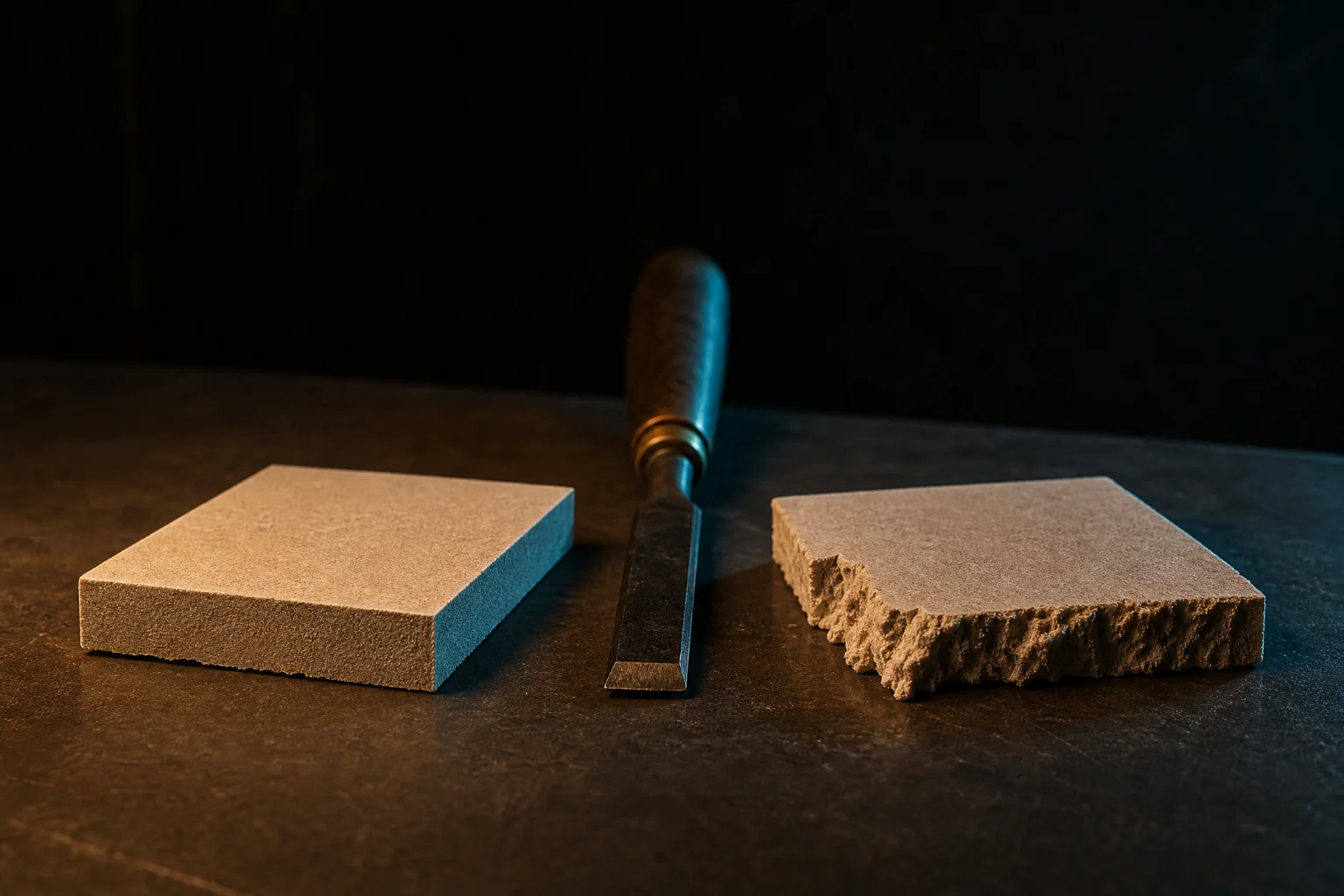
Fibres are the clearest collision point. A fibre that bridges a printed layer plane usefully resists interlayer separation, which is exactly what a printed wall needs 1. Under a chisel or rasp, that same fibre is a foreign object: it does not cut, it tears, dragging a ragged thread out of a surface a carver is trying to finish clean. A material asked to resist separating in one context and to separate cleanly and predictably in another is being asked two different things by two different tools, and stone-carving practice has never had to reconcile fibre reinforcement with a chisel edge, because natural stone does not contain any 23.
04
Where the pool goes quiet
This is the honest gap. Nothing in the federal research on printable concrete tests carvability as an outcome; pumpability, buildability, and structural bonding are the documented targets, not how the cured material responds to a hand tool 1. Nothing in the stone-fabrication literature and company documentation tests a printed mineral paste at all; it describes natural stone and how robots and hand tools now share the work of shaping it 23. No source in this pool sits at the intersection and reports a mix formulated for both flow-then-set printing behavior and fine, fibre-free, chisel-friendly carving behavior.
That silence is the finding, and the discipline this publication holds itself to is naming it rather than filling it. It would be easy to sketch a plausible-sounding answer, a leaner fibre dose here, a finer aggregate there, and dress it up as an insight. It would also be invention. No test result, ratio, or mix design appears anywhere in this article, because none exists in the sources this pillar is built on.
05
Why this is not just a marketing gap
Concrete printing is being evaluated for code acceptance right now, through programmes built specifically to assess new 3D-printing construction methods against performance criteria rather than prescriptive rule-of-thumb 4. That process is where a carvability claim would eventually have to be tested, if anyone made one: not as a demonstration video of a chisel meeting a printed panel, but as a documented, repeatable material performance claim reviewed against a stated criterion. As of this pillar's source pool, no such claim has been made or evaluated.
It matters that this gap gets named rather than smoothed over, because the two mixes are not close cousins that differ by a formulation tweak. A printing mix is defined by its behavior while it is still liquid enough to move. A carving mix is defined by its behavior once it is fully solid and never moves again. Engineering a single material to satisfy a moving-state specification and a static-state specification at once is a real, unsolved problem, not a rounding error.
06
What would actually settle it
Settling this would take a documented mix design, published test data comparing chisel and rasp response against a control of traditional carving stone, and ideally a code body's review of the results, the same evidentiary path any other structural or aesthetic performance claim in this field has to walk 4. Until that record exists, the honest posture is patience rather than a confident forecast in either direction.
For now, the working answer for anyone actually printing and later hand-finishing a mineral part is to expect two different materials for two different stages, a printed rough form and a separate carvable near-net blank, rather than one paste asked to be excellent at both jobs. That is not a failure of the allowance thesis; it is the thesis working correctly. The machine and the hand may simply need different material in front of them, not only different tools.
Working vocabulary
Glossary
- Pumpability
- A mineral mix's ability to move through hose and nozzle without segregating, clogging, or losing consistency.
- Thixotropy
- Behavior in which a material's resistance to flow drops under shear and recovers once shear stops, letting a printed bead stiffen quickly after deposition.
- Buildability
- A printed mix's capacity to hold a deposited shape under its own weight and the weight of layers printed on top of it.
- Interlayer bond
- The plane of contact between one printed layer and the next, typically the weakest point in a printed part.
- Fibre reinforcement
- Short fibres mixed into a paste to resist tension and bridge weak planes such as interlayer boundaries.
- Homogeneous matrix
- A material structure that is uniform throughout, without distinct reinforcing inclusions, sought for predictable carving response.
Source ledger
References and further study
Numbered citations point to the sources below. We favor standards, government laboratories, peer-reviewed research, and primary technical documentation. A link is evidence for the claim it supports—not an endorsement of every claim on that website. Read the full editorial and correction method.
- 3D Concrete Printed Construction Systems, Part 2U.S. Department of Housing and Urban Development · federal research report↗Opens in a new tab
- Industrial robot-based sawing method for natural stone sculptureJournal of Computational Design and Engineering · peer-reviewed research↗Opens in a new tab
- The Technology Behind Digital Stone FabricationQuarra Stone · company-reported information↗Opens in a new tab
- 3D printing programmeICC-ES · code evaluation body↗Opens in a new tab