
Mason's Notebook · Craft Notebook
From rough block to true surface
Pitching, pointing, clawing, and finishing: the staged logic of stone shaping, the tools that leave each mark, layout and templets, and how a face is proven true.
- Level
- Beginner
- Reading time
- 14 minutes
- Evidence
- standards-and-practice
- Reviewed
- 2026-08-09
Jump through this guide
The short version
Stone shaping is subtraction under discipline: heavy tools remove most of the block quickly, lighter tools chase accuracy, abrasives negotiate the last fraction, and a straightedge decides when the argument is over. This guide walks the classic sequence, pitching, pointing, clawing, boasting, and finishing, with the layout and checking habits that make it converge, then places hand work beside saws and CNC where modern shops put them. Historic tool finishes remain visible on buildings and are treated as significant fabric in published preservation guidance 1.
After reading, you can
- Order the shaping sequence from pitching to finish and explain what each stage removes
- Match common chisels and tools to the marks they leave
- Use datums, templets, and draft margins to keep a block true while material disappears
- Explain how hand finishing coexists with saws and CNC in modern stone shops
01
Subtraction in stages
The economics of shaping are simple: the heavier the tool, the cheaper the removal, and the rougher the surface it leaves. So the work descends a staircase. Pitch off large waste near the edges; drive a point across the face to a small allowance; tooth the surface flatter with a claw; refine with a boaster or a drag; only then spend abrasives on the last fraction. Skipping a stage does not save time, it moves cheap removal onto expensive tools, and masons learn the staircase early in formal apprenticeship training 2.
Each stage also manages risk differently. Pitching and pointing put energy into the stone and can find hidden vents and seams while there is still allowance left to absorb the discovery, which is precisely why they come first. Finishing strokes are shallow because by then a deep chip is unrecoverable. The rhythm, coarse then check then finer then check, mirrors machining practice on metal for the same reason: material only comes off; it never goes back on.
02
Tools and the marks they leave
The pitcher is a blunt-edged chisel that snaps waste off along a scribed line. The point concentrates force into a small tip and plows furrows; the punch is its stouter sibling for harder stone. The claw, or tooth chisel, bridges the furrows and levels them into a woven texture; the boaster, a wide flat chisel, sweeps claw marks into parallel facets; a drag, a toothed plate pulled across softer stone, erases direction entirely. Mallet-headed chisels take wooden or nylon mallets, hammer-headed chisels take steel lump hammers, and mixing them up wastes both.
Saws changed the arithmetic without changing the logic. A diamond blade or wire saw removes in minutes what pitching removes in hours, delivering a sawn six-sided block to the banker, and abrasive pads then run from coarse grits toward hone and polish. On soft limestones and sandstones, drags and rasps do fine work; granite demands carbide and patience. The marks matter beyond pride: historic buildings display tooled, boasted, and dragged finishes as designed surfaces, and preservation guidance treats reproducing them as part of an honest repair 1.
- Pitcher: snaps off waste, leaves a rock face
- Point and punch: fast furrowed removal
- Claw: levels furrows into a toothed texture
- Boaster: wide facets approaching flat
- Drag: directionless surface on softer stone
- Saws and abrasives: bulk removal and final polish
03
Layout, templets, and datums
Shaping is measurement wearing work gloves. Work starts by establishing one true face, checked with a straightedge and proven free of twist, then a second face square to the first; every later dimension is scribed from those datums. Templets cut from sheet zinc or plywood, and now sometimes printed in plastic, carry the profile of a moulding or arch stone from drawing to block, and sinkings and returns are squared from scribed lines rather than measured freehand. The habit generalizes: reference first, feature second, exactly as a machinist datums a casting.
Story rods and setting-out boards keep individual stones honest to the building: a voussoir is cut to its templet plus the joint, not to a number remembered from yesterday. Formal training sequences layout before heavy shaping for this reason, so apprentices learn to scribe before they learn to strike 2. Dry stone traditions run the same discipline with string lines and frames instead of templets, and certification assessments judge whether the finished wall honors those references 4.
04
Proving a surface true
A face is not flat because it feels flat; it is flat because it survives a test. Cut narrow draft margins around the perimeter and prove them with a straightedge; connect opposite margins and remove the island of high stone between them; set winding strips across the corners to reveal twist the eye misses. Wet the surface, light it from the side, and high spots gleam. The sequence, margins first, cross-checks second, middle last, converges because every pass shrinks the worst error instead of chasing local blemishes.
Checking is also when honesty is cheapest. A margin proven wrong at the second stage costs a few strokes; the same error found at polish costs the finish, and found at fixing costs a stone. Preservation practice extends the discipline to repairs, where new work is expected to sit true to adjacent historic surfaces rather than merely near them 1. The craft rule is old and slightly smug for good reason: measure twice, cut once, and let the straightedge win every argument.
05
Finish is a design decision
Finishes are not cosmetics; they set how a surface meets light, water, and time. A rock-faced pitched finish reads as mass and hides small damage. Batted and boasted finishes stripe the face with disciplined tool rhythm; dragged and rubbed surfaces carry fine detail; honed and polished faces show the stone's figure and record every future scratch. Exposure matters too, since coarse finishes weather gracefully while polish near ground traffic forgives nothing. Preservation guidance treats surviving tool marks as historic evidence worth reading closely before anything is recut 1.
Conservation science adds a caution: aggressive refinishing removes the weathered surface layer that sometimes protects stone, and it erases evidence future workers would need. Institutions such as the Getty Conservation Institute study historic surfaces and the consequences of treatments for exactly this reason 3. On new work the mason chooses the finish freely; on old work the building chooses, and the mason's skill lies in reproducing a finish convincingly enough that only the discreet date mark gives the repair away.
06
Hand beside machine
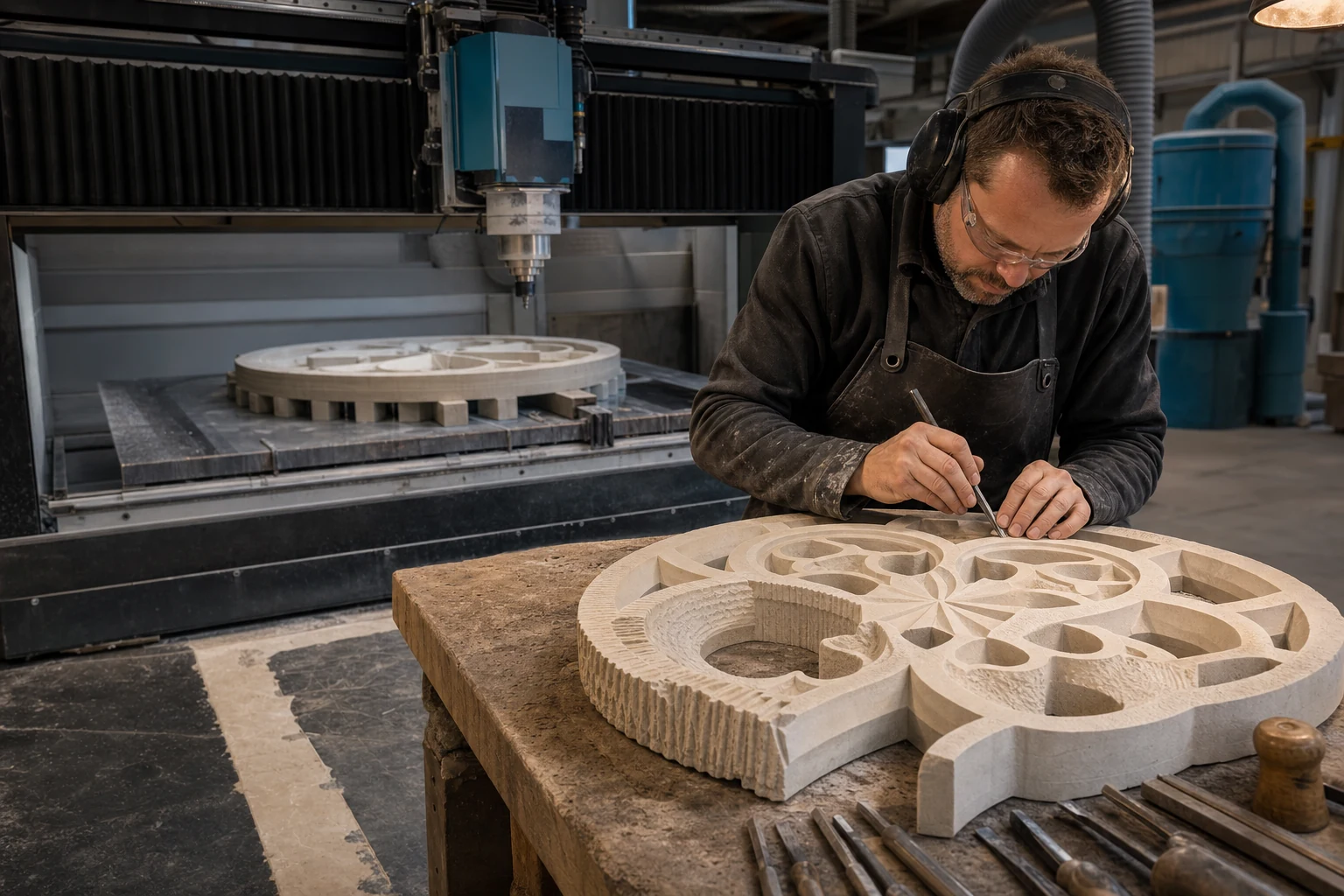
Modern shops split the staircase between motors and hands. Saws and CNC machines remove bulk and cut repeatable profiles; hands take over for arrises, undercuts, corrections, and every surface the cutter cannot reach or the clamp cannot hold. The split follows tolerance and consequence rather than sentiment, machine time being bought by the hour and judgment by the decade, and structured training now walks apprentices between the saw shed and the banker as a matter of course 2.
The hand skills survive because they are the acceptance layer. A certified waller passing a Stone Trust assessment 4 and a banker mason proving a moulding against its templet are doing the same thing: demonstrating that reference, removal, and judgment converged. A later article in this collection follows the digital half of the partnership, scanning, stereotomy, and robotic carving, but every one of those tools ends its day the old way, under a straightedge held by someone who knows what flat means.
- Machines take bulk, repetition, and sawn datum faces
- Hands keep arrises, undercuts, and final surfaces
- Tolerance and consequence decide the split
- Templets and straightedges remain the acceptance test
- Training now covers both sides of the shop
Working vocabulary
Glossary
- Banker
- The bench or stand a stone rests on while being worked.
- Templet
- A rigid profile pattern used to transfer a moulding or joint shape onto stone.
- Pitching
- Snapping waste stone off along a scribed line with a blunt-edged pitcher.
- Claw chisel
- A toothed chisel that levels pointed furrows into an even textured surface.
- Boaster
- A wide flat chisel used to refine a surface into parallel facets.
- Draft margin
- A narrow dressed border cut true around a face as the reference for flattening it.
- Winding strips
- Paired straight bars sighted across a surface to reveal twist.
- Voussoir
- A wedge-shaped arch stone cut to a templet so the ring closes correctly.
Source ledger
References and further study
Numbered citations point to the sources below. We favor standards, government laboratories, peer-reviewed research, and primary technical documentation. A link is evidence for the claim it supports—not an endorsement of every claim on that website. Read the full editorial and correction method.
- Preservation BriefsU.S. National Park Service · government preservation guidance↗Opens in a new tab
- Apprenticeship.govU.S. Department of Labor · government workforce program↗Opens in a new tab
- Getty Conservation InstituteJ. Paul Getty Trust · conservation research institute↗Opens in a new tab
- The Stone TrustThe Stone Trust · craft education organization↗Opens in a new tab