
The Commons · Product Story
The PrintMason Commons: files become conversations
The staged plan for a file community built on honest foundations: standard packaging, explicit licenses, and moderation before any social feature exists.
- Level
- Beginner
- Reading time
- 13 minutes
- Evidence
- editorial-plan
- Reviewed
- 2026-08-09
Jump through this guide
The short version
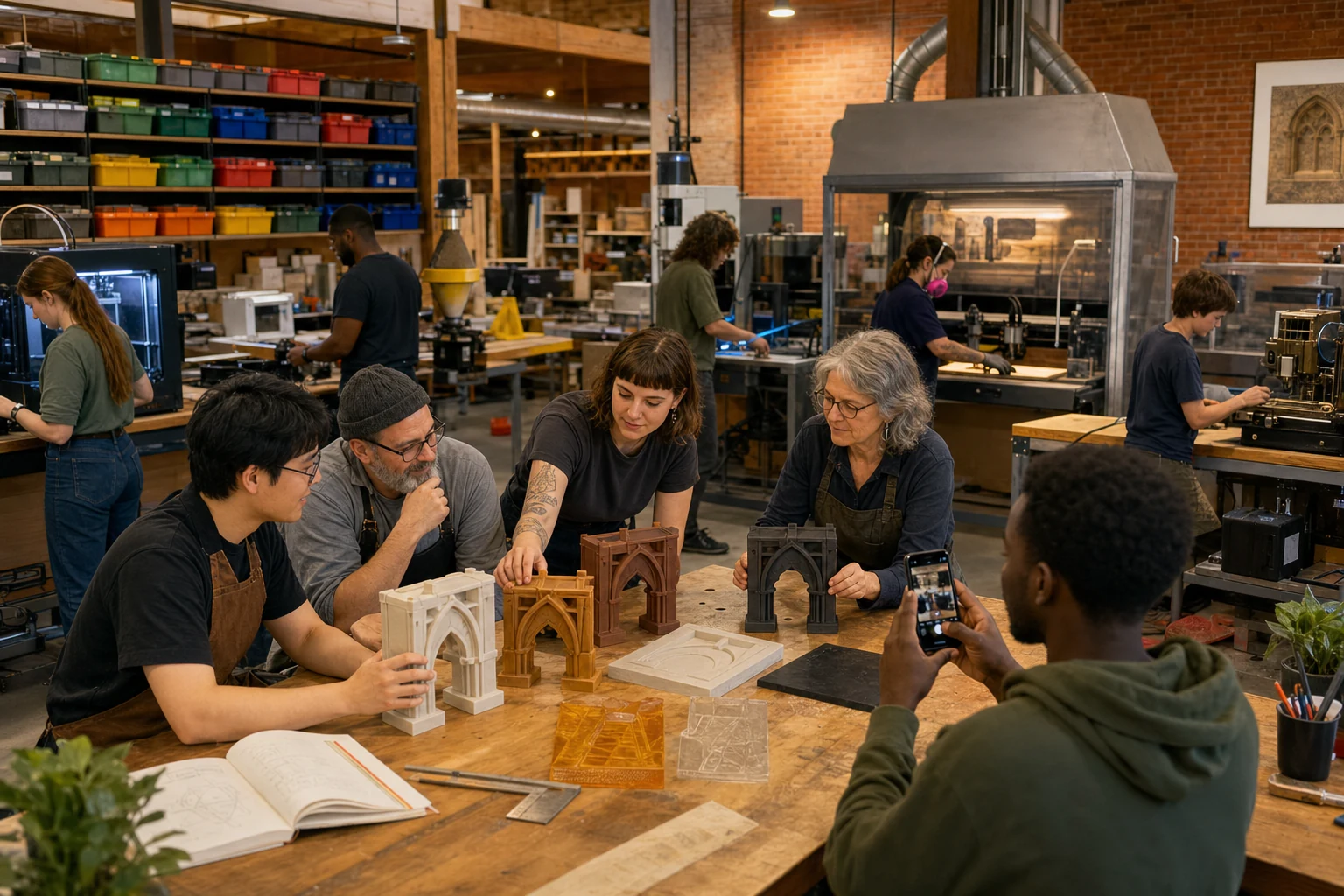
Most making communities are built around files, and the interesting part of a file's life begins after publication: someone prints it, changes it, improves it, and reports back. The PrintMason Commons is this publication's staged plan for hosting that life honestly. Today the Model Lab publishes reference files read-only, and conversation happens on social platforms and by email. The plan's foundation is deliberately boring: standard packaging, explicit licenses, and working operations before any social feature. The packaging layer already exists as an industry standard, the 3MF specification suite 1.
After reading, you can
- Describe the model, version, remix, make, and reaction stages a shared file can move through
- Explain why moderation, file safety, and rights operations must precede social features
- Choose and state a license so a shared design can actually be reused
- Participate in the Commons today using the channels that really exist
01
A file is a conversation waiting to happen
A published model file is a proposal: print me, and tell me what happened. Everything a making community does well grows from that exchange. The designer learns which overhang failed on other machines; the printer learns why the wall is exactly this thick; the third person, arriving a year later, inherits both lessons if, and only if, someone recorded them next to the file. The Commons plan treats that record as the product. The file is the seed; the documented conversation around it is the value.
Packaging determines how much of the conversation the file itself can carry. The 3MF specification suite defines a container that holds geometry with declared units alongside materials, properties, and production metadata, and its specifications are published royalty-free and now recognized as an international standard 1. A format that carries its own facts removes a whole class of guessing. What the format cannot carry, license intent, test history, honest failure notes, is exactly what a model page and a community layer must add.
02
The staged data model
The plan's spine is five stages. A model is the published design with its page of stated facts. A version is a numbered revision of that model, with what changed and why. A remix is a new model that declares its parent, inheriting a lineage rather than hiding one. Together those three form the authorship layer: who made what, from what, and when. None of this requires social machinery; it requires discipline and a naming scheme, which is why it comes first.
The last two stages are the community layer. A make is evidence that someone produced the thing, with process, material, settings, and outcome, failures welcome. A reaction is the lightweight response that tells a designer the work mattered. Today, plainly: these are editorial concepts, not site features. Makes and reactions happen on Instagram and X with the #PrintMasonChallenge tag, or by email, exactly like the weekly challenges. The staged plan describes the order in which that may change, not a date.
- Model: the published design plus its stated facts
- Version: a numbered revision with reasons
- Remix: a new model that names its parent
- Make: documented evidence of a real build
- Reaction: a lightweight response to any of the above
03
Why read-only comes first
Accepting uploads from strangers is an operations problem long before it is a software feature. Files must be quarantined and scanned before anyone downloads them. Geometry must be checked against what its page claims. Rights must be handled: a working notice-and-takedown process, a policy for repeat infringers, and a way to verify that a license was the uploader's to grant. Comments need moderation that actually happens. Each of these is a standing duty that exists every day the feature exists, staffed or automated, and unglamorous either way.
So the Model Lab is read-only, and social writes arrive only after those operations demonstrably work. No launch dates are promised here, deliberately: a date would be invented, and invented dates are the first lie a product tells. Slow is not a defect in this plan. A community whose first uploaded file is malware, or whose first remix chain is a stolen design, spends years repaying a week of haste. The publication would rather be late than untrustworthy, and this ordering is that preference written down.
04
Licenses are the social contract
Remixing is only generous if it is permitted, and permission lives in licenses. Creative Commons publishes a small family of standardized public licenses spanning a spectrum from attribution-only reuse to more restrictive terms, each in machine-readable, human-readable, and lawyer-readable layers 2. The mechanics of the most permissive attribution license are simple: others may share and adapt the work, including commercially, provided credit is given and changes are indicated 3. One clearly stated license does more for a design's future than any amount of enthusiasm.
License diversity is real and worth respecting rather than flattening. Some makers bring the software tradition of copyleft, using licenses like the GNU General Public License, which requires derivative works to remain under the same terms 4. Mixing incompatible licenses along a remix chain is where goodwill goes to die, so the Commons plan treats the license as a required, prominent field on every model page, and remix lineage as the record that keeps obligations traceable. The rule of thumb is unromantic: state your terms, honor your parents' terms, and never assume.
05
What you can do today
Participation is already open; it just runs on existing rails. Post your builds, remixes, and documented failures publicly on Instagram or X, tag @print.mason or @printmasons with the hashtag #PrintMasonChallenge, or email photos and notes to right.just.right@gmail.com. Practice the data model manually: version your own files, name your remix parents, write a settings card with every make. The community keystone challenge is the first live experiment in exactly this discipline, run entirely on those channels. Makers who document this way now will lose nothing if the plan's later stages never ship, and gain a working archive either way.
What the publication does with your participation is equally plain. Emailed entries are read; nothing is quoted unless you have said quoting is welcome. Public tagged posts stay on your platforms, under your control, and no follower counts or engagement numbers will be recited back as if they were achievements. The Commons will be judged by whether files become honest conversations, and that judgment can wait until there is something real to judge. Until then: make things, state your terms, and show your work.
- Post publicly and tag @print.mason or @printmasons, hashtag #PrintMasonChallenge
- Or email photos and notes to right.just.right@gmail.com
- Version your files and name remix parents now, by habit
- State a license on anything you share
- Tell us if quoting your notes is welcome; nothing is assumed
Working vocabulary
Glossary
- Model page
- The published page of stated facts accompanying a design file: license, units, settings, status, and lineage.
- Version
- A numbered revision of a model, recorded with what changed and why.
- Remix
- A new model that declares the existing model it derives from.
- Make
- Documented evidence that someone actually produced a design: process, material, settings, and outcome.
- Reaction
- A lightweight response signaling that a model, remix, or make was seen and valued.
- Quarantine
- Holding uploaded files away from the public until safety and rights checks complete.
- Notice-and-takedown
- An operational process for receiving infringement claims and removing material while disputes resolve.
Source ledger
References and further study
Numbered citations point to the sources below. We favor standards, government laboratories, peer-reviewed research, and primary technical documentation. A link is evidence for the claim it supports—not an endorsement of every claim on that website. Read the full editorial and correction method.
- 3MF Specifications3MF Consortium · industry consortium specification↗Opens in a new tab
- About CC LicensesCreative Commons · license overview↗Opens in a new tab
- Attribution 4.0 International (CC BY 4.0)Creative Commons · license text↗Opens in a new tab
- GNU General Public License, version 3Free Software Foundation · license text↗Opens in a new tab