
The Commons · Field Guide
A good model page tells the truth
The anatomy of an honest model page: license, versions, units and orientation, settings, hazards, a test-status ladder, and remix lineage that keeps attribution working.
- Level
- Beginner
- Reading time
- 13 minutes
- Evidence
- standards-and-practice
- Reviewed
- 2026-08-09
Jump through this guide
The short version
A model page is the difference between a file and a usable design. The mesh carries shape; nearly everything else, units, orientation, license, settings, hazards, and how far anyone has actually tested the thing, must be stated, or every downloader re-derives it badly and some derive it dangerously. File formats can carry part of the truth: a 3MF package declares its units and can bundle materials and properties with the geometry, which is exactly the kind of ambiguity-killing a good model page extends to everything the format cannot say 1.
After reading, you can
- List the fields an honest model page states before any beauty shot
- Declare license, units, orientation, and settings so reuse works without guessing
- Place a design honestly on a five-rung test-status ladder
- Record remix lineage so attribution and license obligations stay traceable
01
A truth document, not a sales page
Most model pages are written as advertisements: renders at flattering angles, adjectives where numbers should be, and silence about everything that went wrong. The reader who suffers is always the same person, the maker three time zones away deciding whether to spend four hours of machine time on your file. A model page exists for that person. It states what the thing is, what it is for, what it needs, what it has survived, and what remains unknown. A page that cannot admit its part warps is advertising, not documentation.
The habit scales down from industry. Manufacturing keeps a traceable record connecting design intent to process to measured outcome, and the hobby equivalent is simply a page that records the same chain in plain language. None of it requires special tooling, only the willingness to write down what you actually know, separately from what you hope. The sections below are the fields that do the work, roughly in the order a careful stranger will look for them.
02
State the license, or reuse dies
An unlicensed file is a legal shrug: nobody can safely remix, redistribute, or improve it, so its future is limited to being downloaded and forgotten. Creative Commons maintains a small family of standardized public licenses covering the spectrum from attribution-only to more restrictive terms, each published in human-readable and legal versions, which makes stating your intent a one-line act 2. The most common choice for shared designs, Attribution 4.0, lets others share and adapt the work, commercially included, provided they credit the creator and indicate changes 3.
Some designers prefer copyleft terms instead, such as the GNU General Public License, under which derivatives must carry the same license forward 4. The choice is yours; the obligation is only clarity. Name the exact license and version, show it near the download rather than in a footnote, and keep it consistent across your file versions, because a design whose revision three is licensed differently from revision two is a puzzle no downstream maker deserves. If you want attribution phrased a certain way, write out the exact credit line you want.
- Exact license name and version, visible near the download
- The credit line you want, written out
- Commercial use: allowed or not, stated plainly
- Remix expectations: what derivatives must carry forward
- Where the canonical, most current file lives
03
Geometry facts: units, scale, orientation
A bare mesh has no inherent size: the same numbers describe a 60 millimeter keystone and a 60 inch one, and legacy mesh files leave the guess to the slicer. The 3MF core specification addresses this class of ambiguity by declaring the model's unit inside the package itself 1. Whatever format you publish, the page should still state units, overall bounding dimensions, and the intended real-world size, because a stranger's import dialog is the wrong place for your design intent to be decided.
Orientation is the second silent fact. State which face is meant to sit on the build plate, whether supports are expected and where, and which dimensions are critical. If the design includes fitted interfaces, say what clearance is already modeled in, since a maker who does not know the 0.2 millimeter gap is deliberate will helpfully scale it away. Sliced-in-place assumptions, part splits, and any keyed features deserve a sentence each. Geometry facts are cheap to write and expensive for every single downloader to rediscover.
- Units and bounding dimensions, stated on the page
- Intended print orientation and expected support regions
- Critical dimensions that must survive printing
- Modeled-in clearances, so nobody rescales them away
- Splits, keys, and assembly relationships between files
04
Name the process and settings honestly
Say what the design was made for, using the standard vocabulary so the words mean the same thing on every machine: the process families and their terms are defined in ISO/ASTM 52900 5. A vase designed for material extrusion in spiral mode is a different object from the same silhouette meant for vat photopolymerization, and the page should say which was intended, what it was actually proven on, and, just as usefully, what it has never been tried on. Untested is not a flaw; unstated is.
Then give the settings card: material by generic class, brand optional; layer height; wall or perimeter count; infill; temperatures if extrusion; exposure basics if resin; any post-processing the result depends on. The card describes your successful build, not a universal law, so label it that way. One honest sentence about failure modes, where it warped, which overhang needed help, what the first attempt taught, is routinely the most valuable line on the page. Measurement, provenance, and failure are normal parts of craft; a good page treats all three as content.
05
The test-status ladder
The single most honest field a model page can carry is how far the design has actually been proven. A five-rung ladder covers it. Concept: modeled, never sliced. Slicer-checked: sliced without errors, preview reviewed, never printed. Test-printed: built at least once by the author, with photos of the real part. Community-tested: independently built by others, with their processes and results recorded. Rights-reviewed: lineage and license checked, so the page's legal claims are as examined as its geometry.
State the rung plainly and let the evidence match: a concept page shows renders and says so; a test-printed page shows the physical object, warts included, not just the render at a kinder angle. Rungs are not grades, and a well-documented concept outranks a vague claim of tested any day. What poisons a commons is not unproven work but unproven work dressed as proven. Climbing happens naturally as others build the design, provided the page makes reporting back feel welcome rather than like an audit.
06
Hazards, limits, and lineage
Every honest page states what the object must not be trusted to do. Printed hobby parts default to decorative: not food-contact, not structural, not load-bearing hardware, not child-safe if small parts can detach, not heat-tolerant beyond the material's ordinary limits. If the design involves electronics, say LED-and-battery only and mean it. These lines cost two sentences and spare someone an emergency; a page author who finds them embarrassing is confusing seriousness with weakness. Materials and processes carry their own hazards, and pointing at them is part of the documentation.
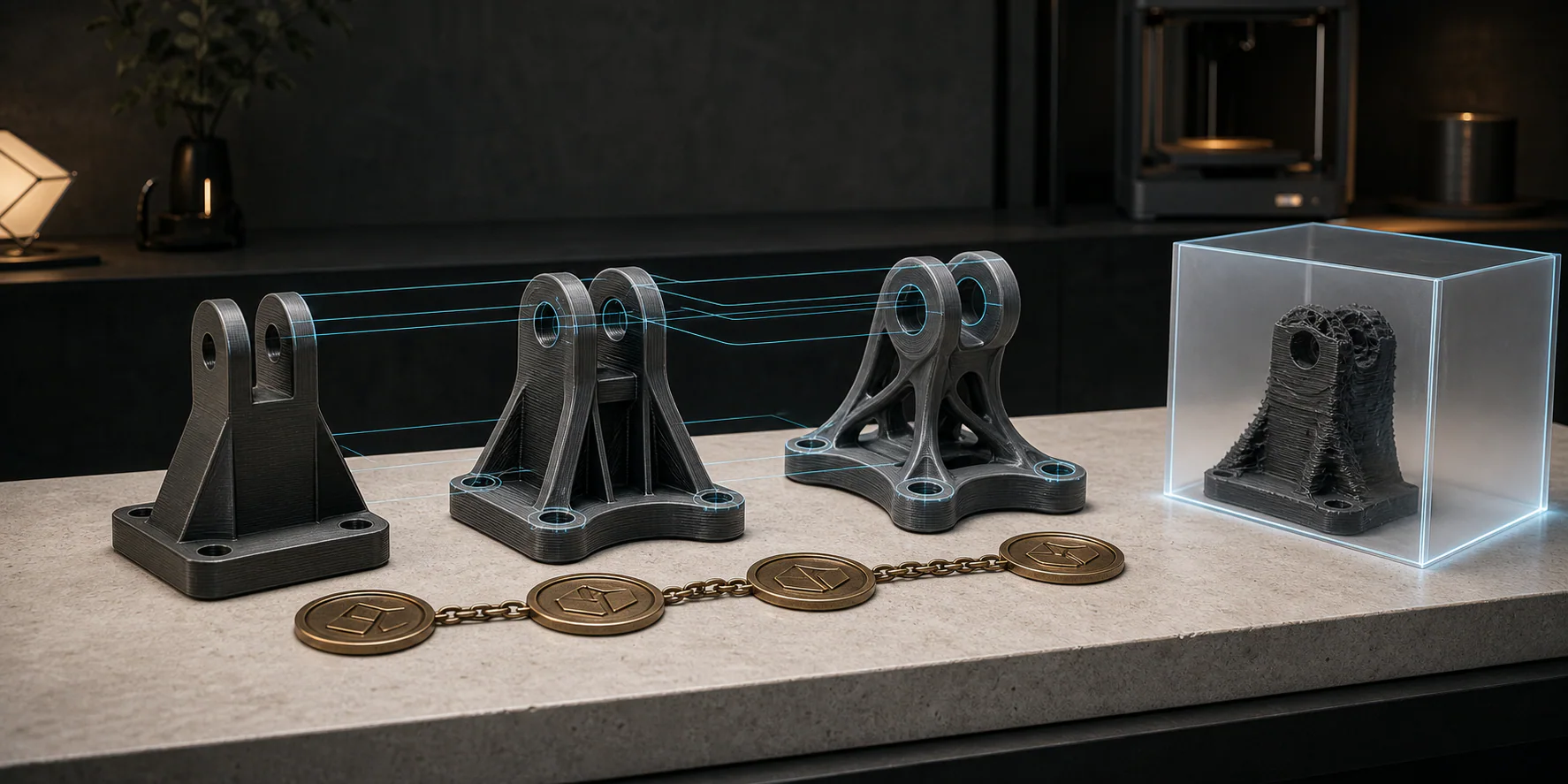
Finally, lineage. If the design remixes another, name the parent, link it, state the parent's license, and confirm yours is compatible with it; attribution obligations under licenses like CC BY exist precisely so credit survives the chain 3. List what changed, so the parent's test history is not silently inherited by geometry it never covered. A remix chain where every page names its parent is a commons; a chain of unattributed copies is just entropy with enthusiasm. Truth on a model page, like everything else in this craft, is mostly the habit of writing things down.
Working vocabulary
Glossary
- Model page
- The published document of stated facts accompanying a design file: license, geometry facts, settings, status, hazards, and lineage.
- Unit declaration
- The statement, ideally inside the file format itself, of which measurement unit the model's numbers describe.
- Settings card
- The recorded parameters of a successful build: material class, layer height, walls, infill, temperatures, and post-processing.
- Test status
- An honest declaration of how far a design has been proven: concept, slicer-checked, test-printed, community-tested, or rights-reviewed.
- Remix lineage
- The recorded chain of parent designs behind a derivative, with licenses and changes at each step.
- Copyleft
- License terms requiring derivative works to carry the same license forward, as in the GNU GPL.
- Attribution
- The credit a license requires reusers to give, ideally specified by the creator as an exact line.
Source ledger
References and further study
Numbered citations point to the sources below. We favor standards, government laboratories, peer-reviewed research, and primary technical documentation. A link is evidence for the claim it supports—not an endorsement of every claim on that website. Read the full editorial and correction method.
- 3MF Core Specification (version 1.3.0)3MF Consortium · industry consortium specification↗Opens in a new tab
- About CC LicensesCreative Commons · license overview↗Opens in a new tab
- Attribution 4.0 International (CC BY 4.0)Creative Commons · license text↗Opens in a new tab
- GNU General Public License, version 3Free Software Foundation · license text↗Opens in a new tab
- ISO/ASTM 52900:2021 - Additive manufacturing - General principles - Fundamentals and vocabularyInternational Organization for Standardization · international standard↗Opens in a new tab