
The Commons · Community Challenge
The community keystone challenge
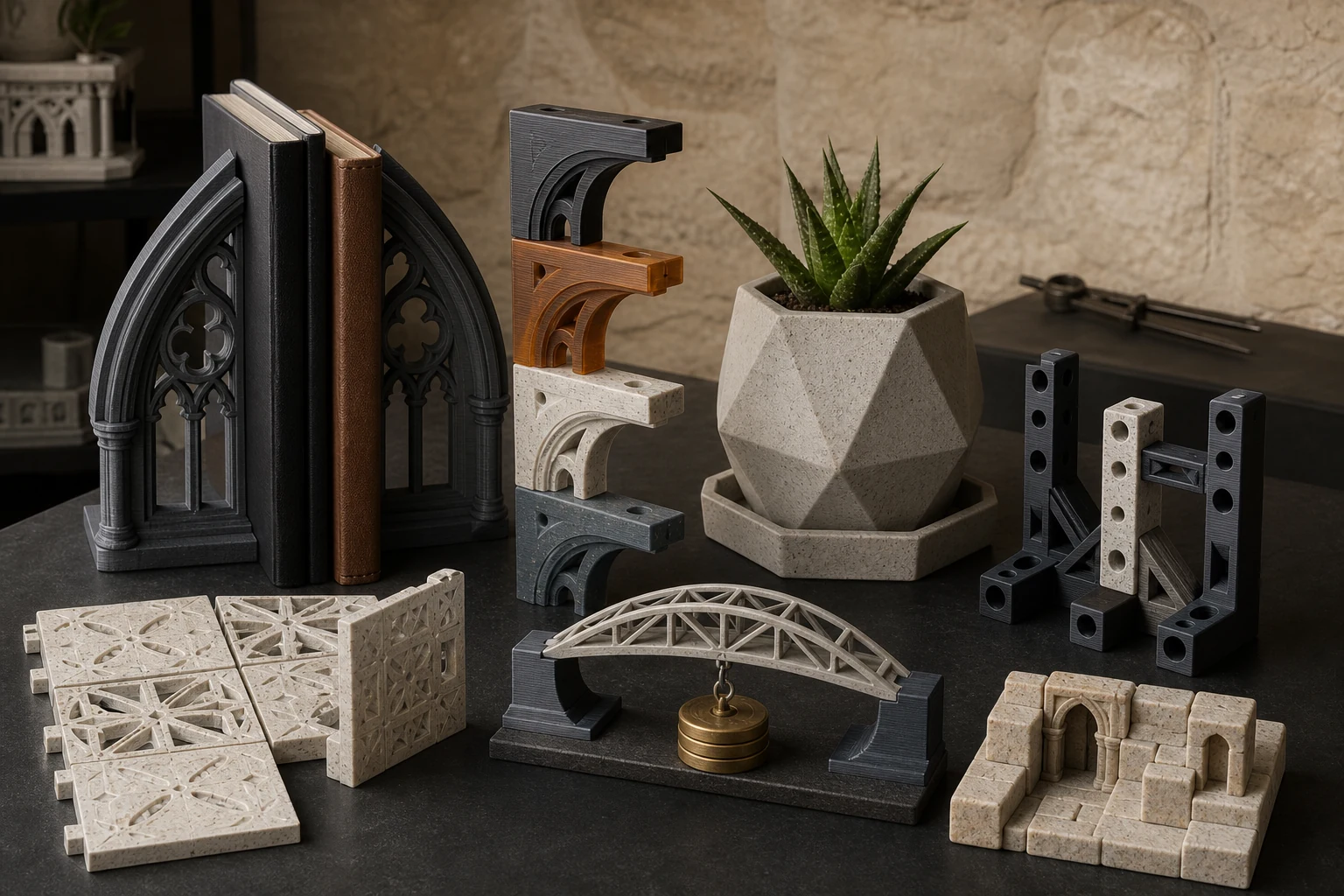
Design an original keystone-shaped desk object with a standard interface so remixes can stack or interlock. Document your lineage and license honestly.
- Level
- Beginner
- Reading time
- 7 minutes
- Evidence
- community-brief
- Reviewed
- 2026-08-09
Jump through this guide
The short version
A keystone earns its name by locking a whole arch together at its center, and this challenge borrows the idea for a small desk object: design an original keystone-shaped piece with a standard interface, so that anyone's remix can physically stack or interlock with anyone else's. A written concept brief describes the interface; a reference file exploring one interpretation is separately viewable in the Model Lab, but neither the file nor an account is required to take part 1. What matters is the interface, the honest lineage notes, and a clearly stated license 2.
After reading, you can
- Design an original object around a fixed, reusable physical interface
- Document a remix lineage honestly, including when a piece is built from scratch
- Choose and state a license appropriate to a piece meant to be remixed
- Understand how standard vocabulary and file practices support a shared, growing set of variations
01
Why this challenge
A keystone is a single wedge-shaped block that lets an entire arch stand without mortar, purely through geometry and compression. As a community exercise, the idea translates well: fix one shared interface, a stacking lip, a dowel pattern, a consistent bolt spacing, and let every maker's own keystone interpretation lock onto everyone else's. The result, over time, is not one object but a growing, interlocking set of them, each traceable back to whoever designed it and under what terms.
The exercise doubles as practice in the habits the Commons is built around: naming your lineage plainly and licensing your work clearly, using vocabulary the field already shares 3 rather than inventing loose new terms for old ideas. A written concept brief is enough to start from; a reference interpretation of that brief is also viewable, read-only, in the Model Lab for anyone who wants a starting silhouette rather than a blank page 1.
02
The brief
Design an original keystone-shaped desk object, a bookend, a paperweight, a small sculptural piece, built around a standard interface of your choosing: a defined stacking lip, a consistent dowel-hole pattern, a fixed bolt spacing, or a similar simple, repeatable feature that lets a second maker's piece physically stack or interlock with yours. State your interface's exact dimensions in your notes so someone else can design to match it without guessing.
You may start from the written spec above with nothing else, sketch and print entirely your own interpretation, or begin from the reference concept file viewable in the Model Lab and remix it, crediting it as your starting point if you do 1. Either path is equally valid; what matters is that your notes state plainly which one you took. Package your file sensibly, current practice favors formats like 3MF that can carry more build and metadata than older formats 4, though any common format is accepted.
- Original keystone-shaped object with a stated, repeatable interface
- Interface dimensions documented so others can design to match
- Lineage stated honestly: from scratch, from the written spec, or remixed from the reference file
- Clear license stated on anything shared
- A metadata-capable format such as 3MF is preferred but not required
03
Safety and rights boundaries
Original design applies as everywhere in the Commons: no trademarked characters, logos, or scanned commercial parts folded into your keystone. If you remix the reference concept file or another maker's posted keystone, name it explicitly in your notes rather than presenting a derivative as entirely your own; lineage is the whole point of a remix challenge, and hiding it defeats the exercise. This is a desk object, not a structural component; do not present a printed keystone as load-bearing or building-code relevant.
License your work plainly using established terms rather than inventing your own rules. The Creative Commons suite offers a documented range of permission levels, from attribution-only to more restrictive share-alike or non-commercial terms 2, and Attribution 4.0 specifically requires only credit back to the original creator 5; state which one applies to your file the moment you share it, so remixers know exactly where they stand.
04
How to participate
Post your keystone publicly on Instagram or X and tag @print.mason or @printmasons with the hashtag #PrintMasonChallenge, or email a print reaction photo, your lineage notes, and your stated license to right.just.right@gmail.com. There are no on-site accounts, uploads, or comments beyond the read-only reference file in the Model Lab; participation happens entirely on your own platforms or by email, gathered by the shared hashtag.
There is no deadline and no prize, and the challenge is meant to compound over time: post a second keystone that interlocks with your first, or with someone else's, and note the lineage each time you do. A reaction photo, your finished piece next to your notes on interface dimensions and license, tells the story of the challenge far better than the object photographed alone ever could.
05
What a strong entry shows
A strong entry states its interface dimensions clearly enough that a stranger could design a matching piece without asking a follow-up question. Its lineage notes are specific and honest, naming the written spec, the reference file, or a from-scratch design without hedging, and its license is stated once, plainly, rather than implied. The keystone form itself can be as playful or as restrained as the maker likes; the interface discipline is what makes it a community object rather than a one-off.
The quiet test is whether a second maker actually could interlock with it, sight unseen, using only your written notes. An interface documented precisely enough to be reproduced, paired with an honestly stated lineage and a plainly stated license, is what turns an individual keystone into part of a shared, growing set, which is the entire premise of a remix challenge done right.
Working vocabulary
Glossary
- Keystone
- The central wedge-shaped block of an arch that locks the surrounding stones together through geometry and compression.
- Standard interface
- A fixed, documented physical feature, such as a stacking lip or dowel pattern, that lets separate designs connect or stack consistently.
- Remix lineage
- The documented chain of who designed, modified, or built upon a file or object, and in what order.
- Model Lab
- A read-only reference file area where a concept brief or example file can be viewed; no accounts or uploads exist there.
- 3MF
- A 3D file format built to carry richer build, material, and metadata than older mesh-only formats such as STL.
Source ledger
References and further study
Numbered citations point to the sources below. We favor standards, government laboratories, peer-reviewed research, and primary technical documentation. A link is evidence for the claim it supports—not an endorsement of every claim on that website. Read the full editorial and correction method.
- 3MF Specifications3MF Consortium · file format specification↗Opens in a new tab
- License your workCreative Commons · license text↗Opens in a new tab
- ISO/ASTM 52900:2021 - Additive manufacturing - General principles - Fundamentals and vocabularyInternational Organization for Standardization · international standard↗Opens in a new tab
- 3MF Core Specification3MF Consortium · file format specification↗Opens in a new tab
- Attribution 4.0 International (CC BY 4.0)Creative Commons · license text↗Opens in a new tab