
Future Foundry · Future Sketch
Mobile, swarm, and in-situ printers
Printers that travel to the work: site robots, swarm concepts, earth and regolith feedstocks, and the coordination, power, and QA problems that decide them.
- Level
- Intermediate
- Reading time
- 14 minutes
- Evidence
- research-and-concept
- Reviewed
- 2026-08-09
Jump through this guide
The short version
Most printers stand still while the part takes shape inside a fixed frame. A different research direction sends the machine to the site and asks it to use what it finds there. On Earth that means robots that deposit local soil; off Earth it means construction from lunar regolith, a feedstock NASA has patented technology to process for building 1. The promise is shipping information instead of material. The constraints — coordination, power, and feedstock quality — are the real story.
After reading, you can
- Explain why remote construction favors local feedstock over shipped material
- Describe current mobile and in-situ demonstrations and who reports them
- Distinguish patents, awards, and company reports from built capability
- List the coordination, power, and quality-assurance constraints on swarm concepts
01
Why move the printer at all
Every remote construction project fights the same arithmetic: moving material costs more than moving information. For a lunar site the arithmetic is absolute — every shipped kilogram is priced launch by launch — which is why NASA's technology-transfer catalog includes patented technology for turning regolith, the loose rock and dust already on site, into construction feedstock 1. Process what the site provides and the cargo manifest shrinks to machines, binders, and spare parts. The printer stops being a factory fixture and becomes the expedition's mason.
On Earth the same logic applies at lower stakes. Soil is everywhere buildings are wanted, and an earth-printing system that uses excavated site material shortens the supply chain to meters. WASP, an Italian printer manufacturer, reports that its TECLA prototype habitat was printed from local raw earth using its crane-style printer system 4 — a company-reported demonstration, and a real one to reckon with. The claims in this article stay sorted: patents, awards, university news, and company pages each prove different things.
02
Machines that already move
The machines that already move fall on a spectrum. Fixed gantries build within their frame. Crane and cable systems extend reach while staying anchored. Fully mobile bases promise an unbounded envelope and inherit a hard problem: the machine must know where it is, precisely, without rails to tell it. WASP's reported earth prints sit near the anchored end of that spectrum 4; most of the mobile end still lives in laboratories and papers, which is not a criticism — it is a location.
ETH Zurich reported a different escape from the nozzle in 2024: a robotic method its researchers call impact printing, in which material is shot at speed and bonds on arrival rather than being laid in slow beads 3. The university describes it as fast and suited to low-cement earth materials — research claims, from a research group, at research scale. It also reframes the design space: deposition does not require touching the wall at all. Distance, it turns out, can be a feature.
- Fixed gantry: envelope limited by the frame
- Crane or cable systems: larger reach, careful staging
- Mobile bases: envelope grows, positioning burden grows
- Impact methods: material flies, machine stands back
- All remain demonstrations or single prototypes
03
Swarms on paper, teams in practice
The swarm is the concept everyone sketches: many small agents building one large structure, redundant by number, scalable beyond any single machine's envelope. The built record is more modest — coordinated units working as a small team on one print, as in company-reported earth construction 4 — and the gap between sketch and record is instructive. Parallelism in construction is not free. Every agent added multiplies the questions of who builds what, where, and when, and wet material does not wait politely while robots negotiate.
Name the open problems plainly. A shared coordinate frame without rails, outdoors, in dust or glare. Collision avoidance between agents carrying wet material. Task reallocation when one agent fails mid-wall. And the material itself: beads placed by different machines at different times must still fuse, or the structure inherits a lattice of cold joints. None of these is unsolvable; all of them are unsolved at building scale, and honest coverage keeps the tense right — future conditional, not present.
04
Off-world: regolith and the ICON award
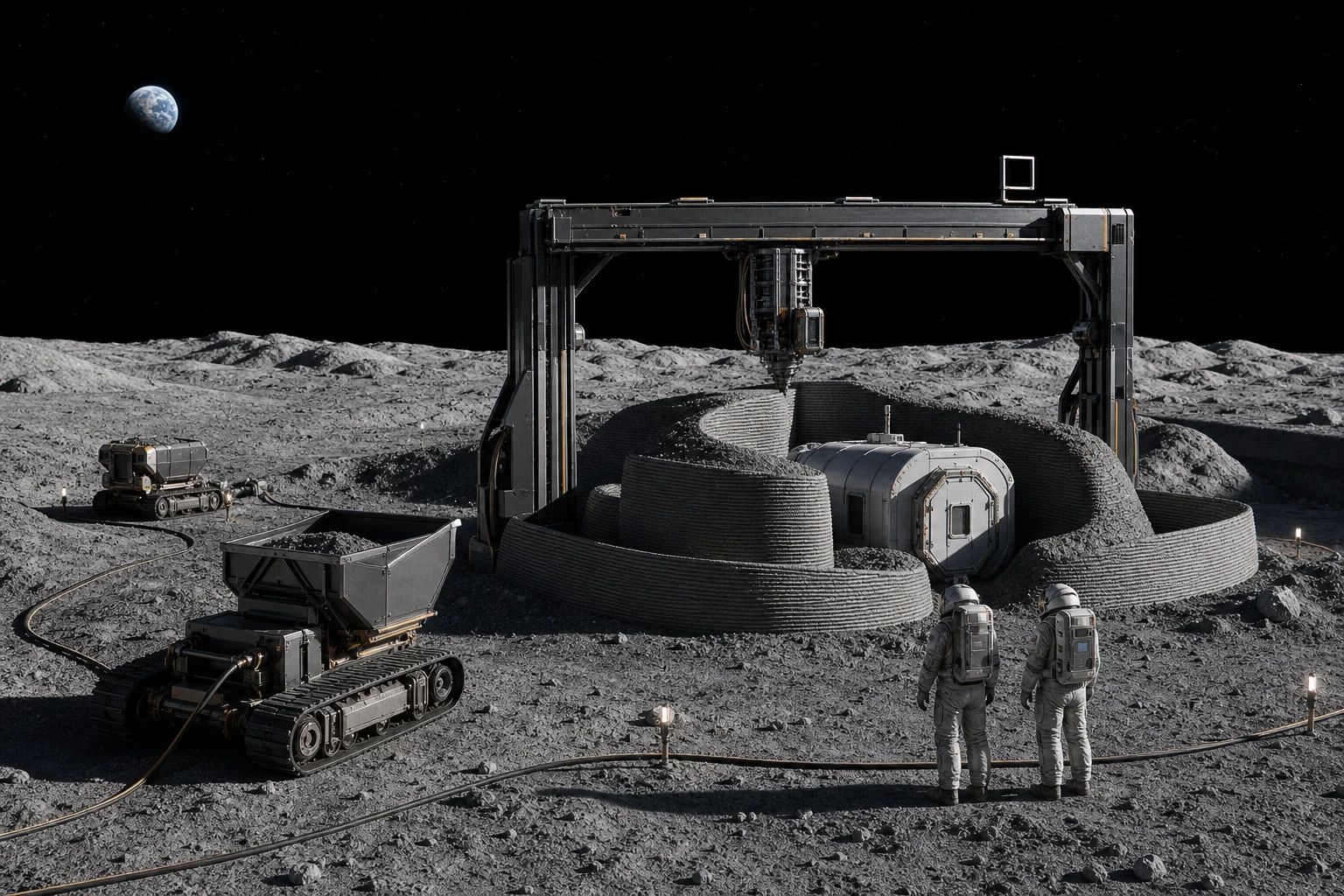
Off-world, in-situ construction stops being an efficiency and becomes the whole plan. NASA's patented regolith-based construction technology addresses the feedstock half of the problem 1; the machine half is under contract. ICON, the Texas construction-printing company, reports a $57.2 million NASA award to develop a lunar surface construction system 2. Read that sentence as an evidence exercise: the figure and the goal come from the company's own newsroom, and an award marks the beginning of development, not the existence of a lunar printer.
The lunar constraint list explains the caution. Vacuum removes convection and changes how heat leaves fresh material. Regolith is abrasive and clings; thermal swings between light and shadow are enormous; power is whatever the site generates; and every command may travel with seconds of delay, so autonomy is not optional. Each constraint is tractable on paper. The engineering program that closes them, with hardware, in place, is precisely what the award funds and what does not yet exist 2.
05
Feedstock QA without a lab
Feedstock quality assurance is the least glamorous constraint and probably the decisive one. A factory printer eats certified spools; a site printer eats whatever the site provides, and soil changes pit to pit, sometimes shovel to shovel. Moisture, particle gradation, and binder dosing all drift, and the reported earth demonstrations depend on mixes tuned to their specific site 4, just as impact printing depends on engineered material behavior at the moment of arrival 3. The machine must carry its quality lab with it, or build blind.
Power and pace complete the ledger. A mobile machine budgets every watt — pumps, motion, sensing, sometimes heating — against cable, battery, or sun. Deposition speed must respect the material's own clock: earth dries, binders cure, and each layer must carry the next pass. Certification is an open question we label as such: no pathway yet exists for approving structure printed from field-qualified soil by a moving machine. What is imagined — machines that test as they build, qualifying material in real time — remains imagined.
- Incoming material varies by the shovel-load
- Moisture and binder dosing drift in the field
- Bead geometry is the first in-process signal
- Power arrives by cable, battery, or sun — all budgeted
- Certification of site-made material is an open question
06
How to read the next site-robot claim
Apply a fixed checklist to the next site-robot story, starting with the venue. A company newsroom documents the company's account 24; a university release documents a result as the university tells it 3; an agency catalog documents that an invention was filed, examined, and granted 1. Each is real evidence; none is independent verification of routine capability. Then ask what actually stood, from what feedstock, measured by whom. The answers usually shrink the headline to its true size — which is still, often, worth reading.
This publication visits no sites and tests no machines; sorting sources is the service. The mobile, swarm, and in-situ family is real research with real hardware behind it, and it is still a family of demonstrations. The mason's questions apply on every world: what holds it up, what keeps the water or the vacuum out, and who repairs it in year ten. A robot that prints a wall is impressive. A wall that survives ten winters is architecture.
- Who reports it, and what can that venue prove
- What stood: a segment, a shell, or an approved building
- What feedstock, qualified how
- What was measured, and where are the numbers
- Who maintains it in year ten
Working vocabulary
Glossary
- In-situ resource utilization
- Using materials found at the construction site — soil, rock, regolith — as feedstock instead of shipped supplies.
- Regolith
- The loose layer of dust, soil, and broken rock covering a planetary surface, including the Moon's.
- Swarm construction
- A concept in which many coordinated machines build one structure in parallel.
- Crane printer
- A construction printer that reaches its work from an anchored crane- or cable-style structure rather than an enclosing gantry.
- Impact printing
- A research method in which material is projected at speed and bonds on arrival instead of being extruded in place.
- Feedstock qualification
- The testing that establishes whether an input material batch is fit for the process about to consume it.
- Cold joint
- A weak interface formed where fresh material meets material that has already begun to set.
Source ledger
References and further study
Numbered citations point to the sources below. We favor standards, government laboratories, peer-reviewed research, and primary technical documentation. A link is evidence for the claim it supports—not an endorsement of every claim on that website. Read the full editorial and correction method.
- KSC-TOPS-88: Regolith-based construction technologyNASA Technology Transfer Program · government technology listing↗Opens in a new tab
- ICON to develop lunar surface construction system with $57.2 million NASA awardICON · company-reported information↗Opens in a new tab
- Shooting, not printing: new robotic building methodETH Zurich · university research news↗Opens in a new tab
- 3D printed house TECLAWASP · company-reported information↗Opens in a new tab