
Future Foundry · Future Sketch
Beyond layers: volumetric and computed axial printing
Tomographic light projection can solidify a whole object at once in rotating resin. What the research demonstrates, what it promises, and what remains unsolved.
- Level
- Intermediate
- Reading time
- 14 minutes
- Evidence
- research-and-concept
- Reviewed
- 2026-08-09
Jump through this guide
The short version
Most additive manufacturing builds objects one layer at a time. Volumetric methods take a different route: they treat the resin vat as a whole volume and deliver light from many angles so that an entire object solidifies almost at once. Computed axial lithography, the most discussed version, borrows the mathematics of medical tomography and runs it in reverse, projecting calculated patterns into a rotating container of photopolymer until the accumulated dose crosses a gelation threshold, as demonstrated in peer-reviewed research published in Science 1.
After reading, you can
- Explain how tomographic projection differs from layer-by-layer photopolymerization
- Describe what published demonstrations of volumetric printing actually showed
- List the physical limits that keep the method at research scale
- Apply a maturity checklist before repeating frontier claims
01
Layers are a choice, not a law
The international vocabulary for additive manufacturing defines the field as joining material from 3D model data, typically layer upon layer, and sorts nearly every machine on the market into seven process categories 3. That word typically matters. Layers are a manufacturing convention, not a physical requirement. A build could, in principle, be defined as a whole volume solidified at once — if a machine could deliver energy to every point of a three-dimensional region in a controlled way. Volumetric additive manufacturing is the research effort to do exactly that.
The nearest established relative is vat photopolymerization, the family that cures liquid resin with light; national measurement laboratories study its cure behavior down to the voxel scale because photopolymer performance depends on exactly how much light arrives, where, and when 2. Volumetric methods push that dependence to its limit: the entire build becomes one exposure problem. They currently sit outside the seven families as research directions rather than a certified eighth category, and this article treats them that way — promising, real, and unfinished 3.
02
Tomography run backwards
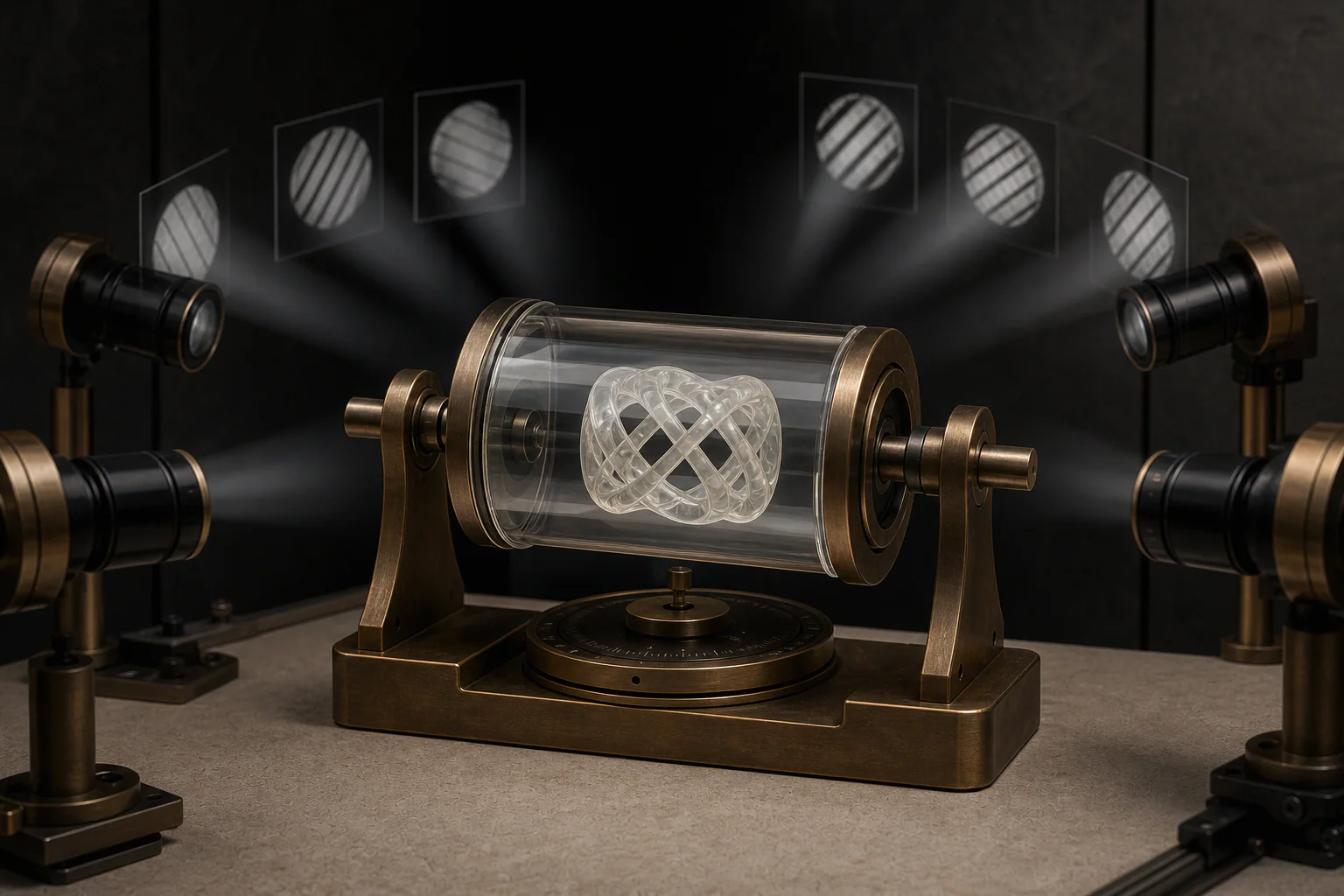
A medical CT scanner records many X-ray projections from different angles and computes the volume that must have produced them. Computed axial lithography runs the same mathematics in reverse. Starting from a target shape, an algorithm calculates a sequence of two-dimensional light patterns. A projector plays those patterns into a slowly rotating, transparent container of photosensitive resin, and each point inside the volume accumulates light dose from every angle as the container turns 1.
The resin is engineered to respond like a threshold switch. Below a critical dose it stays liquid; above it, gelation begins. Dissolved oxygen inhibits the reaction and helps hold that boundary sharp. After enough rotations, the accumulated three-dimensional dose map crosses the threshold everywhere the part should exist, and the object solidifies through its whole volume at nearly the same time. The surrounding liquid drains away afterward, leaving the solidified form 1.
- Target geometry is converted into angular projection patterns
- A projector plays the patterns into rotating resin
- Dose accumulates in three dimensions over many rotations
- Material above the gelation threshold solidifies almost simultaneously
- Unsolidified resin drains off after the build
03
What the demonstrations actually showed
The peer-reviewed demonstration in Science reported small objects formed in seconds to minutes rather than hours, surfaces without the stair-stepping that layer processes leave on slopes, builds in soft and highly viscous materials, and geometry formed around an existing solid component placed in the vat 1. Each of those is genuinely new capability, and each was shown under laboratory conditions, in selected resins, at laboratory scale. The paper documents a process that works; it does not document a process that is ready.
Honesty about maturity is the frontier reader's first tool. A demonstration establishes existence: this physics, this chemistry, this control loop produced this object, with the authors watching. It does not establish dimensional tolerance across arbitrary geometry, repeatability between machines and batches, long-term material properties, operator safety envelopes, or cost. Those come later, if they come at all. Many demonstrated processes never cross that distance, and nothing in the published record yet shows volumetric printing has crossed it.
04
The promise, stated carefully
Why pursue it at all? Speed is the headline: build time scales with rotations rather than height, so a squat part and a tall part can take similar time. Surface quality follows: with no layers, sloped and curved faces come out smooth without post-processing. Support elimination may matter more than either. Because the surrounding resin carries the forming part, geometries that would need scaffolding in layer processes can form free-floating, and very soft materials that would slump under their own weight become candidates 1.
The demonstrated ability to solidify around an object already inside the vat points toward hybrid assemblies — printing a soft component directly onto a hard one 1. Beyond that line, the literature turns speculative, and we label it so: patient-matched soft devices, embedded optics, and encapsulated mechanisms are proposals, not products. Between today's demonstrations and those applications sit unglamorous years of process control, measurement, and qualification — the same road every additive family has had to walk 2.
- Build time set by rotation count, not part height
- No stair-stepping on slopes and curves
- Surrounding resin acts as a temporary support
- Soft, high-viscosity materials become printable
- Speculative: overprinted hybrid and encapsulated assemblies
05
The limits that keep it in the lab
The physics that enables the method also constrains it. Light must reach every voxel, so the resin must stay transparent at the curing wavelength; scattering and absorption grow with size, which pressures the build volume. The dose everywhere outside the part must remain below threshold until the build ends, which makes stray light, temperature drift, and resin history live tolerances. Filled, opaque, or pigmented materials — routine in other families — are largely off the table for now.
Control and measurement are the deeper problems. Layer processes can be watched layer by layer; a volume that gels almost at once offers no such checkpoints, and in-process metrology for it is an open research question. The measurement groundwork — how photopolymers cure at the voxel scale, how properties depend on dose — is active government-laboratory territory 2. Standards have not caught up either: the current vocabulary's process categories do not yet include a volumetric family, and classification will follow maturity rather than precede it 3.
- Resin must be transparent at the curing wavelength
- Dose control tightens as parts grow
- Resolution depends on optics, rotation, and chemistry together
- No layer-by-layer checkpoints for inspection
- No dedicated standards category yet
06
How to read the next volumetric headline
When a volumetric claim crosses your feed, ask the questions this article was built on. What object, in what material, at what size? Measured how, and by whom? Repeated how many times, on how many machines? Published where — a peer-reviewed venue with methods attached, or a launch video? The Science demonstration earns its citations because it answers such questions in print 1; secondary coverage often quietly drops the conditions and keeps the adjectives.
For makers, nothing here replaces a resin printer this year, and this publication has no laboratory and claims no hands-on trial. The value is watching a process earn trust in the open: chemistry first, then control, then metrology, then standards, then products 2. Layer-based printing climbed that ladder over decades. Volumetric printing is attempting the same climb without the layers — and, so far, without the shortcuts.
Working vocabulary
Glossary
- Volumetric additive manufacturing
- A research family of processes that solidify an entire object throughout a material volume rather than building sequential layers.
- Computed axial lithography (CAL)
- A volumetric method that projects computed light patterns into rotating photopolymer so accumulated dose forms the whole part.
- Tomographic reconstruction
- The mathematics of recovering a volume from many angular projections; CAL runs the calculation in reverse to generate projections.
- Photopolymer
- A resin formulated to solidify when it absorbs sufficient light energy.
- Gelation threshold
- The accumulated light dose at which liquid resin begins converting to a solid network.
- Oxygen inhibition
- Suppression of photopolymerization by dissolved oxygen, used in volumetric printing to sharpen the boundary between cured and uncured regions.
- Overprinting
- Forming new material directly around or onto a component already present in the build volume.
Source ledger
References and further study
Numbered citations point to the sources below. We favor standards, government laboratories, peer-reviewed research, and primary technical documentation. A link is evidence for the claim it supports—not an endorsement of every claim on that website. Read the full editorial and correction method.
- Volumetric additive manufacturing via tomographic reconstructionScience (AAAS) · peer-reviewed research↗Opens in a new tab
- Vat PhotopolymerizationNational Institute of Standards and Technology · government research program↗Opens in a new tab
- ISO/ASTM 52900:2021 — Additive manufacturing — General principles — Fundamentals and vocabularyInternational Organization for Standardization · international standard↗Opens in a new tab