
Mason's Notebook · Material Field Guide
Read the stone before you cut it
Igneous, sedimentary, and metamorphic stone in plain terms: bedding, defects, weathering, durability, and how repair stone is matched to original fabric.
- Level
- Beginner
- Reading time
- 14 minutes
- Evidence
- standards-and-practice
- Reviewed
- 2026-08-09
Jump through this guide
The short version
Stone is not a uniform material; it is a geological archive with grain, memory, and preferences. Reading it, class by class, bedding by bedding, defect by defect, is the difference between a wall that sheds centuries and a sill that spalls in a decade. This guide explains the three broad rock families conceptually, shows what bedding orientation means for laying, lists the defects and decay forms worth recognizing, and describes how repair stone is matched to existing fabric, following conservation practice documented in the National Park Service's Preservation Briefs 1.
After reading, you can
- Distinguish igneous, sedimentary, and metamorphic building stone at the conceptual level
- Explain why bedding orientation controls how sedimentary stone weathers
- Recognize common defects and decay forms before and after a stone is laid
- Describe how replacement stone is matched for repair without harming original fabric
01
Three families, three temperaments
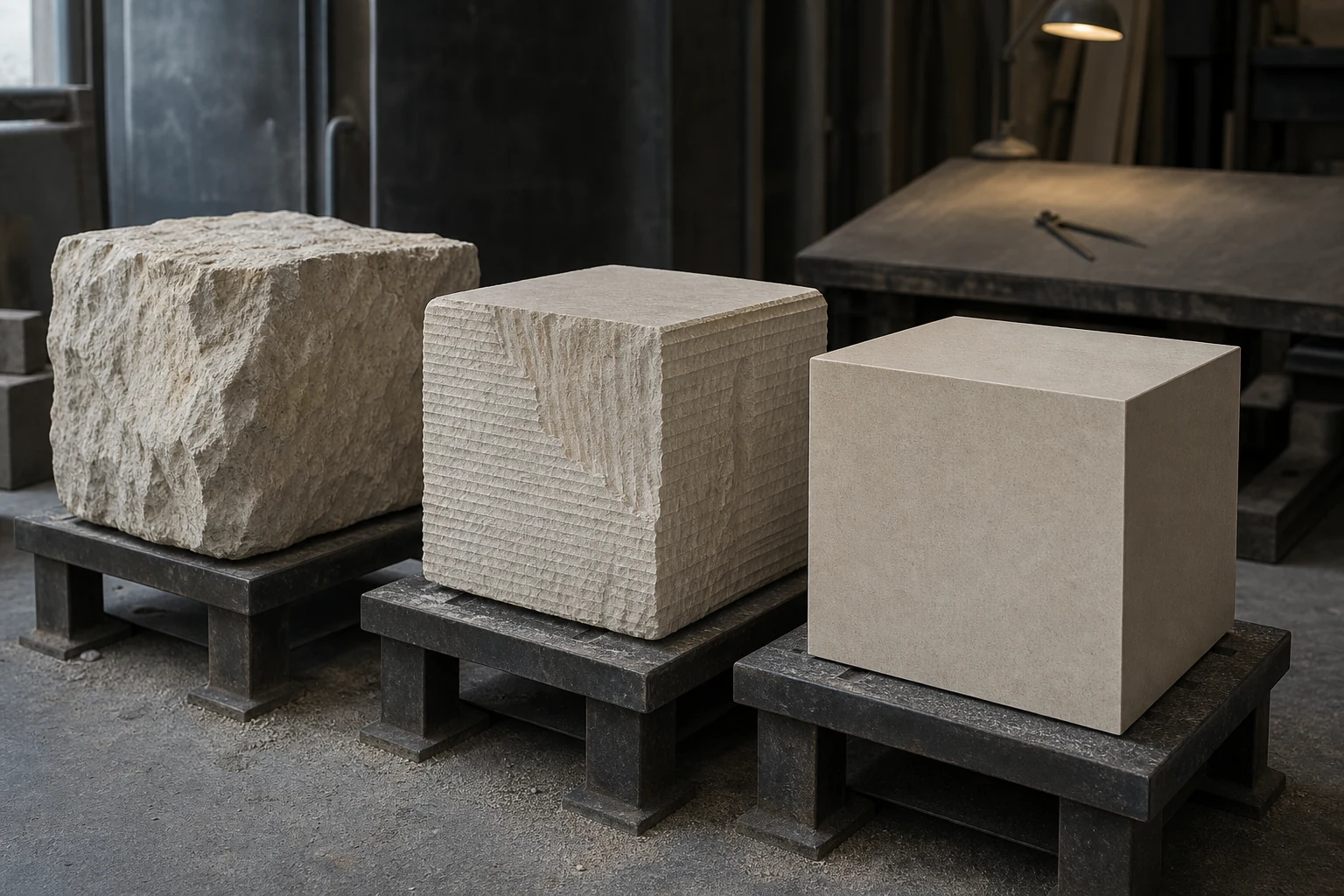
Igneous stone, granite most familiarly, cooled from melt: interlocking crystals, no layering, high hardness, slow to weather and slow to work. Sedimentary stone, limestone and sandstone, was deposited in layers and cemented; it is generally softer, more workable, and more variable, with properties that differ along and across its layers. Metamorphic stone, marble, slate, and quartzite, was recrystallized by heat and pressure; slate cleaves into flat sheets, and marble takes a polish yet slowly sugars outdoors. Conservation literature treats each family's decay separately for exactly these reasons 2.
These are temperaments, not grades. Granite outperforms limestone in a wet plinth but is miserable to carve; fine limestone holds crisp detail that would exhaust a granite budget; slate roofs outlive their nails. Selection means matching temperament to task, and the field names quarries use, freestone, flagstone, dimension stone, describe behavior more than geology. A freestone cuts equally well in any direction; a flagstone splits into paving; neither term appears on a geologic map.
- Igneous: crystalline, hard, unlayered, slow to work and to weather
- Sedimentary: layered, workable, variable, bedding-sensitive
- Metamorphic: recrystallized; slate cleaves, marble polishes and sugars
- Freestone: works equally in all directions
- Trade names describe behavior, not strict geology
02
Bedding is the grain of the rock
Sedimentary stone carries bedding planes, the layered record of its deposition, and like timber it is strongest and most durable when loaded sensibly relative to that grain. A stone laid on its natural bed, layers horizontal as they formed, compresses its layers and weathers evenly. The same block set with layers vertical and parallel to the wall face is face-bedded: water and frost work between the layers and peel the face off in sheets. Preservation guidance on masonry decay identifies incorrect bedding as a recurring cause of delamination 1.
Reading bedding takes practice because sawn faces can hide it. Look at weathered edges, wet the stone to bring out banding, and study how existing stones on the same building have decayed: delaminating faces usually mean face bedding, while crumbling rounded arrises suggest soft stone or salt. Arch voussoirs and cornices follow their own bedding conventions because their load paths and exposure differ from plain walling. When bedding cannot be determined at all, treat the stone as suspect for exposed positions.
03
Defects and decay you can name
Quarry defects come first: clay seams and shakes that open with frost, vents running as hairline cracks, soft pockets, and iron minerals that rust, stain, or burst. A tap test helps, since sound stone rings and cracked or punky stone answers dull. Then come the decay forms of stone in service: spalling, where faces pop off; delamination along beds; sugaring of marble as crystal bonds fail; honeycomb weathering in porous sandstone; salt crystallization near ground and copings; and biological growth holding moisture against the surface. Conservation research institutions maintain detailed typologies of these mechanisms 2.
The point of naming decay is diagnosis. Salt damage near a sidewalk implicates de-icing and rising damp, not the stone; delamination implicates bedding; uniform surface loss implicates the stone's own softness or acidic exposure. A hard cement repointing on soft stone concentrates evaporation, and therefore salt, in the stone rather than in the sacrificial joint, which is a common way good intentions destroy fabric and a standing argument for mortar softer than the masonry it joins 1.
- Vents, shakes, clay seams: quarry-inherited weaknesses
- Spalling and delamination: faces detaching
- Sugaring: marble losing crystal bond outdoors
- Honeycomb weathering: pitting in porous stone
- Salt crystallization: decay concentrated where water evaporates
- Ring test: sound stone rings, cracked stone thuds
04
Durability is exposure-specific
No stone is durable in the abstract; durability is a match between material and position. Copings, plinths, sills, chimneys, and anything near ground or splash live in the saturated, frozen worst case; sheltered walling above a good plinth lives an easier life. Dense stone with well-cemented grains generally survives saturation and frost better, but pore structure matters as much as total porosity, because how water moves and where it evaporates decides where damage concentrates. Quarries publish absorption and strength results; conservation practice reads them alongside the building's actual microclimates 2.
Dry stone work makes the same judgment without mortar to forgive errors. Wallers sort stone by soundness, shape, and the role each piece will play, face, heart, through, or cope, and durability comes as much from drainage and structure as from the rock itself. Training organizations such as The Stone Trust codify this selection and placement as a certifiable, assessable skill 4, a useful reminder that reading stone is craft knowledge with standards rather than folklore.
05
Matching stone for repair
Replacement begins with identification: what stone is this, from where, and can that quarry or a close analogue still supply it. The match must extend past color to texture, porosity, and strength, because a repair denser than its neighbors sheds moisture into them and accelerates their decay. Preservation Briefs describe in-kind replacement, dutchman repairs, and the limited, honest use of compatible repair mortars 1. Conservation science adds laboratory tools, petrography and salt analysis among them, when the stakes justify the cost 2.
Philosophy constrains technique. The Venice Charter's position is that replacements should integrate harmoniously with the whole while remaining distinguishable from the original, so the repair does not counterfeit history 3. In practice that means matching behavior exactly and appearance closely, with a dated mark or a subtle finish difference for the future's benefit. Whether a new stone, a dutchman, or a mortar repair is right depends on loss depth, exposure, and significance, decided stone by stone rather than building by building.
06
A five-minute field routine
Before cutting or laying, walk the stone through a routine. Look at it dry, then wet a face: bedding, veins, and old repairs appear. Ring it with light hammer taps and listen. Find the bedding and mark the natural bed on the block. Inspect arrises and corners, where weakness shows first. Check for clay seams, vents, and iron staining. Then look up: the same stone already on the building is the best durability archive available, so note which faces failed, and why, before choosing where the new stone goes 1.
Write down what you conclude. A block's identification, bedding orientation, intended position, and any doubts belong in the job record with the delivery ticket, the same documentation habit conservation practice applies to historic fabric 2 and part of the working knowledge the stonemason trade is defined by in occupational terms 5. Reading stone is learnable, physical, and slightly addictive; buildings have been teaching it for as long as people have looked at their own walls honestly.
- Dry look, wet look: bedding and repairs appear
- Tap test: ring is sound, thud is suspect
- Mark the natural bed before it leaves the pile
- Check arrises, seams, vents, and staining
- Read the building itself as the durability archive
Working vocabulary
Glossary
- Bedding plane
- A layer surface in sedimentary stone recording how the material was deposited.
- Natural bed
- The orientation a sedimentary stone formed in; laying on it puts layers horizontal under load.
- Face bedding
- Setting stone with layers vertical and parallel to the wall face, inviting delamination.
- Arris
- The sharp edge where two dressed faces meet; the first place weakness shows.
- Spalling
- Loss of surface material as flakes or larger face fragments detach.
- Sugaring
- Granular surface disintegration of marble as crystal bonds fail outdoors.
- Freestone
- Fine, even-grained stone that can be cut equally well in any direction.
- Dutchman
- A fitted partial-stone repair let into sound original material.
Source ledger
References and further study
Numbered citations point to the sources below. We favor standards, government laboratories, peer-reviewed research, and primary technical documentation. A link is evidence for the claim it supports—not an endorsement of every claim on that website. Read the full editorial and correction method.
- Preservation BriefsU.S. National Park Service · government preservation guidance↗Opens in a new tab
- Getty Conservation InstituteJ. Paul Getty Trust · conservation research institute↗Opens in a new tab
- International Charter for the Conservation and Restoration of Monuments and Sites (The Venice Charter 1964)ICOMOS · international conservation charter↗Opens in a new tab
- The Stone TrustThe Stone Trust · craft education organization↗Opens in a new tab
- Brickmasons, Blockmasons, and Stonemasons — Occupational Outlook HandbookU.S. Bureau of Labor Statistics · government occupational data↗Opens in a new tab