
The Commons · Community Challenge
The coil-built texture vase challenge
Build a vessel from clay coils by hand, or a printed interpretation of coil texture. Decorative by default; kiln firing and glaze certification are separate steps.
- Level
- Beginner
- Reading time
- 7 minutes
- Evidence
- community-brief
- Reviewed
- 2026-08-09
Jump through this guide
The short version
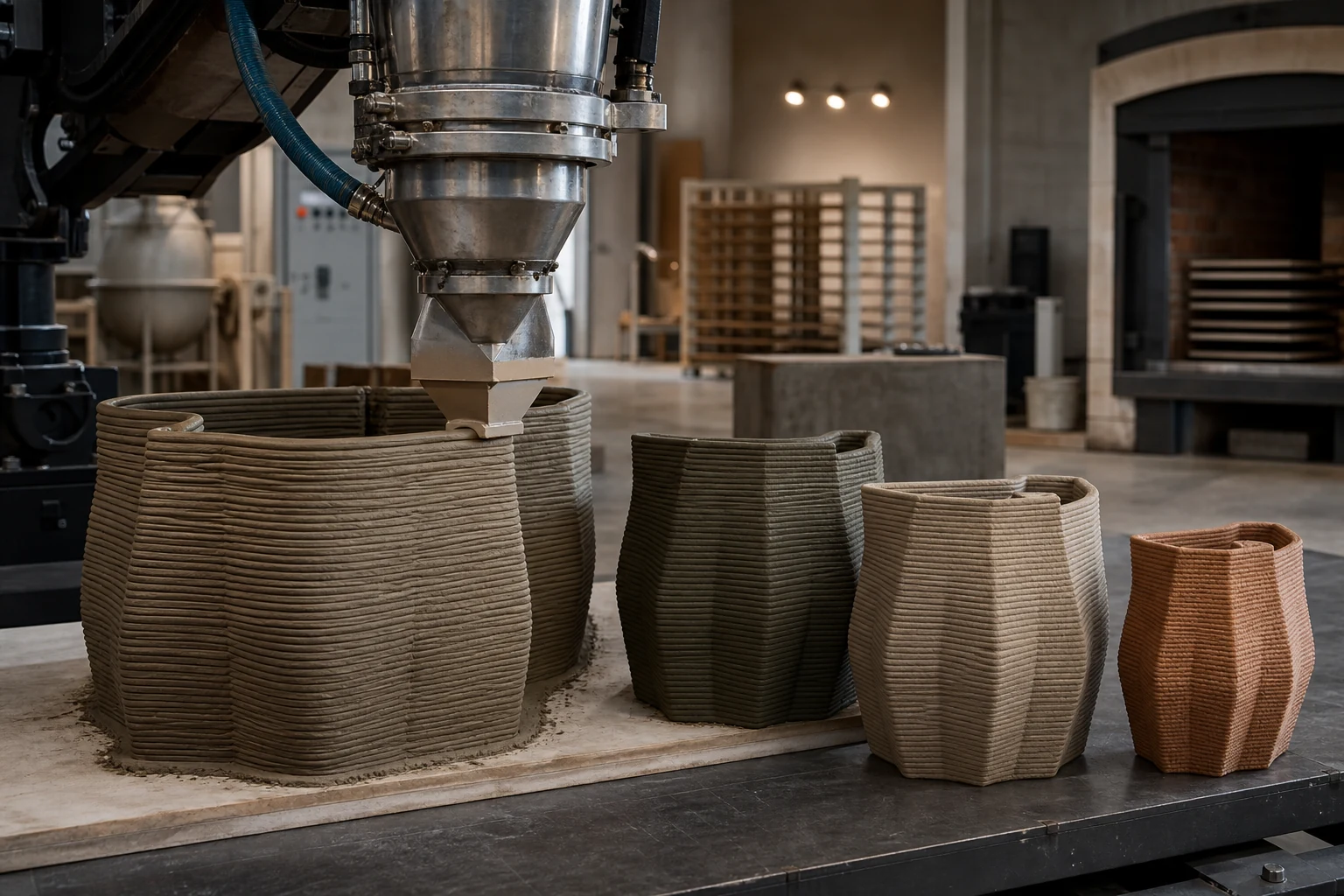
Coil building is one of the oldest ways to raise a vessel wall, stacking and pinching ropes of clay into a rising form, and it is also a close ancestor of paste-extrusion 3D printing, which lays down a continuous bead in much the same logic with a nozzle instead of a hand. This challenge welcomes both routes: build a texture vase by hand-coiling clay, or print an interpretation of coil texture, and be precise about what firing and glaze status your piece actually has. Ceramic additive manufacturing is an active research area precisely because the printed and hand-built traditions share so much physics 1.
After reading, you can
- Build or print a vessel whose surface texture records a coil-by-coil, or bead-by-bead, construction logic
- State plainly whether a piece is fired, unfired, glazed, or unglazed
- Understand why hobby glazes and firing vary too much to assume food safety by default
- Document the kiln or printing process behind a ceramic entry honestly
01
Why this challenge
Coil building predates the wheel and the nozzle alike: a rope of clay laid in a ring, pinched to the ring below, repeated until a wall rises. Robotic and desktop paste-extrusion printing of ceramic slurries follows the same logic mechanically, laying a continuous bead that can be left visibly ribbed or smoothed away, and research groups studying robocasting-style deposition of ceramic pastes treat that bead-by-bead structure as a real variable in the finished part, not a cosmetic afterthought 2.
Putting hand-coiling and printed interpretation side by side in one challenge makes the shared logic visible. Both processes fight the same problems: a coil or bead too thin slumps, one added too fast to a wet wall buckles, and texture left exposed on purpose becomes a design decision rather than a flaw. National ceramic additive manufacturing research treats these deposition behaviors as an open, ongoing subject, which is exactly the spirit this challenge asks makers to bring to their own vase 1.
02
The brief
Build a texture vase two ways, or pick one: hand-coil raw clay into a vessel, leaving the coil ridges visible rather than smoothing them flat, or print an interpretation of coil texture, either a clay-paste printer laying visible ribs or an FFF print whose surface pattern deliberately echoes a coiled build. Either route, the texture is the point; a form that hides its construction logic under a smooth finish has missed the brief. Size and silhouette are open.
State the piece's status honestly at every stage: greenware (unfired clay), bisque (fired once, unglazed), or glaze-fired, and name your kiln process or printer and material. If you print in clay paste, note whether the piece is fired afterward or left as an unfired printed object, since printed clay does not become ceramic until it goes through a kiln. Original texture and form only, no molds or scans of commercial coil-ware.
- Hand-coiled clay or a printed interpretation of coil texture, either welcome
- Coil or bead ridges left visible as the design's texture
- Firing status stated plainly: greenware, bisque, or glaze-fired
- Kiln or printer process and material named
- Original form and texture, no molded or scanned coil-ware
03
Safety and rights boundaries
Decorative by default. Hobby glazes vary widely in composition, and food safety depends on the specific glaze being certified food-safe and fired to the correct temperature and duration for full maturity; without both conditions verified, treat any vase, printed or hand-built, as decorative only, never for food or drink contact. Unfired greenware is more fragile still: it can crumble, is not waterproof, and should never be assumed durable enough for daily use of any kind.
Kiln safety is a separate, serious discipline: proper ventilation for firing fumes, correct loading and firing schedules, and heat-resistant handling of loaded and unloaded kilns are not optional shortcuts, and firing should only be done with equipment and training suited to the task. Rights follow the usual rule, original coil and texture work only; if you share your form or texture pattern, license it clearly, Creative Commons Attribution 4.0 requires only credit back to you 3.
04
How to participate
Post your vase publicly on Instagram or X and tag @print.mason or @printmasons with the hashtag #PrintMasonChallenge, or email photos and notes to right.just.right@gmail.com. There are no on-site accounts, uploads, or comments; the challenge lives across your own platforms and by email, gathered only by the shared hashtag. A raking-light photo of the coil or bead texture alongside a full-form shot shows the work clearly.
There is no deadline and no prize, and repeat entries as your coiling or printing technique improves are welcome. If your first piece cracks in the kiln or your printed interpretation slumps mid-build, photograph the failure alongside the fix; a coil vase that split at the shoulder, with the moisture-control lesson learned, teaches the community more than a flawless single result.
05
What a strong entry shows
A strong entry treats coil or bead texture as the design, not an accident of process. The ridges are consistent enough to read as intentional, the form respects what a rising wall of soft material can support before slumping, and the firing or printing status is stated in plain, unambiguous terms rather than implied. Where food-safety language could apply, it is either fully justified with a certified glaze and correct firing, or explicitly declined.
The quiet test is whether someone unfamiliar with ceramics could read your notes and understand exactly what they are looking at: hand-built or printed, fired or not, glazed or not, food-safe or decorative. That clarity, more than the elegance of the coil pattern, is what makes an entry trustworthy enough to sit in a shared community record, and worth returning to as your own coiling or printing technique keeps improving.
Working vocabulary
Glossary
- Coil building
- A hand-forming technique that raises a vessel wall from stacked, pinched ropes of clay.
- Robocasting
- A paste-extrusion additive process that deposits ceramic slurry bead by bead, similar in logic to hand-coiling.
- Greenware
- Unfired clay, fragile and not waterproof, that has not yet been through a kiln.
- Bisque
- Clay that has been fired once, hardened but typically unglazed and still porous.
- Food-safe glaze
- A glaze certified safe for food contact only when its specific formulation and correct firing schedule are both verified.
Source ledger
References and further study
Numbered citations point to the sources below. We favor standards, government laboratories, peer-reviewed research, and primary technical documentation. A link is evidence for the claim it supports—not an endorsement of every claim on that website. Read the full editorial and correction method.
- Additive Manufacturing of CeramicsNational Institute of Standards and Technology · government research program↗Opens in a new tab
- Robocasting publicationFraunhofer-Gesellschaft · research publication↗Opens in a new tab
- Attribution 4.0 International (CC BY 4.0)Creative Commons · license text↗Opens in a new tab