
The Commons · Community Challenge
The one-wall vessel challenge
Design and print an original vessel in single-perimeter spiral mode: one continuous wall that exposes extrusion, cooling, and design honesty. Decorative use only.
- Level
- Beginner
- Reading time
- 7 minutes
- Evidence
- community-brief
- Reviewed
- 2026-08-09
Jump through this guide
The short version
A vessel printed in spiral, or vase, mode is one continuous wall a single extrusion wide, climbing from base to rim without a stop. Nothing hides in it: every wobble of flow, every cooling hiccup, every over-ambitious curve of the design is right there on the surface, which is what makes it the perfect second challenge. Design an original vessel, print it one wall thick, and document the settings that made it work. Prusa's guidance on modeling with the printing process in mind is the natural companion reading 1.
After reading, you can
- Design an original vessel whose form survives being built as one continuous extrusion
- Read a spiral print's surface as a record of extrusion consistency and cooling
- Document settings so another maker can reproduce or improve your result
- State the non-food boundary honestly on anything vessel-shaped you share
01
Why one wall
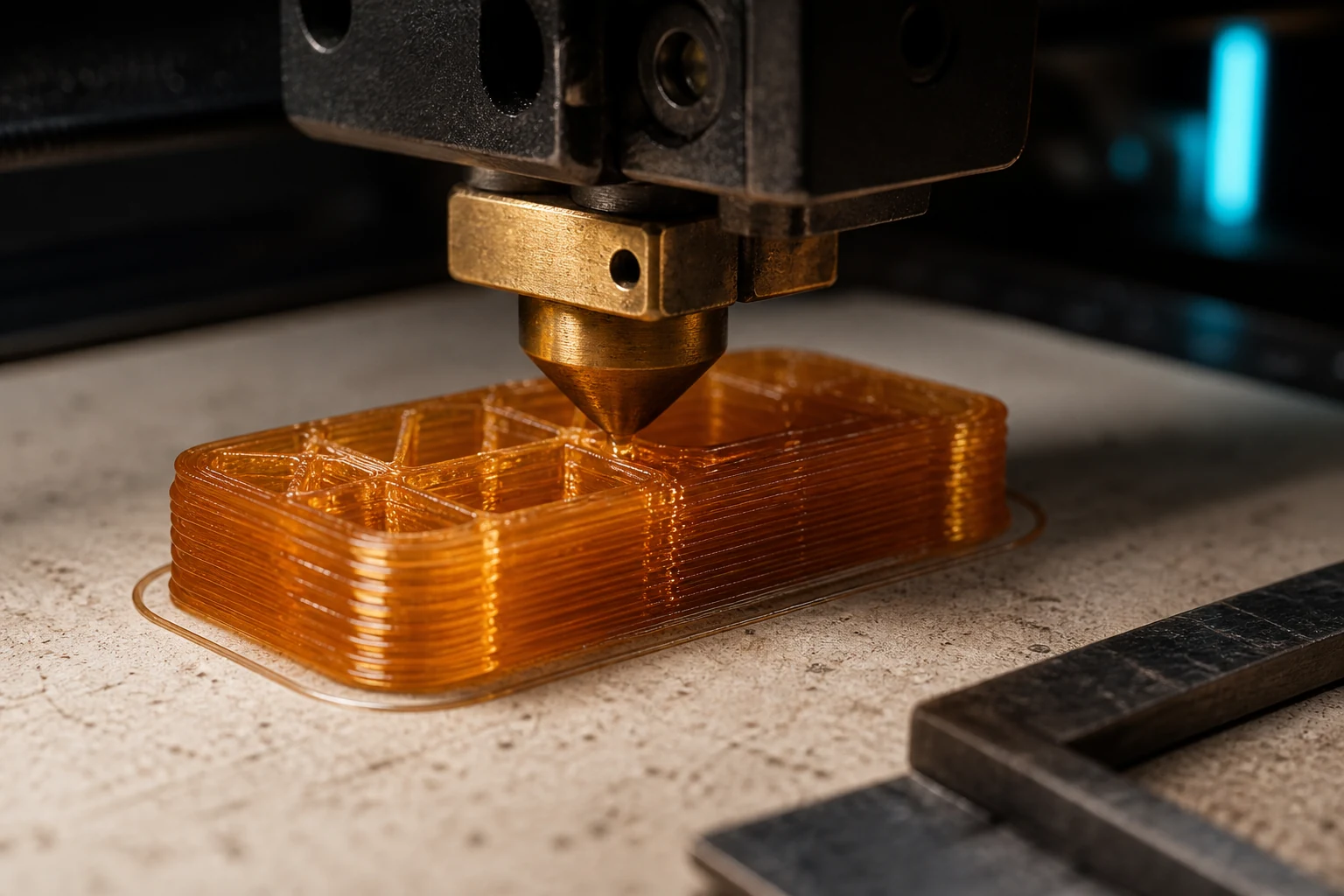
Spiral printing strips material extrusion down to its physics. The nozzle rises continuously, laying a single road of molten polymer on the road below, so the finished wall is a seismogram of the build: consistent extrusion reads as glass-smooth bands, moisture in the filament reads as stipple, rushed cooling reads as ripple on overhanging curves. Material extrusion, the process family behind desktop FFF printing, is an active subject of federal measurement research precisely because bead-by-bead deposition couples geometry, flow, and heat so tightly 2. A vase makes that coupling visible for the price of an evening.
The challenge is also a design test, because one wall forgives nothing structural. There is no infill to prop a careless slope, no second perimeter to bridge a gap, and any cross-section that narrows too fast or overhangs too far will fold, tear, or ripple. Working inside those limits is a miniature course in designing for a process rather than against it. The reward is efficiency that borders on elegance: a vessel of respectable size from a few tens of grams of material, printed in a single unbroken gesture.
02
The brief
Design an original vessel, vase, beaker, planter sleeve, pencil cup, abstract form, and print it in spiral mode: single perimeter, zero infill, a few solid base layers, no seam because there is no layer change. Size and material are open; a common desktop starting point is a nozzle-width wall in PLA or PETG, but any extrusion material you actually use is welcome. Design for the mode: gentle slope changes, cross-sections that evolve rather than jump, and overhang angles your machine has demonstrated, not ones a render promised. Prusa's modeling guidance covers the wall-thickness and overhang thinking that applies directly here 1.
Document as you go, because the documentation is half the entry. Record material class, nozzle and bed temperatures, layer height, print speed, cooling fan behavior, and anything you changed after a failure. Surface texture is welcome, ribs, twists, fluting, provided it is your own geometry; no downloaded commercial models, no trademarked forms, no scanned products. If your first attempt collapses at the shoulder, photograph the collapse: a vase that failed at 80 percent height plus the setting that fixed it is a better entry than a perfect print with no story.
- Original geometry only, designed by you
- Spiral mode: one perimeter, no infill, solid base
- Any extrusion material you genuinely use
- Slopes and overhangs your machine has demonstrated
- Settings card: temperatures, layer height, speed, cooling
- Failures photographed and explained, not hidden
03
Safety and rights boundaries
Vessel-shaped is not food-safe, and this challenge is explicitly decorative. A spiral print is unsealed polymer with microscopic crevices between beads; it can trap residue, it may weep at pinholes, and neither the material spool nor your process carries any food-contact clearance. Food-contact materials in the United States sit under the Food and Drug Administration's regulatory framework, and a hobby print has been through none of it 3. Keep printed vessels for pens, dried arrangements, and potted plants with liners; state the same boundary plainly if you share the file or gift the object.
Process safety is the familiar routine: ventilate the printing space, since melting filament can release ultrafine particles and volatile compounds, and keep hands away from a hot nozzle chasing a wobbling single wall mid-print; a collapsing vase is never worth a burn. Rights are equally routine: the design must be yours. If you publish the file, state a license so others know what they may do, Creative Commons Attribution 4.0 is a common choice that requires only credit 4, and if you remixed a shape you had rights to use, say so and name it.
04
How to participate
Post your vessel publicly on Instagram or X and tag @print.mason or @printmasons with the hashtag #PrintMasonChallenge, or email photos and notes to right.just.right@gmail.com. There are no on-site accounts, uploads, or comments; your work stays on your platforms, under your control. Include at least one photo in flat light showing the whole form, one raking-light close-up of the wall surface, and your settings card. If you email, tell us whether the publication may quote your notes in future community coverage; nothing is assumed.
The challenge is ongoing: no deadline, no prizes, no promised features, and repeat entries are encouraged as your walls get cleaner. If your printer cannot spiral, or you work in clay or resin, an interpretation in the spirit of the brief, one continuous thin wall, honestly labeled with its actual process, is welcome; name the process family in standard terms so the comparison stays fair. The point is the wall, not the workflow that made it.
05
What a strong entry shows
Strong entries read like small lab reports that happen to be beautiful. The form suits the mode: slopes that flow, transitions that respect what a single hot road of polymer can do unsupported. The surface tells a story the settings card corroborates, here is the band where the speed changed, here is the ripple the extra cooling cured. The documentation names material and parameters in plain reproducible terms, the way measurement-minded process research would expect 2, and the non-food boundary is stated without being asked.
The quiet test is whether another maker with a different machine could take your card, print their own vessel, and get closer on their first try because you posted. A wall one bead wide keeps everyone honest: it shows exactly what your process, your material, and your design decisions did, with nowhere to hide and nothing to fake. That transparency, more than the vase, is the entry.
Working vocabulary
Glossary
- Spiral mode
- A slicing mode that prints a vessel as one continuous single-extrusion wall, raising the nozzle steadily with no layer changes.
- Perimeter
- One extruded outline of a layer; spiral prints have exactly one.
- Bead
- The individual road of deposited material whose width and consistency define a single-wall surface.
- Overhang angle
- The slope at which fresh material extends past the layer below; too aggressive and an unsupported wall curls or fails.
- Settings card
- The recorded parameters of a build: material class, temperatures, layer height, speed, and cooling.
Source ledger
References and further study
Numbered citations point to the sources below. We favor standards, government laboratories, peer-reviewed research, and primary technical documentation. A link is evidence for the claim it supports—not an endorsement of every claim on that website. Read the full editorial and correction method.
- Modeling with 3D printing in mindPrusa Research · manufacturer technical documentation↗Opens in a new tab
- Material ExtrusionNational Institute of Standards and Technology · government research program↗Opens in a new tab
- FoodU.S. Food and Drug Administration · government regulatory information↗Opens in a new tab
- Attribution 4.0 International (CC BY 4.0)Creative Commons · license text↗Opens in a new tab