
The Commons · Community Challenge
The material swatch library
Print a standardized swatch tile in a material you actually use, pair it with an honest settings card, and grow a shared visual library. Generic class required.
- Level
- Beginner
- Reading time
- 7 minutes
- Evidence
- community-brief
- Reviewed
- 2026-08-09
Jump through this guide
The short version
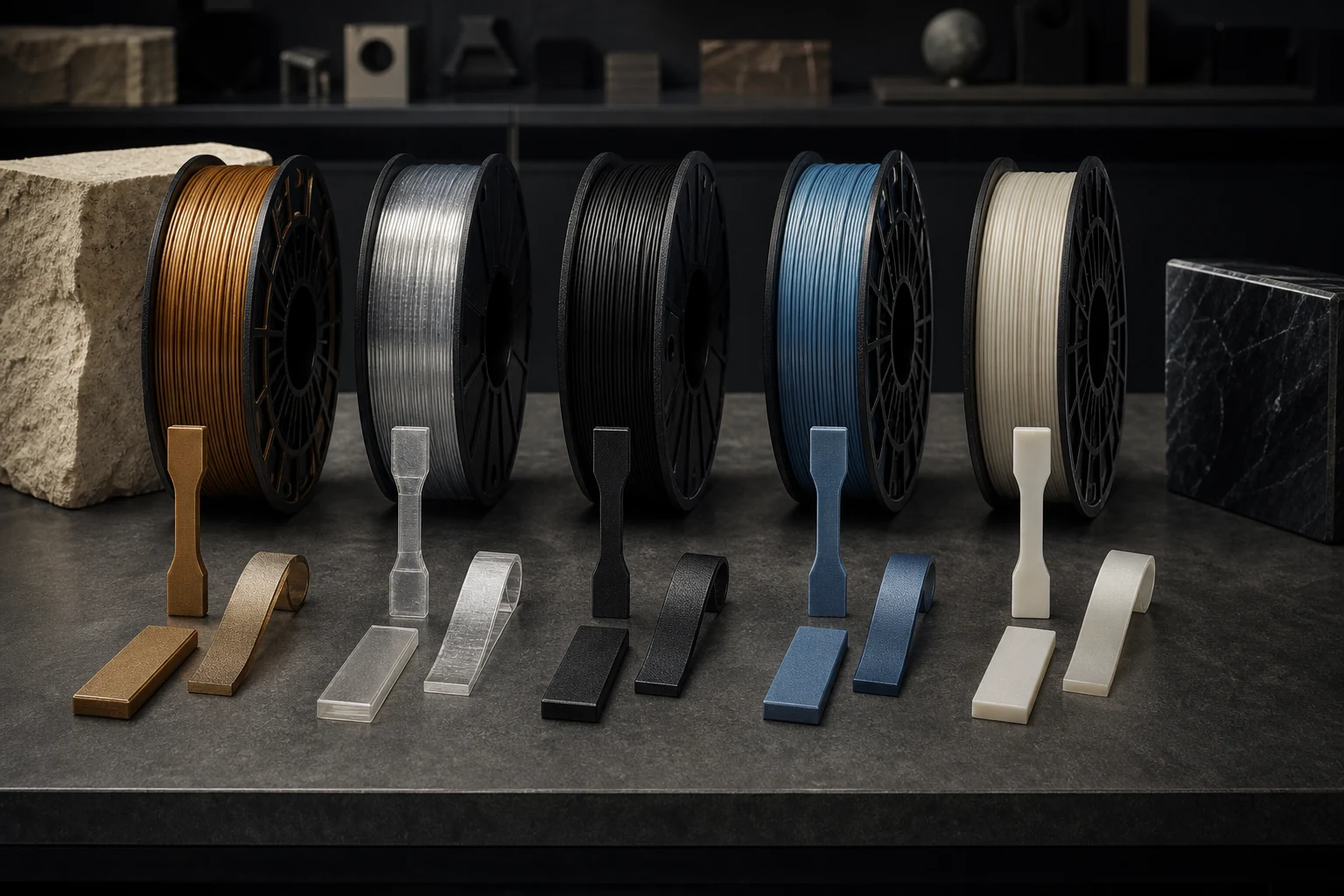
Every workshop eventually builds a wall of samples, because no photograph substitutes for the real surface of a real material off a real machine. This challenge builds that wall together: print one standardized swatch tile in a material you genuinely use, photograph it consistently, and pair it with an honest settings card. The reason swatches matter is the reason polymer additive manufacturing is a measurement research area at all: the properties of a printed polymer depend on how it was processed, not just what the spool said 1.
After reading, you can
- Print a swatch tile that exposes surface, steps, texture, and fine features in one small object
- Write a settings card that makes your result reproducible by a stranger
- Label materials honestly: generic class required, brand optional
- Read manufacturer datasheets as documented claims with stated conditions, not guarantees
01
Why a swatch library
The same generic polymer prints differently on different machines, at different temperatures, at different speeds, after different weeks in different humidity. That variability is not gossip; the processing dependence of printed polymer properties is precisely why national measurement laboratories run polymer research programs for additive manufacturing 1. For a community, the practical answer is not a bigger spreadsheet but a shared shelf of physical evidence: identical tiles, different materials and machines, photographed the same way, each carrying the exact settings that produced it.
A library like that answers the questions beginners actually ask. What does PETG look like at the seam. How does a matte blend hide layers. What does drying do to stringing. One honest swatch with its card answers each better than a review video, because the geometry is standardized and the conditions are written down. Twenty makers times three materials is sixty data points the Commons can browse by hashtag, which is a modest, useful institution built out of an evening of printing apiece.
02
The brief
Print a flat tile, roughly 50 to 80 millimeters on a side, that packs standard interrogations into one object: a smooth flat field, a stepped ramp of three or four thicknesses, a textured quarter, a few fine ribs or pins near your process's small-feature limit, and a short bridge or chamfered edge if you like. Design your own tile or reuse a shared one with attribution; the geometry matters less than using the same tile for every material you submit. Emboss a short label area, material class and date, so the physical object stays honest when it outlives your filing system.
Then the card, which is the real entry. Material by generic class, required; brand and color, optional but welcome. Machine style, nozzle size, layer height, temperatures, speed, cooling, drying if any, and one line on how the material behaved. Name the process family in the standard vocabulary so entries compare cleanly across machines 2. Photograph the tile in flat light and again in raking light, same angles each time; consistency is what turns a pile of photos into a library.
- One standardized tile geometry per maker, reused for every material
- Flat field, thickness steps, texture, and fine features on one tile
- Embossed label: material class and date
- Card: class required, brand optional, full settings, one behavior note
- Two photos, flat and raking light, consistent angles
03
Safety and rights boundaries
Honest labeling is the rights rule here. State the generic class truthfully, do not present one brand's blend as the behavior of a whole polymer family, and never photograph a competitor's failure as a class verdict; the swatch documents your combination of material, machine, and settings, nothing grander. For calibration on how careful materials documentation reads, a manufacturer datasheet is instructive: EOS's PA 2200 sheet, for its laser-sintering polyamide, states properties by build orientation, names the test standards behind each number, and still cautions that achieved part properties depend on the user's process 3. Hobby cards deserve the same modesty.
Safety is the standard printing routine plus one materials note. Ventilate the workspace, particularly for higher-temperature materials, and dry filaments in a proper dryer rather than an oven that also cooks food. Keep swatches decorative: a tile is not a wear part, a food surface, or a child's toy, and small fine-feature pins snap into exactly the fragments toddlers find. If you share your tile design, license it clearly, Creative Commons Attribution 4.0 keeps it reusable with credit 4, so the library's geometry can standardize instead of fragmenting.
04
How to participate
Post your swatch and card publicly on Instagram or X and tag @print.mason or @printmasons with the hashtag #PrintMasonChallenge, or email photos and notes to right.just.right@gmail.com. There are no on-site accounts, uploads, or comments; the library lives distributed across its makers' own platforms, findable by the hashtag. One material per post keeps entries browsable; a thread or series per material family is even better. If you email, say whether quoting your notes in later community coverage is welcome; nothing is assumed.
The challenge is ongoing, with no deadline, no prizes, and no promised features. It compounds: each new material you actually adopt earns a tile, and re-swatching an old material after a machine upgrade documents the difference honestly. Clay and resin workers are welcome with the same discipline, one standard tile, one truthful card, process named in standard terms, because a swatch library that spans process families is worth more than one that assumes everyone extrudes.
05
What a strong entry shows
A strong swatch is boring in the best way: the same tile as last time, lit the same way, with a card a stranger could follow verbatim. The generic class is stated before any brand romance, the settings are complete enough to reproduce, and the behavior note says something falsifiable, dried four hours and stringing stopped, rather than something promotional. Where a number matters, it is presented like careful documentation presents numbers: with its conditions attached, in the spirit of a proper datasheet 3.
The quiet test is whether your swatch changes someone's purchase or settings for the better. A tile that saves one maker a wet spool of frustration has done more community work than a dozen unboxing posts. Materials knowledge in this craft is measured, local, and provisional, which is exactly why the properties of printed polymers remain an active research subject 1; a library of honest little tiles is the hobbyist wing of the same project.
Working vocabulary
Glossary
- Swatch tile
- A standardized small print, flat field, steps, texture, fine features, used to compare materials under recorded conditions.
- Generic material class
- The material family name, such as PLA, PETG, or polyamide 12, stated independently of brand.
- Settings card
- The recorded parameters behind a swatch: machine, nozzle, layer height, temperatures, speed, cooling, drying.
- Datasheet
- A manufacturer's documented material claims, stated with test standards and conditions, not a guarantee of printed-part properties.
- Raking light
- Light skimming the surface at a low angle, used to reveal layer texture consistently across swatch photos.
Source ledger
References and further study
Numbered citations point to the sources below. We favor standards, government laboratories, peer-reviewed research, and primary technical documentation. A link is evidence for the claim it supports—not an endorsement of every claim on that website. Read the full editorial and correction method.
- PolymersNational Institute of Standards and Technology · government research program↗Opens in a new tab
- ISO/ASTM 52900:2021 - Additive manufacturing - General principles - Fundamentals and vocabularyInternational Organization for Standardization · international standard↗Opens in a new tab
- PA 2200 Material Data SheetEOS · company technical documentation↗Opens in a new tab
- Attribution 4.0 International (CC BY 4.0)Creative Commons · license text↗Opens in a new tab