
Future Foundry · Future Sketch
4D printing and materials that change after the print
Shape-memory polymers, moisture-driven composites, and self-assembly: what 4D printing demonstrations show, and the distance between a lab video and a product.
- Level
- Intermediate
- Reading time
- 14 minutes
- Evidence
- research-and-concept
- Reviewed
- 2026-08-09
Jump through this guide
The short version
A 3D print is finished when it leaves the machine. A 4D print is not: its geometry or properties are designed to change afterward, on cue, when heat, moisture, light, or load arrives. The fourth dimension is time, and the material is the machine. Research groups such as MIT's Self-Assembly Lab have spent years demonstrating programmable materials that fold, stiffen, and assemble themselves — demonstrations that define the field's promise and, read carefully, its current limits 1.
After reading, you can
- Define 4D printing as printed structure plus a programmed response over time
- Distinguish shape-memory, moisture-driven, and self-assembly mechanisms
- Separate laboratory demonstrations from shippable products when reading claims
- Identify where responsive materials could serve building and craft, labeled as speculation
01
Time as the fourth dimension
The term 4D printing describes an ordinary print with an extra instruction set baked into its material. Three dimensions come off the build plate; the fourth is time. Heat, moisture, light, or load arrives later and the object executes its program — folding, curling, stiffening, or locking into a new shape. No single machine owns the term. It is a family of approaches united by one idea, pursued most visibly by research groups such as MIT's Self-Assembly Lab, which studies programmable materials that transform themselves after fabrication 1.
The standards vocabulary that organizes additive manufacturing classifies processes by how material is joined, not by what the part does afterward, and it contains no 4D category 4. That absence is informative. 4D printing is a research label, not a certified process family, and the distance between those two states is where this article lives. The printer involved is often unmodified; the novelty sits in material pairings and in the arrangement of material that the toolpath writes into the part.
02
Three mechanisms, one idea
Shape-memory polymers are the oldest mechanism: deform a printed part above a transition temperature, fix it cold, and it recovers its printed shape when reheated. Moisture-driven composites are subtler. Pair a swelling material with a stable one and the mismatch bends the part as humidity changes, the way plant tissues curl as they dry. Bioinspired-engineering centers such as Harvard's Wyss Institute study materials and devices that borrow exactly these design rules from living systems 2.
Self-assembly extends the idea from shape change to construction: components designed so that ambient energy — agitation, gravity, moisture cycling — drives them to find and join one another. The Self-Assembly Lab's public work spans programmable materials, transformable objects, and assembly experiments run in tanks and tumblers 1. What unites all three mechanisms is that the intelligence lives in geometry and material arrangement, not in motors or firmware. The part does the assembling; the engineer does the worrying, earlier.
- Shape-memory: deform, fix, recover on a trigger
- Moisture-driven: differential swelling bends or twists
- Thermal mismatch: paired materials curl as temperature shifts
- Self-assembly: components join under ambient energy
- All depend on printed arrangement, not just chemistry
03
What demonstrations actually establish
The published demonstrations are genuinely striking: flat lattices that fold into volumes, printed strands that knot themselves, textiles that stiffen on demand, valves that answer to moisture. Each proves existence — this material system, in this geometry, under these conditions, transformed as designed, with the researchers watching 1. Existence is not performance. A hinge that folds once on video and a hinge that folds ten thousand times in weather are different engineering objects, and the second rarely appears in a launch clip.
Measurement is the honest bottleneck. Even static printed polymers lack the mature, shared property data that older manufacturing enjoys, which is why national laboratories maintain research programs on polymer additive-manufacturing measurement 3. Responsive polymers add stimulus, time, and cycling to every test matrix. Until datasheets report recovery force, cycle life, and aging alongside tensile numbers, a 4D part cannot be specified the way an engineer specifies a bracket — and a demonstration, however elegant, is not a product.
04
The quiet engineering problems
The quiet problems are the ones videos skip. Recovery is rarely total: parts creep, hysteresis accumulates, and each cycle can return a little less than the last. Environments drift — a moisture-driven component lives in weather, and its activation window may overlap an ordinary summer. Programming costs labor: many shape-memory parts must be individually deformed and fixed before service. None of these is fatal. All of them are exactly the sort of behavior that must be measured before it can be designed around 3.
There is also no feedback. A conventional actuator senses and corrects; a responsive material simply answers whatever the environment says, including the wrong thing. Robust designs therefore tolerate partial actuation and fail safely when the stimulus arrives early, late, or halfway. Standard test methods for such behavior are still forming, and the vocabulary standard has no category to hang them on yet 4. Expect datasheets before products, and standards before datasheets — that ordering is the industry's actual roadmap.
- Cycle life and fatigue of the responsive mechanism
- Partial or asymmetric actuation
- Aging, UV, and moisture history shift the response
- Trigger windows can overlap service conditions
- Few standard test methods exist yet
05
Where it could matter for building and craft — labeled speculation
Now the labeled speculation. In architecture and craft, one can imagine facade elements that shade themselves as temperature rises, vents that open with humidity, flat-packed components that fold into stiffness on site, and formwork that releases itself after cure. We flag every item in that list as a sketch: none is a product, none has published performance in service, and building codes have no place to put them. The imagining is useful anyway, because it names what would have to be true — cycle life in weather, decades of material data, inspection methods.
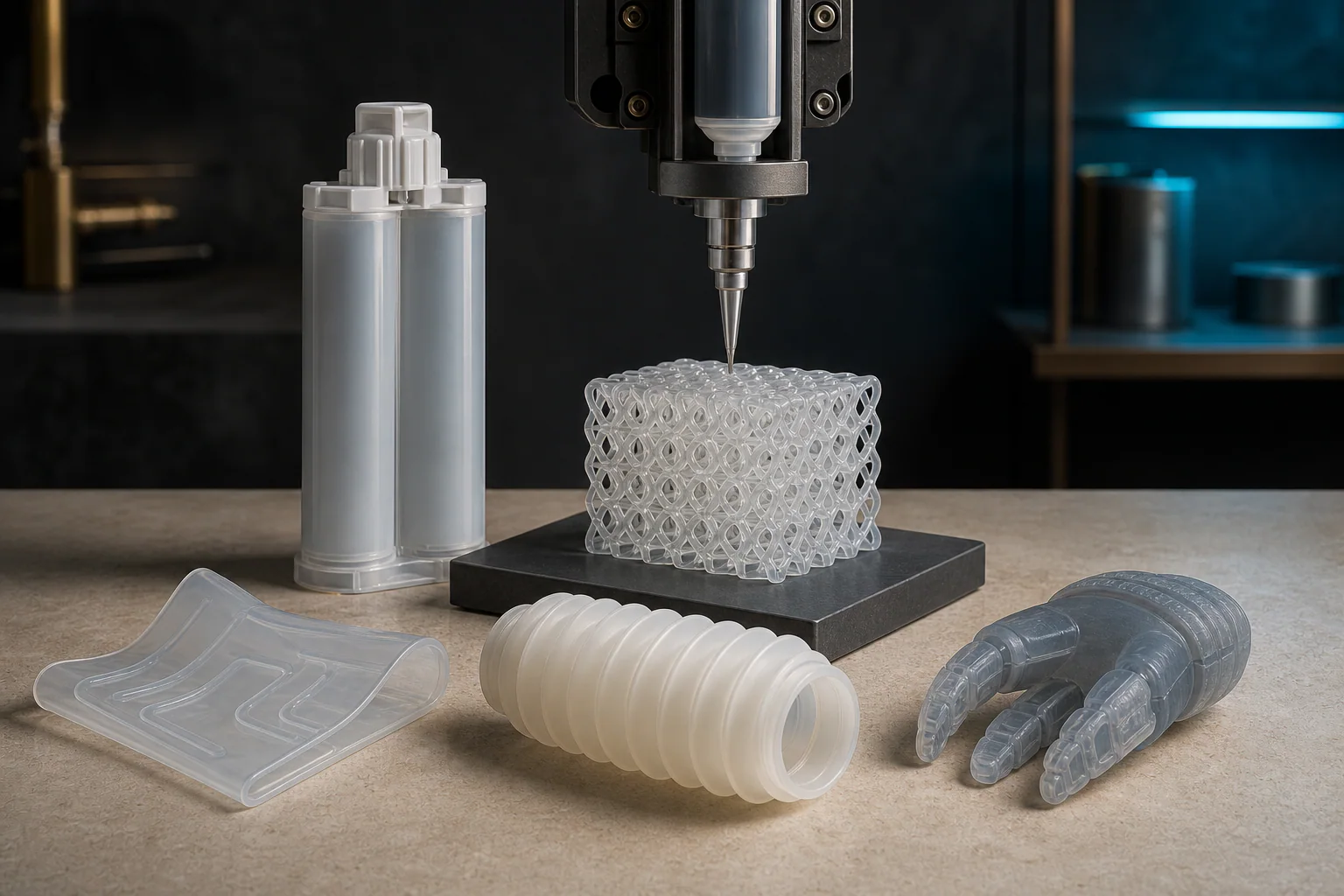
The nearer value is on the bench. Bilayer coupons, printed hinges, and soft silicone or flexible-filament studies teach material behavior cheaply and honestly, in the spirit of the research groups doing this work in public 12. A maker who prints a humidity-curling strip and logs its motion for a month learns more about responsive materials than any showreel can teach. The distance from coupon to cladding is measured in qualification years, not firmware updates.
06
How to read a 4D headline
When the next 4D headline arrives, interrogate it like a materials engineer. What stimulus, at what threshold? What material system, printed on what process? How many cycles were demonstrated, and what fraction of the shape came back each time? Was the result published with methods attached, as laboratory groups publish 1, or shown in a cut video? Who measured, and with what instrument? The questions are not hostile. They are the same questions the researchers ask themselves, printed in their methods sections.
This publication runs no laboratory and has tested none of this; our authority is the ledger below, and the reading frame is the deliverable. Time-based materials will probably arrive the way most materials do — slowly, unevenly, and first in small unglamorous parts. Watch for shared measurement methods 3, then datasheets, then standards categories 4, in that order. When the vocabulary committee finally needs a word for the fourth dimension, the field will have earned it.
- What stimulus, and what activation window
- What material, on what process
- How many cycles, with how much recovery
- Measured how, published where
- Demonstration or product — which is claimed
Working vocabulary
Glossary
- 4D printing
- Additive manufacturing of parts designed to change shape or properties after fabrication in response to a stimulus; the fourth dimension is time.
- Shape-memory polymer
- A polymer that can be deformed and fixed in a temporary shape, then recovers its printed geometry when triggered, typically by heat.
- Stimulus-responsive material
- A material whose form or properties change predictably when heat, moisture, light, or load arrives.
- Programmed anisotropy
- Direction-dependent material arrangement written into a part by the printing process so that swelling or contraction produces a designed motion.
- Self-assembly
- A process in which components join or order themselves under ambient energy inputs rather than external manipulation.
- Bilayer
- Two bonded layers with different expansion or swelling behavior, causing controlled bending as conditions change.
- Activation stimulus
- The specific trigger — temperature, humidity, light, or force — that a responsive part is designed to answer.
Source ledger
References and further study
Numbered citations point to the sources below. We favor standards, government laboratories, peer-reviewed research, and primary technical documentation. A link is evidence for the claim it supports—not an endorsement of every claim on that website. Read the full editorial and correction method.
- Self-Assembly LabMassachusetts Institute of Technology · university research laboratory↗Opens in a new tab
- Wyss InstituteWyss Institute at Harvard University · university research institute↗Opens in a new tab
- PolymersNational Institute of Standards and Technology · government research program↗Opens in a new tab
- ISO/ASTM 52900:2021 — Additive manufacturing — General principles — Fundamentals and vocabularyInternational Organization for Standardization · international standard↗Opens in a new tab