
The Allowance · Process Guide
Printed sand moulds meet the bell foundry
Binder jetting can print a foundry mould; printed patterns already shape bells. Documented fact, company-reported claims, and the trade-off against a skilled hand mould.
- Level
- Intermediate
- Reading time
- 15 minutes
- Evidence
- standards-and-company-reported
- Reviewed
- 2026-08-09
Jump through this guide
The short version
"Print a bell" is a misleading sentence, because no documented route prints finished bronze into a ringing shape. The honest sentence is narrower and more interesting: print the mould, or the pattern that shapes the mould, then cast and tune the bell the way founders always have. This guide defines binder jetting as NIST documents it, follows government-laboratory research into printed sand moulds and reusable patterns for large castings, reports the one documented bell-specific case in detail, and states plainly why printed sand is not automatically better than a mould built by a skilled hand.
After reading, you can
- Define binder jetting and distinguish printing a mould from printing a bell
- Summarize documented federal-laboratory research on printed sand moulds and reusable patterns for large castings
- Describe the one documented case of 3D printing entering bell founding, and what it actually prints
- Explain the trade-off between printed sand and a compacted, hand-built mould without overstating either
01
Two different claims wearing the same words
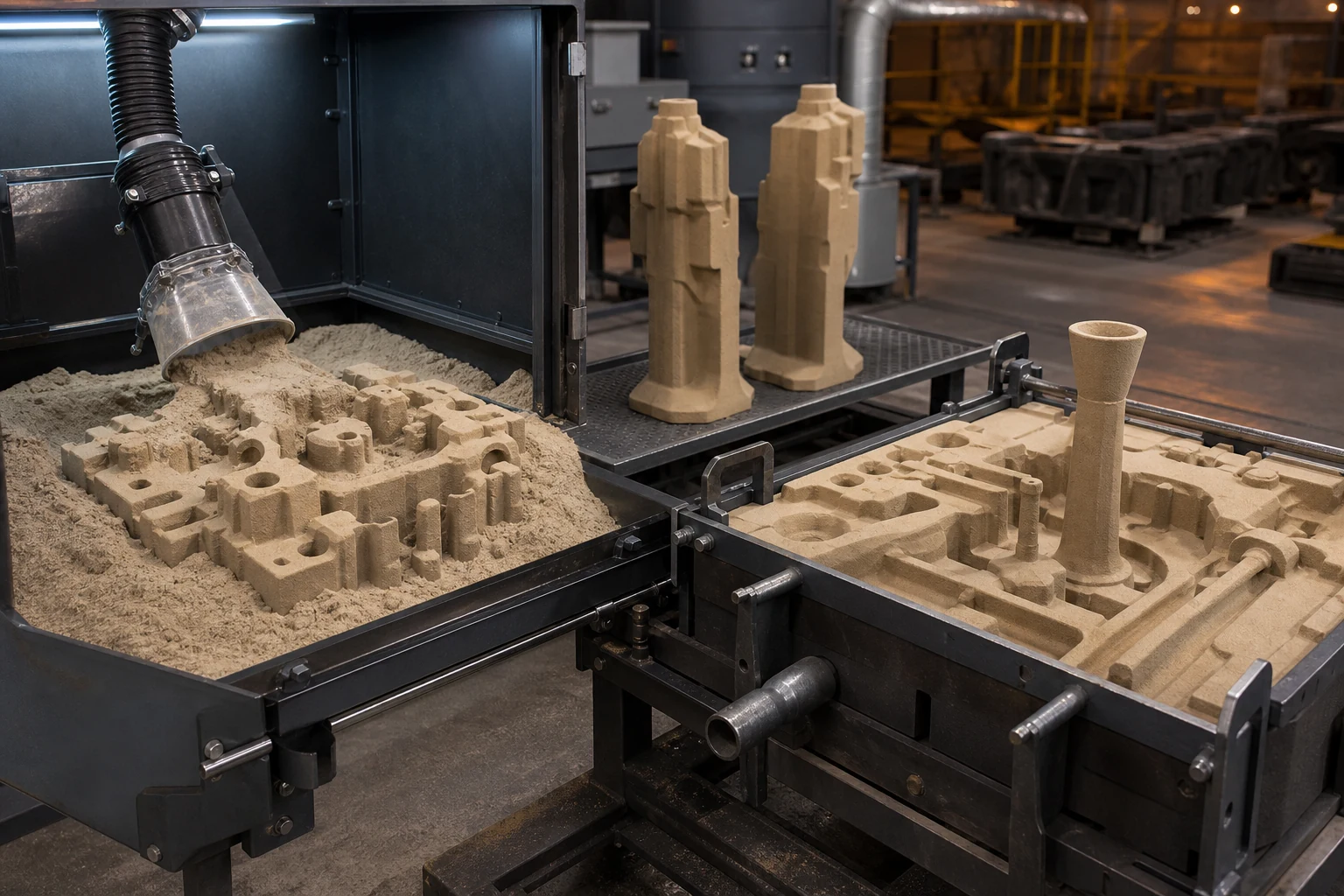
No pool source documents a route that prints finished bronze directly into a ringing bell shape. Bell metal is still melted and poured into a mould, and a poured bell still needs the same tuning reserve and hand judgment described elsewhere in this series. What has changed is what can build the mould, or the pattern that shapes the mould, before the pour ever happens. The National Institute of Standards and Technology (NIST) defines binder jetting as a technique that prints three-dimensional structures by fusing powdered material together with a binder, and notes the technique can build with metals, polymers, or ceramics, which includes the silica sand foundries have always used to make moulds and cores 1.
Keeping that distinction explicit matters for an honest article. "Printed bell" implies the bronze itself was printed; it was not. "Printed mould" or "printed pattern" describes what the evidence actually supports: a digital file replacing part of the traditional loam or greensand build process, while casting, cooling, breakout, and tuning stay exactly where they have always been.
02
What binder jetting actually does to a bed of sand
A binder-jet machine spreads a thin layer of sand across a build platform, then an inkjet-style printhead deposits liquid binder only where the design calls for solid material. The platform lowers, another layer of sand spreads over it, and the head prints again, building the mould or core one cross-section at a time. Unbound sand around and inside the printed shape stays in place as support during the build and is later removed, leaving a bound sand mould or core ready to receive metal. NIST's general definition covers this selective, layer-by-layer joining of powder as the core operating principle behind every binder-jet material system 1.
The technique's appeal for foundry work is structural rather than decorative: a printed mould or core can carry internal passages, undercuts, and cross-sections that would be difficult or impossible to draw from a rigid pattern in a flask, because there is no pattern to pull and no draft angle to argue with the geometry. That capability is why binder jetting has drawn the most serious foundry attention for large, complex, or low-volume castings rather than for simple repeatable shapes a conventional pattern already handles well.
03
Where federal-laboratory research has actually put it to work
Oak Ridge National Laboratory (ORNL) has run pilot-scale production case studies evaluating two distinct AM-enabled casting routes for large parts, defined as components with any dimension greater than 12 inches: direct printing of sand moulds by binder jet, and printing reusable cope-and-drag patterns that are then used to form conventional sand moulds. The published case studies covered hydroelectric and automotive components, and found single-use printed moulds reduced start-up cost for one-off or legacy parts, while additively manufactured patterns showed promise for complex geometry and large castings that previously required expensive subtractive machining 2.
A separate line of ORNL work targets the binder chemistry itself. A 2023 technical report on advances in binder jet additive manufacturing describes developing a novel binder system that makes binder-jetted sand stronger than concrete while remaining water-soluble for easy removal, a casting binder aimed at producing better surface finishes on castings, and a metal binder that reduces residual carbon contamination in printed metal parts 3. A peer-reviewed ORNL study published in Nature Communications reports a polyethyleneimine (PEI) binder for silica sand that doubled flexural strength to 6.28 megapascals compared with a conventional binder, exceeding the flexural strength of unreinforced concrete at roughly 4.5 megapascals; a secondary infiltration step using ethyl cyanoacrylate raised that figure further, to 52.7 megapascals, while preserving the ability to wash the sand out of a finished casting as a sacrificial core 4.
- Direct binder-jet printing of sand moulds: documented for large hydroelectric and automotive parts 2
- Reusable printed cope-and-drag patterns: documented for the same case studies 2
- Novel PEI binder: doubled flexural strength, exceeded unreinforced concrete 4
- Secondary infiltration: raised strength further while keeping the sand washable out 4
- Ongoing binder R&D explicitly targets surface finish and reduced contamination 3
04
Bells specifically: the one documented case is a pattern, not a mould
No source in this pillar's pool documents a bell foundry printing a sand mould directly by binder jet. The one documented case of 3D printing entering bell founding uses a more conservative route. The Verdin Company, a bell foundry founded in 1842, worked with Cincinnati Incorporated, a manufacturer of large-format printing and cutting machinery, to print reusable bell patterns on a Big Area Additive Manufacturing (BAAM) machine, a large-format fused filament fabrication system extruding carbon-fibre-reinforced ABS plastic. The mould itself is still formed conventionally around that pattern: the printed pattern is placed inside a flask, sand mixed with an epoxy resin is filled in around it, and once the sand hardens the pattern is withdrawn, leaving the cavity that receives the molten bronze. Only the pattern, not the mould or the sand, is printed 5.
The company-reported figures are specific and worth stating plainly as company-reported. For a roughly 38-inch bell cast for Hershey Park, an aluminum pattern would have cost about $19,960 with an eight-to-ten-week lead time plus roughly 48 hours of finish machining; the printed carbon-fibre pattern cost about $700 and took about five hours to print, before finishing. Cincinnati Incorporated's system is reported capable of layer accuracy within 0.005 inch, against a target pattern tolerance of ±0.010 inch, and patterns are printed oversized, machined and coated with body filler, then sanded smooth before use. Because a founder can flatten a bell's pitch by removing metal but cannot sharpen it by adding metal back, Verdin's sixth-generation president Tim Verdin has explained the pattern must never be printed undersized: "I can't sharpen the bell, I can only flatten it" 5.
05
The honest trade-off: printed sand against a skilled hand
What is documented: ORNL's own binder research programs explicitly name stronger green parts, better surface finish on castings, and reduced residual contamination as active goals of current work, not settled advantages already banked 34. What is interpreted, and should be labelled as such, is why those goals matter. A hand-rammed or machine-squeezed sand mould gains strength and density from mechanical compaction, packing sand grains tightly around a pattern under real pressure. A binder-jet mould instead spreads loose sand and relies on liquid binder to hold grains together, with no comparable compaction step. That difference plausibly explains why binder chemistry, not packing pressure, is the lever ORNL's research keeps pulling to close the gap on strength and surface finish 34.
The practical conclusion follows without needing a dramatic verdict either way: a printed mould is not automatically better than a mould built by a founder's practiced hand. It trades the compaction and centuries of accumulated strickle-work behind a hand-built mould for programmable geometry and, in the Verdin case, dramatically lower pattern cost and lead time on parts a shop would otherwise machine from aluminum 5. Where geometry genuinely needs to change often, printing wins on cost and speed. Where it does not, a well-made loam or greensand mould, and the founder who knows how to build one, remains a reasonable, sometimes superior, choice.
06
Where this leaves "print a bell"
Put together, the documented picture supports a narrower and more honest sentence than the headline version. Binder jetting can print a sand mould directly, and federal-laboratory research documents that route for large industrial castings 1234. The one documented bell-specific case instead prints a reusable pattern that still feeds a hand-built sand mould, because that is the combination one foundry found practical for its own production 5. Either way, the metal is still melted, poured, cooled, broken out, and tuned exactly as this series' companion notebook, How a bell is made, describes.
Printer emissions deserve the same plain treatment as the sand itself. Large-format fused filament printing and binder-jet powder handling both carry documented occupational hazards, including inhalation of fine or powdered material, volatile organic compound emission from heated plastics, dermal exposure to binders and resins, and fire or explosion risk from flammable or combustible dust, which is why federal occupational health research treats additive manufacturing as an active safety research area rather than a solved one 6. Sand preparation, moulding, melting, and pouring downstream of any printed pattern or mould remain governed by the same metal-casting safety practice that applies to a fully traditional foundry 7.
Working vocabulary
Glossary
- Binder jetting
- An additive manufacturing process that selectively deposits liquid binder into layers of powder to join them into a solid shape.
- Green part
- A printed or moulded part held together by binder alone, before any further processing strengthens it.
- Pattern
- A reusable positive model of an object, pressed into sand to form a mould cavity around it.
- Cope and drag
- The two halves of a conventional sand-casting mould flask, typically the top and bottom sections.
- Big Area Additive Manufacturing (BAAM)
- A large-format fused filament fabrication process capable of printing patterns and tooling far larger than a typical desktop printer.
- Sacrificial mould
- A single-use mould or core, whether printed or hand-built, that is destroyed to release the finished casting.
Source ledger
References and further study
Numbered citations point to the sources below. We favor standards, government laboratories, peer-reviewed research, and primary technical documentation. A link is evidence for the claim it supports—not an endorsement of every claim on that website. Read the full editorial and correction method.
- Binder JettingNational Institute of Standards and Technology (NIST) · federal research overview↗Opens in a new tab
- Additively Manufactured Single-Use Molds and Reusable Patterns for Large Automotive and Hydroelectric ComponentsOak Ridge National Laboratory · peer-reviewed government laboratory research↗Opens in a new tab
- Advances in Binder Jet Additive ManufacturingOak Ridge National Laboratory · government laboratory technical report↗Opens in a new tab
- Additive manufacturing of strong silica sand structures enabled by polyethyleneimine binderOak Ridge National Laboratory / Nature Communications · peer-reviewed government laboratory research↗Opens in a new tab
- A Resonant Harmony for Bell Casting and 3D PrintingAdditive Manufacturing Media · trade journalism, company-reported figures↗Opens in a new tab
- 3D Printing (Additive Manufacturing)National Institute for Occupational Safety and Health (NIOSH) · government occupational safety research↗Opens in a new tab
- Standard Practice for Safety Requirements in Metal Casting Operations: Sand Preparation, Molding, and Core Making; Melting and Pouring; and Cleaning and FinishingASTM International · industrial safety standard↗Opens in a new tab