
The Commons · Build Lab
Print a wall coupon, not a house
A desktop-scale challenge: design and print a small non-structural wall coupon to explore bead overlap, corner turns, and overhang, then document it honestly.
- Level
- Beginner
- Reading time
- 8 minutes
- Evidence
- community-brief
- Reviewed
- 2026-08-09
Jump through this guide
The short version
Full-scale concrete printing runs on reinforcement engineering, code review, and weather-driven scheduling, but the core toolpath logic underneath it, bead overlap, corner turning, and overhang, can be tested on a desk with clay, mortar, wax, or plastic. This challenge asks for one small, explicitly non-structural wall coupon that explores that logic and documents what happened, using the shared vocabulary material-extrusion processes already use at any scale 1.
After reading, you can
- Explain why bead overlap, corner turns, and overhang behave differently at any print scale
- Design and print a small coupon that tests those variables honestly
- State clearly why a desktop coupon is not a structural claim
- Document and share results in a way a stranger could learn from
01
Why this challenge
The companion articles in this series look at construction-scale concrete printing: gantries and robot arms, reinforcement strategies, code paths through ICC-ES and ICC 1150, and weather as an operating constraint. Underneath all of that machinery sits a much smaller idea: a nozzle moves, deposits a bead, and the next bead has to bond to it, turn a corner without collapsing, or briefly hang unsupported. That idea is testable on a desk, in an afternoon, with almost any extrusion-capable process, well before anyone needs a jobsite, a permit, or a structural engineer.
ISO/ASTM 52900 names material extrusion as one of the additive-manufacturing process families and defines the shared vocabulary this challenge borrows: bead, layer, toolpath 1. NIST's own overview of material extrusion describes the same fundamental mechanism, a nozzle moving and depositing material, whether the machine sits on a desk or straddles a building lot 2. This challenge is small on purpose: it studies the mechanism, not the machine.
02
The brief
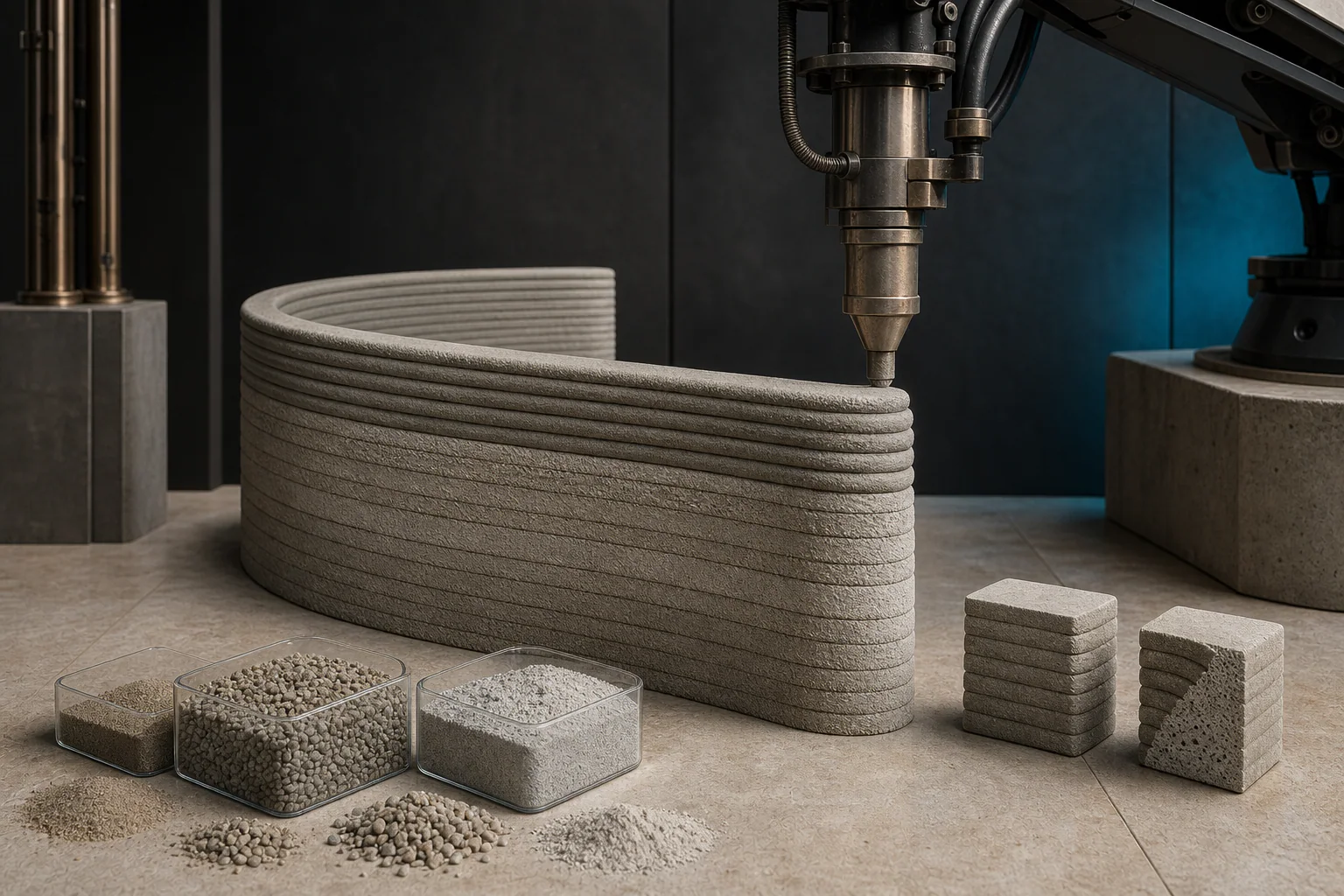
Design and print one small wall coupon, a short sample section of layered wall, at whatever scale your printer or hand tools comfortably handle. Use any process: material extrusion in plastic, clay, or mortar; hand-built coils; anything that deposits or stacks material in a controlled path. Build in at least two of these on purpose: an overlap zone where adjacent beads meet and bond, a corner where the toolpath changes direction, and a small overhang or step where a bead briefly runs without support beneath it.
Print or build more than one version if you can, changing one variable at a time, speed, overlap amount, corner style, or material, so the comparison teaches something. When you describe your process, use the standard family name from ISO/ASTM 52900 rather than a brand name, so entries stay comparable across very different equipment 1. A cut cross-section, if you can make one safely, tells you more than the outside surface ever will.
- Bead overlap: how adjacent beads bond or separate
- Corner turns: does the path starve or double the bead
- Overhang: how far a bead runs before it sags or fails
- Any process: extrusion, hand-built coils, cast layers
- Vary one thing at a time and compare
03
Safety and rights boundaries
This coupon is decorative and instructional, never structural: do not present it, or let anyone else present it, as evidence that any wall, load-bearing or not, is safe to build. If you use mortar or clay, dry mixing and carving release respirable crystalline silica, so work wet or with extraction and a fitted respirator 3. Resin needs gloves and full cure before handling; hot nozzles and kilns burn; work with adult supervision if you are not one.
Rights matter too: original designs and layouts only, no trademarked characters, logos, or scans of commercial architectural parts. If you reference full-scale practice, keep the distinction explicit: ICC 1150 exists specifically to regulate load-bearing 3D-printed concrete walls 5, and the federal overview of 3D-concrete-printed construction treats reinforcement, inspection, and code review as required steps for anything occupied 4. None of that applies to your coupon, and your caption should say so.
04
How to participate
Share your coupon publicly on Instagram or X and tag @print.mason or @printmasons with the hashtag #PrintMasonChallenge, or email photos and notes to right.just.right@gmail.com. There are no on-site accounts, uploads, or comments; participation happens on platforms you already control. Include a photo of the overlap zone, the corner, and the overhang or step, plus a few sentences naming your process family, material, and settings.
This challenge is ongoing, with no deadlines, no prizes, and no promised features. Post your first attempt or your fifth; a coupon that shows a clean failure and an honest explanation teaches more than a lucky success with no notes. If you email an entry, say whether we may quote your notes if the publication later discusses community work, because permission is never assumed.
05
What a strong entry shows
Strong entries make the toolpath legible: a clear view of where beads overlap and where they separate, a corner that either turned cleanly or visibly failed to, and an overhang documented at the point it started to sag or hold. Photographs beat description, but a sentence naming process family, material, and print or build settings, in the vocabulary ISO/ASTM 52900 provides, lets a stranger learn from your result without guessing 1.
The best entries are explicit about scale and limits: a caption that says plainly this is a desktop coupon, not a structural claim, and points curious readers toward how construction-scale printing actually gets reinforced, coded, and inspected. A well-documented failure, a bead that tore at a tight corner, an overhang that sagged past some point, is exactly the kind of result worth posting; it is data, not embarrassment.
Working vocabulary
Glossary
- Bead
- The continuous ribbon of extruded or deposited material a nozzle leaves in one pass.
- Coupon
- A small representative sample used to test or compare a process, not a finished functional part.
- Toolpath
- The programmed or hand-followed route the nozzle or hand follows, including starts, stops, and corner moves.
- Overlap zone
- The region where two adjacent beads meet and bond, or fail to.
- Overhang
- A feature extending beyond underlying material such that it may sag, tear, or fail without support.
Source ledger
References and further study
Numbered citations point to the sources below. We favor standards, government laboratories, peer-reviewed research, and primary technical documentation. A link is evidence for the claim it supports—not an endorsement of every claim on that website. Read the full editorial and correction method.
- ISO/ASTM 52900:2021 — Additive manufacturing — General principles — Fundamentals and vocabularyInternational Organization for Standardization · international standard↗Opens in a new tab
- Material ExtrusionNational Institute of Standards and Technology · government research program↗Opens in a new tab
- 3D Printing (Additive Manufacturing)National Institute for Occupational Safety and Health (CDC) · government occupational safety guidance↗Opens in a new tab
- 3D Concrete Printed Construction Systems, Part 2: An Overview of 3DCP Construction PracticesU.S. Department of Housing and Urban Development, Office of Policy Development and Research · government research report↗Opens in a new tab
- ICC 1150-2026: Standard for 3D Automated Construction Technology for 3D Concrete WallsInternational Code Council · construction standard↗Opens in a new tab