
The Commons · Community Challenge
Design a palm-sized vault module
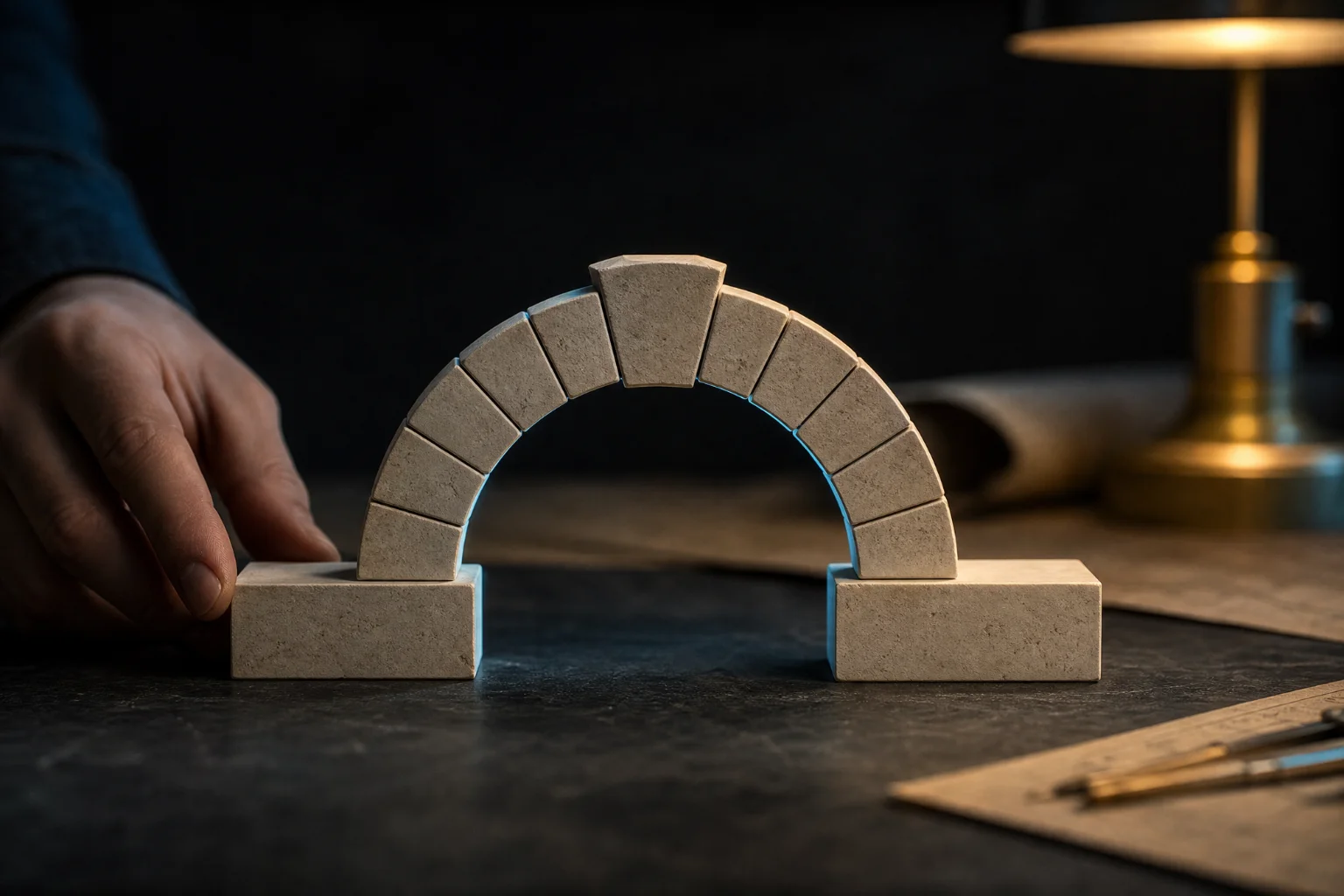
A community challenge: design a palm-sized dry-assembly arch or vault module—voussoirs, keystone, abutments—that demonstrates thrust on a tabletop. No glue, no load.
- Level
- Beginner
- Reading time
- 7 minutes
- Evidence
- community-brief
- Reviewed
- 2026-08-09
Jump through this guide
The short version
An arch is an argument among stones, and a small model lets you watch the argument happen. This challenge asks you to design and make a palm-sized arch or vault module set, wedge-shaped voussoirs, a keystone, and the abutments that keep them honest, which assembles dry and stands on a tabletop with no glue. The point is to feel thrust with your fingers: the outward push that shaped everything from bridges to cathedrals. Physical study of how historic structures work is a respected route to understanding, the kind of understanding conservation institutions like the Getty Conservation Institute exist to build and share 1.
After reading, you can
- Design a voussoir set whose geometry, not adhesive, carries the assembly
- Demonstrate arch thrust and abutment on a tabletop and document it honestly
- Apply original-design and rights boundaries to a community challenge entry
01
Why this challenge
Thrust is the central fact of masonry: an arch carries load across a gap by converting it into an outward push that something else must resist. You can read that sentence, or you can hold a small arch between two abutment blocks, slide the abutments apart, and watch the whole argument collapse in order. The second version sticks. Small models are how students, conservators, and engineers have long built intuition about historic structures without touching a single original stone 1.
This is also a clean design exercise for makers. A dry-assembly arch tolerates no hand-waving: joint angles either converge correctly on a center or they do not, faces either seat or they rock, and the print settings that seemed fine on a flat test suddenly matter on a mating surface. You will learn about your process, your printer or shop tools, and your patience. The reward is a desk object that teaches physics to anyone who picks it up.
02
The brief
Design an arch or small vault module set that fits in an open palm and assembles dry. It must include wedge-shaped voussoirs, an identifiable keystone, and abutments or springer blocks that resist the thrust, and it must stand on a flat table under its own geometry. It must also come apart and reassemble repeatedly, because assembly is the demonstration. Any process family is welcome, material extrusion, vat photopolymerization, or anything else in the standard vocabulary of ISO/ASTM 52900, as are wood, cast plaster, or clay 2.
Document the thing properly. Show the parts laid out, the assembly sequence, the standing result, and at least one failure, because failures are where the geometry teaches. If you publish the design files, consider a license such as CC BY 4.0 so others can build on your work with attribution 3. A short note on what you would change next time is worth more than a glamour shot.
- Voussoirs, keystone, and abutments, assembling dry
- No glue, tape, magnets, or fasteners anywhere
- Palm-sized and stable on a flat tabletop
- Repeatable assembly and disassembly
- Any process or material; document settings
- Photos of parts, assembly, standing arch, and one failure
03
Safety and rights boundaries
This is a tabletop demonstration, full stop. Your module set is non-load-bearing and must stay that way: never scale the geometry into anything that carries weight, spans over people, or attaches to a building. Small parts are a choking hazard for young children, printed edges can be sharp before deburring, and resin parts need full curing and washing before handling. Follow your machine's and material's documented precautions; nothing in this brief overrides them.
Entries must be your own original geometry. No trademarked characters, no logos, no scanned or remixed commercial products, and no passing off. If a real monument inspires your proportions, treat it as study: name the inspiration in your write-up, and do not present your model as a replica or claim it represents the site authoritatively. Replicas and study models exist to learn from the past, never to overwrite or impersonate it.
04
How to participate
Post your entry publicly on Instagram or X and tag @print.mason or @printmasons with the hashtag #PrintMasonChallenge, or email it to right.just.right@gmail.com. There are no on-site accounts, uploads, or comments, and there is no deadline: the challenge is ongoing, and entries are welcome whenever your arch stands. We promise no prizes and no guaranteed features, only an audience that appreciates a keystone seated properly.
Include enough information for someone else to learn from you: process and material, layer height or tool used on the joint faces, what tolerance or clearance you designed into the joints, and what failed before it worked. If you share files, state the license clearly, CC BY 4.0 is a good default for open sharing with credit 3. Clear documentation is the community's currency here.
05
What a strong entry shows
A strong entry shows geometry doing all the work: joint faces that seat cleanly, a keystone that visibly locks the ring, and an arch that stands without sleight of hand. It shows the thrust demonstration, sliding the abutments outward until collapse, because the collapse is the curriculum. It shows honest process notes, including the ugly first attempts. And it shows restraint: a simple, well-executed five-voussoir arch beats an ambitious vault that only stands when nobody breathes.
The best entries teach. A caption explaining why the abutments matter, a short clip of assembly order, a comparison of two joint clearances, any of these turns a desk toy into a lesson someone will remember. That is the spirit of the series: measurement, provenance, and failure treated as normal parts of craft, at a scale that fits in your hand 1.
- Clean, converging joint faces that seat without rocking
- A visible, honest thrust demonstration
- Failure notes alongside the success photos
- Settings and clearances shared for reproducibility
- Simplicity executed well over ambition executed shakily
Working vocabulary
Glossary
- Voussoir
- A wedge-shaped block forming part of an arch ring; its taper converts load into compression.
- Keystone
- The central voussoir that completes and locks an arch ring.
- Springer
- The lowest voussoir of an arch, seated on the abutment where the curve begins.
- Abutment
- The mass or support that resists an arch's outward thrust at its feet.
- Thrust
- The inclined outward push an arch exerts at its supports, which must be resisted for the arch to stand.
Source ledger
References and further study
Numbered citations point to the sources below. We favor standards, government laboratories, peer-reviewed research, and primary technical documentation. A link is evidence for the claim it supports—not an endorsement of every claim on that website. Read the full editorial and correction method.
- Getty Conservation InstituteGetty · conservation institute resource↗Opens in a new tab
- ISO/ASTM 52900:2021 — Additive manufacturing — General principles — Fundamentals and vocabularyInternational Organization for Standardization · international standard↗Opens in a new tab
- Creative Commons Attribution 4.0 International (CC BY 4.0)Creative Commons · license text↗Opens in a new tab