
The Commons · Community Challenge
Design a no-support lattice lantern
Design a lantern shell from a self-supporting lattice that prints without supports. LED lighting only; open flame is never appropriate inside a printed shell.
- Level
- Intermediate
- Reading time
- 8 minutes
- Evidence
- community-brief
- Reviewed
- 2026-08-09
Jump through this guide
The short version
A lattice lantern is a small structure with a large obligation: every strut has to hold its own shape while the print is running, because nothing outside the part is there to catch it. This challenge asks for an original lantern shell whose lattice geometry avoids support structures entirely, either through self-supporting angles on a desktop machine or through the surrounding-powder logic of a bed process, with an LED as the only lighting option ever considered. Design rules for additive manufacturing formalize exactly this kind of self-supporting reasoning 1.
After reading, you can
- Design a lattice whose members stay within a self-supporting angle for your process
- Distinguish support-free design on a desktop machine from support-free printing inside a powder bed
- State and defend the LED-only lighting boundary on every version of the design
- Document strut angle, spacing, and process choices so the geometry is reproducible
01
Why this challenge
Lattices look decorative but behave structurally, and a lantern is an honest way to learn that. Every strut is a small unsupported span the instant it is printed, so a shell that looks graceful on screen can sag, string, or collapse the moment geometry outruns what the process can hold up on its own. Formal design guidance for additive manufacturing treats self-supporting geometry as a first-class constraint rather than an afterthought, with documented angle and orientation reasoning that applies directly to lattice design 1.
The lantern form adds a second constraint on top of the structural one: light has to pass through, unevenly, in a pattern worth looking at. That pushes the lattice toward variation, denser here, more open there, rather than a uniform mesh repeated blindly. Working out how much density change a single self-supporting rule can tolerate before a strut fails is the actual design problem, and it rewards iteration far more than a single ambitious render ever will.
02
The brief
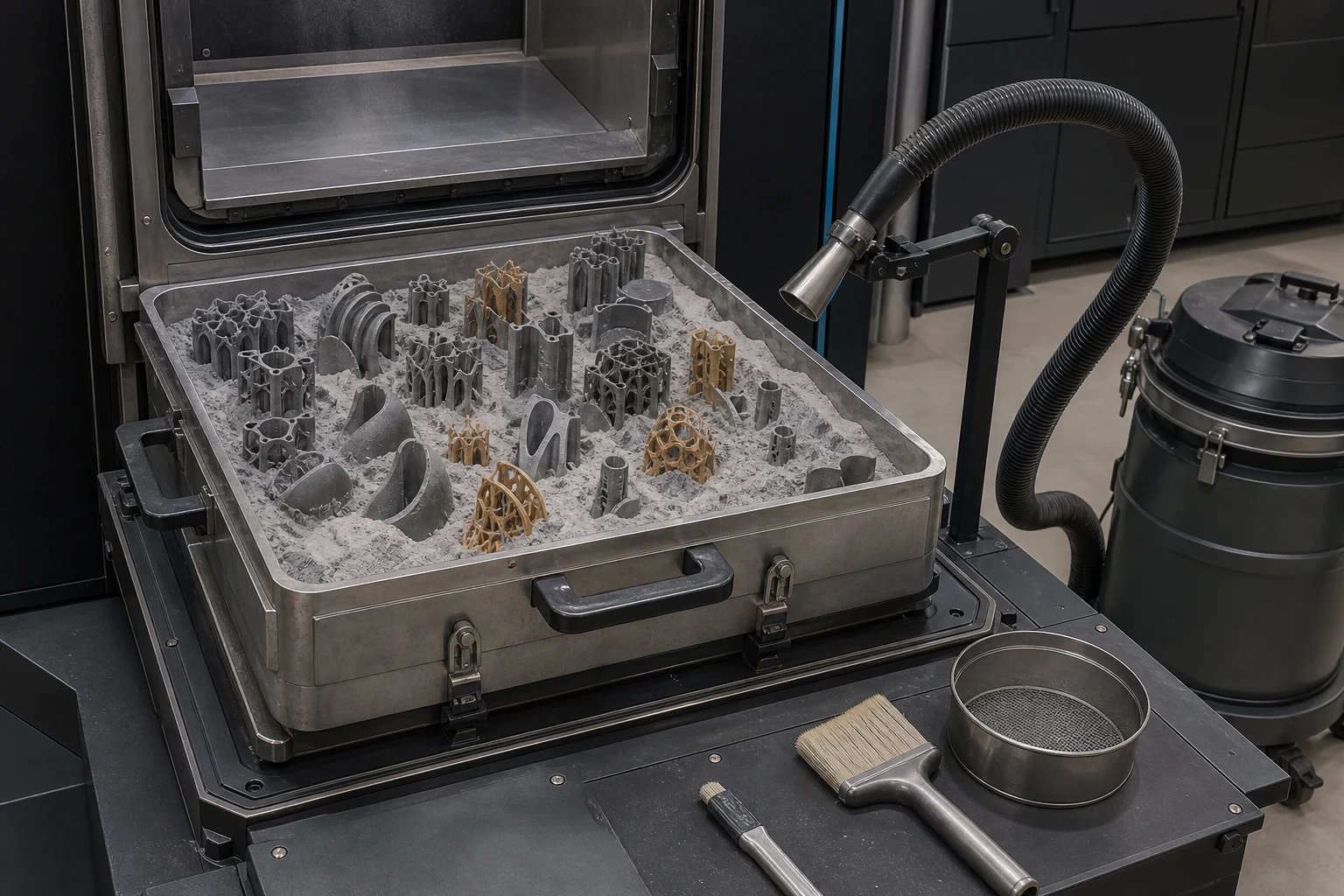
Design an original lantern shell, any silhouette, built from a lattice whose members print without dedicated support structures. On a desktop FFF or resin machine, that means keeping every strut and overhang inside an angle your process has demonstrated it can hold, gradually varied cell density, and no bridge longer than your machine tolerates. On a powder-bed process, the surrounding unfused powder does the supporting, illustrated by materials such as EOS's PA 2200 polyamide, which is documented for exactly that kind of dense, nested, support-free build 2; describe honestly which logic your lattice relies on.
The shell must accept an LED module cleanly, whether a small puck light, a battery-powered fairy-light strand, or a wired fixture, with a base or fitting that holds it without modification to the light itself. Wall and strut thickness should be generous enough to survive handling; a lattice that only exists as a render is not an entry. Note your process, material, and the specific self-supporting angle or nesting strategy you relied on.
- Original lattice geometry, no downloaded or scanned lantern files
- Every strut within a demonstrated self-supporting angle, or nested in powder
- Density variation used deliberately for light pattern, not left uniform
- LED fitting only, built into the design from the start
- Process, material, and angle or nesting strategy documented
03
Safety and rights boundaries
LED only, never flame. A printed lattice shell is thin polymer or, if resin, a photopolymer never rated for heat; a candle or any open flame inside or beneath it is a fire hazard regardless of how convincing the ember-lit render looked. Battery-powered or low-voltage LED fixtures only, kept clear of any pinch point in the lattice, and checked for stability so the fixture cannot tip once the shell is placed over it. General safe-practice framing for 3D printing, including workspace and handling habits, is documented by NIOSH's guidance for the process 3.
Rights follow the usual rule: the lattice must be your own design, not a downloaded lantern remixed without credit and not a trademarked character silhouette cut into the shell. If you publish the file, license it plainly; Creative Commons Attribution 4.0 is a common, permissive choice that only requires credit back to you 4. State your license even if you only intend to share photographs, so anyone who asks knows where they stand.
04
How to participate
Post your lantern publicly on Instagram or X and tag @print.mason or @printmasons with the hashtag #PrintMasonChallenge, or email photos and notes to right.just.right@gmail.com. There are no on-site accounts, uploads, or comments; participation happens entirely on your own platforms or by email, and the publication only ever aggregates what you choose to share. Include a lit photo, a daylight structural photo showing the lattice clearly, and your process notes.
There is no deadline and no prize; the challenge stays open, and a second or third lantern refining a strut angle that failed the first time is exactly the kind of entry worth posting. If you work in resin, note your process explicitly since self-supporting angles differ meaningfully from FFF; if you work in a powder-bed service, note that too, since the supporting logic is entirely different from either extrusion approach.
05
What a strong entry shows
A strong lantern makes its self-supporting logic visible rather than incidental. The angle or nesting choice is named, not just achieved, and the density pattern reads as a deliberate light-and-shadow decision rather than a uniform mesh applied out of convenience. The LED fitting looks designed in, not wedged in after the fact, and the documentation lets someone else attempt the same strut angle on their own machine with a reasonable chance of success.
The quiet test is whether the entry would still stand up as a design lesson if the light were switched off. A lattice that holds its own shape, survives ordinary handling, and explains its angle or nesting choice in plain terms has done the structural work the challenge actually asks for; the glow through the shell is the reward for getting that geometry right, not a substitute for it.
Working vocabulary
Glossary
- Self-supporting angle
- The steepest overhang or strut slope a given process can print without sagging or requiring support material.
- Lattice
- A repeating strut or cell pattern used to build a lightweight, permeable structure such as a lantern shell.
- Powder-bed nesting
- Printing multiple or complex geometries inside a bed of unfused powder, which supports overhangs without dedicated support structures.
- Cell density
- How tightly packed a lattice's repeating units are, which controls both light transmission and structural stiffness.
- Low-voltage LED fixture
- A battery or low-voltage powered light source appropriate for enclosure in printed polymer, unlike an open flame.
Source ledger
References and further study
Numbered citations point to the sources below. We favor standards, government laboratories, peer-reviewed research, and primary technical documentation. A link is evidence for the claim it supports—not an endorsement of every claim on that website. Read the full editorial and correction method.
- ISO/ASTM 52910:2018 - Additive manufacturing - Design - Requirements, guidelines and recommendationsInternational Organization for Standardization · international standard↗Opens in a new tab
- PA 2200 Material Data SheetEOS · company-reported information↗Opens in a new tab
- Approaches to Safe 3D PrintingNational Institute for Occupational Safety and Health · government research program↗Opens in a new tab
- Attribution 4.0 International (CC BY 4.0)Creative Commons · license text↗Opens in a new tab