
The Commons · Community Challenge
The full-color form study
Build an original color-blocked architectural form study using multicolor FFF, jetting, hand-painting, or a labeled render. Display-only, no structural claims.
- Level
- Beginner
- Reading time
- 7 minutes
- Evidence
- community-brief
- Reviewed
- 2026-08-09
Jump through this guide
The short version
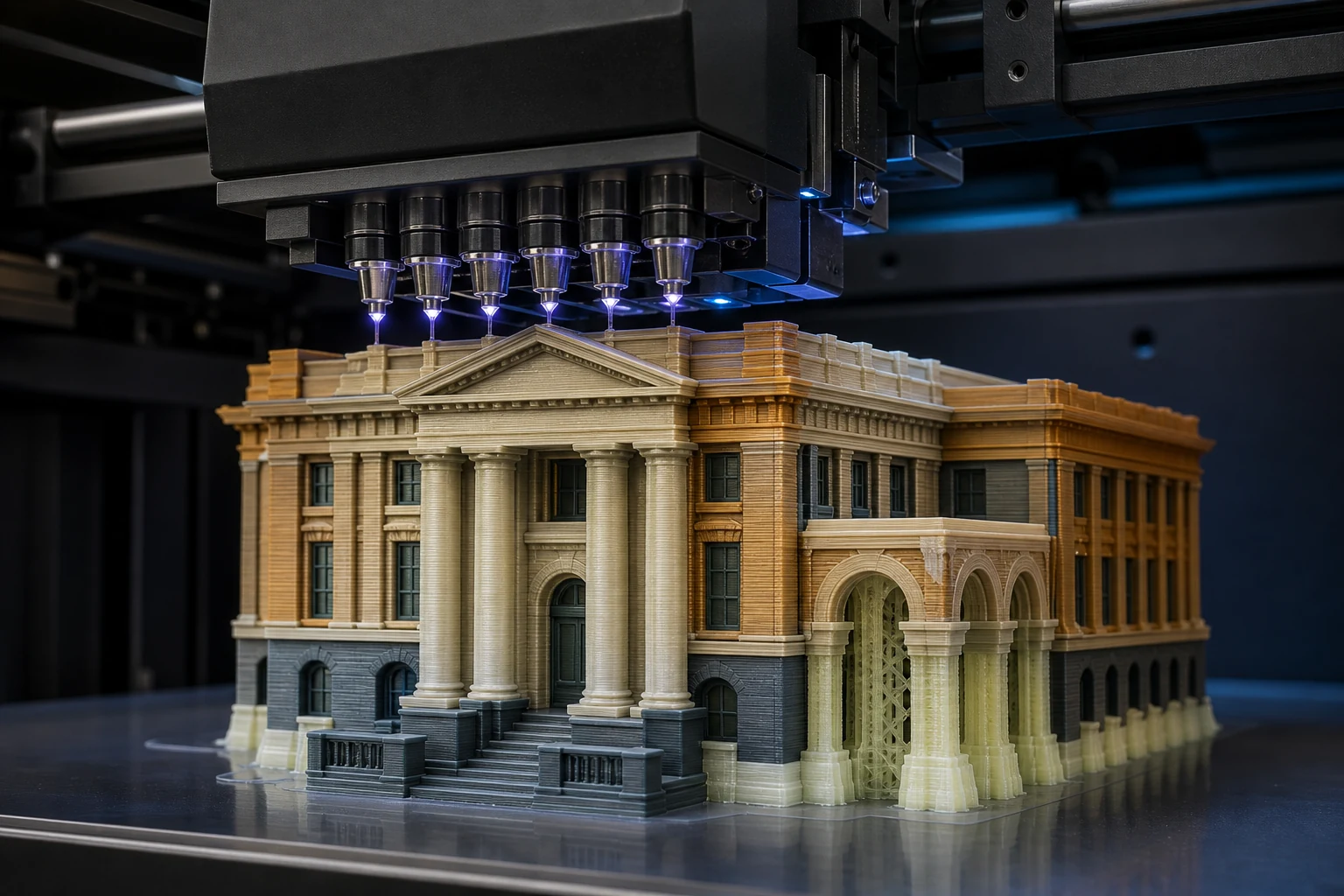
Color is a design tool architects use to separate structure from cladding, mass from void, before a single stone is cut, and this challenge borrows that habit for a small printed or rendered study. Block an original architectural form in color to make a reading legible, a load-bearing core in one tone, a screen wall in another, and be exact about which process made the color happen. Material jetting is the process most naturally suited to this, building full-color parts from droplets of multiple photopolymer materials deposited layer by layer 1.
After reading, you can
- Use color deliberately to separate structural, cladding, and void elements in a form study
- Match the color technique to what your available process can honestly deliver
- Distinguish a printed color result from a painted finish or a rendered concept, and label accordingly
- Practice standard process vocabulary when describing how the color was produced
01
Why this challenge
Architects have long used color-blocked massing models to test a reading before committing to material, and a printed or rendered study lets a hobbyist do the same on a desk. Assigning one color to a structural core, another to a screen or skin, and a third to an opening or void turns an abstract form into something a viewer can parse in seconds. That legibility is the actual skill being practiced, not the printer's color gamut.
It is also a useful lesson in process honesty. Some processes build color into the material itself, as with jetting's droplet-level material deposition 1; others, including most powder-bed and single-nozzle FFF machines, finish in one tone and rely on paint or dye afterward, a distinction the manufacturer literature on jetting-family processes makes plainly when comparing options 2. Knowing which category your process falls into before you design saves a disappointing surprise at the end.
02
The brief
Design an original architectural form study, a massing block, a facade study, a small pavilion concept, and block it in color to separate at least two distinct elements: structure versus cladding, solid versus void, or public versus private zones. Any path to color is welcome provided it is named honestly: multicolor FFF using multiple extruders or a filament-swap technique, a material-jetting bureau service, a single-color print finished with hand-painting, or a rendered concept clearly labeled as unprinted. Name the process in the standard vocabulary additive manufacturing uses for its families 3 so entries compare cleanly regardless of route.
Keep the geometry original and the massing legible at a glance; intricate detail is welcome but should not bury the color logic that is the point of the exercise. If you hand-paint, note the base material and finish so others can judge how the color was achieved. If you render rather than print, say so in the same sentence as the description, not buried in a caption; a labeled render is a valid entry, a mislabeled one is not.
- Original massing or facade study, not a downloaded or scanned building
- Color separates at least two distinct architectural elements
- Process named honestly: printed-native, painted, or clearly labeled render
- Standard process vocabulary used so entries compare fairly
- Display-only, no structural or load-bearing claims implied
03
Safety and rights boundaries
This is display work only; nothing about a color-blocked study implies a structural claim, and captions should avoid language that reads as an engineering statement. Original design applies as everywhere else in the Commons: no trademarked buildings, no logos worked into facades, no scanned commercial architectural models presented as your own massing study. If your process involves hand-painting, ventilate the workspace and check the paint or primer's own safety data rather than assuming a hobby paint is inert.
License clearly if you share the file, model, or render. Creative Commons Attribution 4.0 is a common, permissive choice requiring only credit back to you, and stating it up front avoids ambiguity for anyone who wants to build on your color logic 4. A rendered concept carries the same rights obligations as a printed file; label it, credit any reference imagery you built from, and keep the design your own.
04
How to participate
Post your form study publicly on Instagram or X and tag @print.mason or @printmasons with the hashtag #PrintMasonChallenge, or email photos or renders and notes to right.just.right@gmail.com. There are no on-site accounts, uploads, or comments; everything happens on your own platforms or by email, and nothing you post is required to appear anywhere else. Multiple angles help, since color-blocking often reads differently from an elevation view than from an oblique.
There is no deadline and no prize, and the challenge stays open indefinitely. A second study revisiting a color scheme that read muddy the first time is a welcome return entry, and mixing techniques across posts, one printed, one rendered, one hand-painted, is entirely fine as long as each is labeled for what it actually is rather than left ambiguous.
05
What a strong entry shows
A strong entry uses color the way an architect would: to make a reading obvious, not to decorate. The viewer should be able to say, at a glance, which part is structure and which is skin, without reading a caption first. The process is named plainly and matches what is visible in the photo or render, and any finishing step, paint, dye, bureau service, is documented rather than left to guesswork.
The quiet test is whether the color logic would survive being explained to someone who has never seen the piece. If the answer is a clear sentence, structure in charcoal, screen wall in white, entry in ochre, the study has done its job; if the explanation requires the object in hand, the color-blocking has not yet earned its place in the design.
Working vocabulary
Glossary
- Material jetting
- A process that builds parts by depositing droplets of one or more photopolymer materials layer by layer, capable of native full color.
- Color-blocking
- Assigning distinct colors to separate architectural elements, such as structure versus cladding, to make a form legible.
- Massing model
- A simplified study of a building's overall volume and proportions, used before detailed design.
- Native color
- Color built into the printed material itself during fabrication, as opposed to color applied afterward by painting or dyeing.
- Rendered concept
- A digital visualization of a design that has not been physically printed, which must be labeled as such.
Source ledger
References and further study
Numbered citations point to the sources below. We favor standards, government laboratories, peer-reviewed research, and primary technical documentation. A link is evidence for the claim it supports—not an endorsement of every claim on that website. Read the full editorial and correction method.
- Material JettingNational Institute of Standards and Technology · government research program↗Opens in a new tab
- MJF vs SLSHP · company-reported information↗Opens in a new tab
- ISO/ASTM 52900:2021 - Additive manufacturing - General principles - Fundamentals and vocabularyInternational Organization for Standardization · international standard↗Opens in a new tab
- Attribution 4.0 International (CC BY 4.0)Creative Commons · license text↗Opens in a new tab